Road Traffic
The Traffic Signs Regulations and General Directions 2016
The Secretary of State makes the Regulations in Part 1 of this Instrument in exercise of the powers conferred by—
The Secretary of State gives the General Directions in Part 2 of this Instrument in exercise of the powers conferred by section 65(1)7 and (1A)8 and 85(2)9 of the 1984 Act.
In accordance with article 4 of, and Schedule 3 to, the Scotland Act 1998 (Transfer of Functions to the Scottish Ministers etc.) Order 199910, the Secretary of State has consulted with the Scottish Ministers.
PART 1 THE TRAFFIC SIGNS REGULATIONS 2016
I31 Citation, commencement and extent
2 Interpretation
I43 Prescription of signs
(1) Item | (2) Schedule | (3) Purpose of nature of signs |
|---|---|---|
| 1 | Schedule 2 Parts 1 to 7 | Signs that warn of hazards and signs for bridges and other structures |
| 2 | Schedule 3 Parts 1 to 4 | Upright signs that indicate regulatory requirements for moving traffic |
| 3 | Schedule 4 Parts 1 to 5 | Upright signs that control waiting, loading and parking along a road |
| 4 | Schedule 5 Parts 1 to 4 | Signs that indicate parking places and areas subject to parking controls |
| 5 | Schedule 6 Parts 1 and 2 | Upright signs for red routes |
| 6 | Schedule 7 Parts 1 to 6 | Road markings and miscellaneous upright signs that indicate stopping, waiting, loading and parking controls |
| 7 | Schedule 8 Parts 1 to 4B | Signs indicating the entrance to and the end of, a pedestrian, or pedestrian and cycle, zone, and signs for charging schemes and low emission zone schemes |
| 8 | Schedule 9 Parts 1 to 8 | Regulatory signs at junctions and miscellaneous regulatory signs |
| 9 | Schedule 10 Parts 1 to 3 | Signs for speed limits |
| 10 | Schedule 11 Parts 1 to 6 | Signs that give information, are advisory or guide traffic |
| 11 | Schedule 12 Parts 1 to 28 | Directional signs |
| 12 | Schedule 13 Parts 1 to 11 | Signs only for use in temporary situations |
| 13 | Schedule 14 Parts 1 to 5 | Signs for traffic control by light signals, signs for crossings, and signs for lane control |
| 14 | Schedule 15 Parts 1 to 4 | Matrix signs and light signals for the control of moving traffic on motorways and dual carriageway roads |
| 15 | Schedule 16 Parts 1 to 7 | Variable message signs |
I14 Authorisations
Nothing in these Regulations limits a power of the Secretary of State, the Scottish Ministers or the Welsh Ministers to authorise a sign under section 28(4) or 64 of the 1984 Act13.I475 Letters, numerals and other characters
| Height of letters, numerals and other characters | Applicable Part in Schedule 17 |
|---|---|
| from 280 mm to 700 mm (inclusive) | Part 6 |
| 705 mm, 1035 mm, 1600 mm | Part 7 |
| 2800 mm | Part 8 |
I486 Expressions of time and distance and for parking restrictions
I497 Dimensions and design of signs
(1) Item | (2) Dimensions shown in road marking diagram | (3) Permitted variations |
|---|---|---|
| 1 | 3 metres or more | (i) Up to 15% of the dimension where the varied dimension is greater than the specified dimension; or (ii) Up to 10% of the dimension where the varied dimension is less than the specified dimension |
| 2 | 300 mm or more, but less than 3 metres | (i) Up to 20% of the dimension where the varied dimension is greater than the specified dimension; or (ii) Up to 10% of the dimension where the varied dimension is less than the specified dimension |
| 3 | Less than 300 mm | (i) Up to 30% of the dimension where the varied dimension is greater than the specified dimension; or (ii) Up to 10% of the dimension where the varied dimension is less than the specified dimension |
I508 Illumination of upright signs and associated plates
I519 Illumination – road markings
I5210 Height of road markings and size of studs fitted with reflectors, retroreflecting material or a light source
I5311 Diagram Colours
I5412 Mutual recognition of standards
Any requirement in these Regulations to comply with a specified British Standard is satisfied by compliance with—I5513 Revocations
The Regulations specified in the table in Part 1 of Schedule 19 are revoked.I214 Transitional and savings provisions
I5615 Provision for review of these Regulations

PART 2 THE TRAFFIC SIGNS GENERAL DIRECTIONS 2016
I571 Citation, commencement and extent
I582 Interpretation
I593 Application of general directions
The general directions in the final Part of each of Schedules 2 to 15 apply to the signs provided for in that Schedule to the extent indicated in the Schedule.I604 General provision about upright signs and associated plates and structure warning markings
I615 General provision about placing of signs on vehicles
A sign must not be placed on a vehicle except as expressly authorised by these General Directions.I626 General provision about the removal of temporary signs
I637 Studs that provide illumination
(1) Item | (2) Description of stud | (3) British Standard requirement or test specification and class |
|---|---|---|
| 1 | Non depressible road stud | Dimensions : height-class H1 or H2 |
| 2 | Depressible road stud | Dimensions : height-class H1, H2 or H3 |
| 3 | Permanent road stud | Dimensions : maximum horizontal dimension exposed to traffic: HD1 |
| 4 | Temporary road stud | Dimensions : minimum horizontal dimension exposed to traffic: HDT1 |
| 5 | Permanent road stud | Night-time visibility : photometric requirements - class PRP1 |
| 6 | Temporary road stud | Night-time visibility : photometric requirements - class PRT1 |
| 7 | Temporary road stud | Daytime visibility : colour of body of stud
|
| 8 | Any stud | Colorimetric requirements-class NCR1 for white, amber, red or green retroreflectors only |
| 9 | Any stud | Primary assessment-class S1 |
| 10 | Any stud | Night-time visibility assessment-class R1, R2 or R3 |
I648 Mounting of upright signs
I659 The backs of, and backing boards for, upright signs
I6610 Mutual recognition of standards
Any requirement in these General Directions to comply with a specified British Standard is satisfied by compliance with—I6711 Special directions
Nothing in these General Directions limits the power of the Secretary of State, the Scottish Ministers or the Welsh Ministers, by special direction under section 65(2) of the 1984 Act20, to dispense with, add to or modify any of the requirements of these General Directions in their application to any particular case.I6812 Revocations
The General Directions specified in the table in Part 2 of Schedule 19 are revoked.I6913 Saving
I7014 Provision for review of these General Directions
I682SCHEDULE 1 
Definitions
Regulation 2
(1) Term | (2) Meaning |
|---|---|
|
|
|
|
|
|
|
|
|
|
|
|
|
|
|
|
|
|
| |
|
|
|
|
| |
|
|
|
|
|
|
|
|
|
|
|
|
| |
|
|
|
|
|
|
|
|
|
|
|
|
| |
|
|
|
|
|
|
|
|
|
|
|
|
|
|
|
|
| “electric scooter” |
|
|
|
|
|
|
|
|
|
|
|
|
|
|
|
|
|
| |
|
|
|
|
|
|
|
|
|
|
|
|
|
|
|
|
| “local public authority” |
|
|
|
|
|
|
|
|
|
|
|
|
|
|
|
|
|
|
|
|
|
|
|
|
|
| |
| |
|
|
|
|
|
|
|
|
|
|
|
|
|
|
|
|
|
|
|
|
|
|
|
|
|
|
|
|
|
|
|
|
|
|
|
|
|
|
|
|
|
|
|
|
|
|
| F61“refuge for pedestrians and cyclists” | a part of a road to which vehicles (other than electric scooters being used in a trial and pedal cycles) do not have access and on which pedestrians , drivers of such electric scooters and cyclists may wait after crossing one part of the carriageway and before crossing the other |
|
|
|
|
|
|
|
|
|
|
|
|
|
|
|
|
|
|
|
|
|
|
|
|
|
|
|
|
|
|
|
|
|
|
|
|
|
|
|
|
|
|
|
|
|
|
|
|
|
|
|
|
|
|
|
|
|
|
|
|
|
|
|
|
|
|
|
|
|
|
|
|
|
|
|
|
|
|
|
|
|
|
| “trial” |
|
|
|
|
|
| |
|
|
|
|
|
|
|
|
|
|
|
|
|
|
|
|
|
|


SCHEDULE 2 
Signs that warn of hazards and signs for bridges and other structures
Regulation 3, Direction 3
PART 1 Provisions applying to signs and plates in Parts 2 and 3
I647PART 2 Warning signs and associated plates

(1) Item | (2) Description | (3) Diagram | (4) First associated plate legend | (5) Supplementary associated plate (by reference to Part 3 sign table item number) | (6) Applicable provisions in Part 7 | (7) Schedule 2 General Directions |
|---|---|---|---|---|---|---|
| 1 | Diagram 504.1 Crossroads ahead (Alternative types) |  | A distance | 1 | 3 | |
| 2 | Diagram 505.1 T-junction ahead (Alternative types) |  | A distance | 1 | 3 | |
| 3 | Diagram 506.1 Side road ahead (Alternative types) | 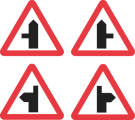 | A distance | 1 | 3 | |
| 4 | Diagram 507.1 Staggered junction ahead (Alternative types) |  | A distance | 1 | 3 | |
| 5 | Diagram 508.1 Traffic merges ahead from left |  | A distance | |||
| 6 | Diagram 509.1 Traffic merges ahead onto main carriageway |  | A distance | |||
| 7 | Diagram 510 Roundabout ahead |  | 1. A distance; or 2. “Adverse camber” | 1 or 4 (or both) | 3 | |
| 8 | Diagram 512 Bend ahead (Alternative types) |  | 1. “Adverse camber”; 2. “Keep in low gear”; or 3. “Oncoming vehicles in middle of road” | 1, 2 or 4 (or any combination) | 3 | |
| 9 | Diagram 512.1 Junction on the outside of a bend ahead (Alternative types) |  | 1. “Adverse camber”; 2. “Keep in low gear”; or 3. “Oncoming vehicles in middle of road” | 1, 2 or 4 (or any combination) | 3 | |
| 10 | Diagram 512.2 Junction on the inside of a bend ahead (Alternative types) |  | 1. “Adverse camber”; 2. “Keep in low gear”; or 3. “Oncoming vehicles in middle of road” | 1, 2 or 4 (or any combination) | 3 | |
| 11 | Diagram 512.3 Crossroads on a bend ahead (Alternative types) |  | 1. “Adverse camber”; 2. “Keep in low gear”; or 3. “Oncoming vehicles in middle of road” | 1, 2 or 4 (or any combination) | 3 | |
| 12 | Diagram 513 Double bend or series of bends ahead (Alternative types) |  | 1. “For” and a distance; 2. “Adverse camber”; 3. “Keep in low gear”; or 4. “Oncoming vehicles in middle of road” | 1, 2 or 4 (or any combination) | 3 | |
| 13 | Diagram 516 Road narrows on both sides ahead |  | 1. A distance; 2. “Single file traffic” with or without an arrow pointing to the left or to the right; 3. “Single file traffic” and a distance, with or without an arrow pointing to the left or to the right; 4. “Single file traffic for” and a distance; 5. “Single track road” with or without an arrow pointing to the left or to the right; 6. “Single track road” or “Single track road for” and a distance, with or without an arrow pointing to the left or to the right; or 7. “Oncoming vehicles in middle of road” | 1 | ||
| 14 | Diagram 517 Road narrows on one side ahead (Alternative types) |  | 1. A distance; 2. “Single file traffic” with or without an arrow pointing to the left or to the right; 3. “Single file traffic” and a distance, with or without an arrow pointing to the left or to the right; 4. “Single file traffic for” and a distance; 5. “Single track road” with or without an arrow pointing to the left or to the right; 6. “Single track road” or “Single track road for” and a distance, with or without an arrow pointing to the left or to the right; or 7. “Oncoming vehicles in middle of road” | 1 | ||
| 15 | Diagram 520 Dual carriageway road ends ahead |  | 1. A distance; 2. “Single file traffic”, with or without a distance; or 3. “Single file traffic for” and a distance | 1 | ||
| 16 | Diagram 521 Two-way traffic ahead |  | 1. A distance; or 2. “For” and a distance | |||
| 17 | Diagram 522 Two-way traffic on route crossing ahead |  | A distance | |||
| 18 | Diagram 523.1 Steep hill downwards ahead |  | 1. A distance with or without an arrow pointing to the left or to the right; 2. “For” and a distance ; 3. An arrow pointing to the left or to the right; 4. “Low gear now”; 5. “Keep in low gear”; or 6. “Low gear for” and a distance | 1 or (when used with a first plate containing legend 4 or 5): 3, or both 1 and 3 | 12 | |
| 19 | Diagram 524.1 Steep hill upwards ahead |  | 1. A distance with or without an arrow pointing to the left or to the right; 2. “For” and a distance; 3. An arrow pointing to the left or to the right; 4. “Low gear now”; 5. “Keep in low gear”; or 6. “Low gear for” and a distance | 1 | 12 | |
| 20 | Diagram 528 Hump bridge ahead |  | 1. A distance with or without an arrow pointing to the left or to the right; 2. An arrow pointing to the left or to the right; or 3. “Oncoming vehicles in middle of road” | 1 | ||
| 21 | Diagram 529 Opening or swing bridge ahead |  | 1. A distance with or without an arrow pointing to the left or to the right; or 2. An arrow pointing to the left or to the right | |||
| 22 | Diagram 529.1 Tunnel ahead |  | 1. A distance with or without an arrow pointing to the left or to the right; 2. An arrow pointing to the left or to the right; or 3. “Oncoming vehicles in middle of road” | |||
| 23 | Diagram 544.1 Pedestrians in road ahead |  | 1. A distance with or without an arrow pointing to the left or to the right; 2. An arrow pointing to the left or to the right; or 3. “No footway for” and a distance | |||
| 24 | Diagram 544.2 Frail or disabled pedestrians likely to cross road ahead |  | 1. A distance with or without an arrow pointing to the left or to the right; 2. An arrow pointing to the left or to the right; 3. “Disabled people” or “Blind people” with or without an arrow pointing to the left or to the right; or 4. “Disabled people” or “Blind people” and a distance, with or without an arrow pointing to the left or to the right | |||
| 25 | Diagram 545 In relation to England, children going to or from school or playground ahead |  | 1. “School”, “Patrol”, “Playground”, “Disabled children”, “Blind children” or “Deaf children” with or without an arrow pointing to the left or to the right; 2. “School”, “Patrol”, “Playground”, “Disabled children”, “Blind children” or “Deaf children” and a distance with or without an arrow pointing to the left or to the right; or 3 “No footway for” and a distance | 1 | ||
| 25A | Diagram 545.2 In relation to Wales, children going to or from school or playground area |  | 1. In the Welsh text—
2. In the English text—
| 5 | 1 | |
| 26 | Diagram 950 Cycle route ahead (Alternative types) |  | 1. A distance with or without an arrow pointing to the left or to the right; 2. An arrow pointing to the left or to the right; 3. “Cycle crossing” or “Cycles crossing” with or without an arrow pointing to the left or to the right; or 4. “Cycle crossing” or “Cycles crossing” and a distance with or without an arrow pointing to the left or to the right | |||
| 27 | Diagram 548 Cattle likely to be in road ahead |  | “For” and a distance | |||
| 28 | Diagram 549 Sheep likely to be in road ahead |  | “For” and a distance | |||
| 29 | Diagram 550 Wild horses or ponies likely to be in road ahead |  | “For” and a distance | |||
| 30 | Diagram 550.1 Accompanied horses or ponies likely to be in road ahead |  | 1. A distance with or without an arrow pointing to the left or to the right; 2. An arrow pointing to the left or to the right; or 3. “For” and a distance | |||
| 31 | Diagram 550.2 Horse drawn vehicles likely to be in road ahead |  | “For” and a distance | |||
| 32 | Diagram 551 Wild animals likely to be in road ahead |  | “For” and a distance | |||
| 33 | Diagram 551.2 Wild fowl likely to be in road ahead |  | “For” and a distance | |||
| 34 | Diagram 553.1 Agricultural vehicles likely to be in road ahead |  | 1. “Farm traffic”, “Wide vehicles” or “Tractors turning”; or 2. “Farm traffic for”, “Wide vehicles for” or “Tractors turning for” and a distance | 1 | ||
| 35 | Diagram 552 Cattle grid ahead |  | 1. A distance with or without an arrow pointing to the left or to the right; 2. An arrow pointing to the left or to the right; or 3. “Horse drawn vehicles and animals” and an arrow pointing to the left or to the right | |||
| 36 | Diagram 554B Gate ahead |  | 1. A distance with or without an arrow pointing to the left or to the right; or 2. An arrow pointing to the left or to the right | |||
| 37 | Diagram 554C Gates ahead |  | 1. “For” and a distance, with or without an arrow pointing to the left or to the right; or 2. An arrow pointing to the left or to the right | |||
| 38 | Diagram 554 Ford ahead |  | 1. A distance with or without an arrow pointing to the left or to the right; 2. An arrow pointing to the left or to the right; or 3. “Road liable to flooding” with or without an arrow pointing to the left or to the right | |||
| 39 | Diagram 554.1 Risk of brake failure ahead (after passing a ford or before descending a steep gradient) |  | “Keep in low gear” | When used with the first plate, item 3 | ||
| 40 | Diagram 555 Quayside or river bank ahead |  | 1. A distance with or without an arrow pointing to the left or to the right; or 2. An arrow pointing to the left or to the right | |||
| 41 | Diagram 555.1 Water course alongside road ahead (Alternative types) |  | “For” and a distance | |||
| 42 | Diagram 556.1 Soft verges ahead |  | 1. “Soft verges”; or 2. “Soft verges for” and a distance | 1 | ||
| 43 | Diagram 557.1 In relation to England, road hump or series of road humps ahead |  | 1. “Hump” or “Humps” with or without an arrow pointing to the left or to the right; 2. “Hump” or “Humps” with two arrows, one pointing to the left and one pointing to the right; 3. “Hump” or “Humps for” and a distance, with or without an arrow pointing to the left or to the right; or 4. “Hump” or “Humps for” and a distance, with two arrows, one pointing to the left and one pointing to the right | 1 | ||
| 43A | Diagram 557.2 In relation to Wales, road hump or series of road humps ahead |  | 1. In the Welsh text—
2. In the English text—
| 5 | 1 | |
| 44 | Diagram 559 Risk of falling or fallen rocks ahead (Alternative types) |  | “For” and a distance | |||
| 45 | Diagram 581 Side winds likely ahead |  | “For” and a distance | |||
| 46 | Diagram 558 Low flying aircraft or sudden aircraft noise likely ahead |  | 1. “For” and a distance; 2. “Gliders”; or 3. “Gliders for” and a distance | |||
| 47 | Diagram 558.1 Low flying helicopters or sudden helicopter noise likely ahead |  | “For” and a distance | |||
| 48 | Diagram 582 Slow moving military vehicles likely to becrossing or in road ahead |  | “For” and a distance | |||
| 49 | Diagram 583 Slow moving vehicles likely on incline ahead |  | “Slow lorries for” and a distance and “mile” or “miles” | 1 | ||
| 50 | Diagram 584 Traffic queues likely on road ahead |  | 1. “Queues likely” with or without an arrow pointing to the left or to the right; or 2. “Queues likely on slip road” with or without an arrow pointing to the left or to the right | 1, 2 | ||
| 51 | Diagram 770 Level crossing with gate or barrier ahead |  | 1. A distance with or without an arrow pointing to the left or to the right; or 2. An arrow pointing to the left or to the right | 6 | ||
| 52 | Diagram 771 Railway level crossing without gate or barrier ahead |  | 1. A distance with or without an arrow pointing to the left or to the right; or 2. An arrow pointing to the left or to the right | 6 | ||
| 53 | Diagram 772 Tramcars crossing ahead |  | 1. A distance with or without an arrow pointing to the left or to the right; or 2. An arrow pointing to the left or to the right | 6 | ||
| 54 | Diagram 779 Electrified overhead cable ahead |  | 1. “Safe height” and numerals indicating height in imperial units and, in brackets, the height in metric units, with or without “load gauge”; or 2. As legend 1 and— (a) a distance; (b) an arrow pointing to the left or to the right; or (c) a distance and an arrow pointing to the left or to the right | 5, 6 | 1 | |
| 55 | Diagram 782 Risk of grounding at a railway or tramway level crossing or hump backed bridge ahead |  | 1. A distance with or without an arrow pointing to the left or to the right; or 2. An arrow pointing to the left or to the right | 6 | ||
| 56 | Diagram 562 Other danger ahead |  | 1.“Ambulance station”, “Blasting”, “Blind summit”, “Concealed access”, “Fire station”, “Hidden dip”, “Pedestrians crossing”, “Pedestrians and cyclists crossing”, “Road liable to flooding”, or “Rising bollards”, with or without an arrow pointing to the left or to the right; or 2.“Ambulance station”, “Blasting”, “Blind summit”, “Concealed access”, “Fire station”, “Hidden dip”, “Pedestrians crossing”, “Pedestrians and cyclists crossing”, “Road liable to flooding” or “Rising bollards” and a distance, with or without an arrow pointing to the left or to the right | 1 |
PART 3 Supplementary associated plates for placing in combination with signs in Part 2
(1) Item | (2) Description | (3) Diagram | (4) Variants |
|---|---|---|---|
| 1 | Diagram 511 Reduction in speed necessary for a change in road layout ahead |  | “REDUCE SPEED NOW” may be varied to “HEAVY PLANT CROSSING” when used in combination with the sign shown in item 1, 2, 3, 4, 9, 10 or 11 of the Part 2 table |
| 2 | Diagram 513.2 Maximum speed in mph advised at a bend or other hazard |  | The numerals may be varied to the appropriate advised maximum speed |
| 3 | Diagram 817.2 Escape lane ahead for vehicles unable to stop on a steep hill | 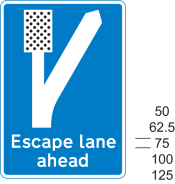 | 1. The route symbol may be varied 2. “ahead” may be varied to a distance, varied to an arrow pointing to the left or to the right, or omitted |
| 4 | Diagram 513.1A Risk of lorries overturning on adverse camber (with bend to the left) and maximum speed advised | 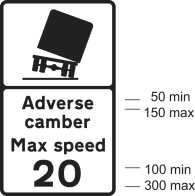 | 1. The symbol may be reversed when the bend is to the right 2. The numerals indicating the maximum speed advised may be varied as appropriate 3. The legend “Max speed 20” may be omitted |
| 5 | Diagram 545.3 In relation to Wales, road safety image or slogan |  |
PART 4 Traffic signs for bridges and other structures
(1) Item | (2) Description | (3) Diagram | (4) Associated plate or structure warning marking (by reference to an item number in the Part 5 sign table) | (5) Applicable provisions in Part 7 | (6) Schedule 2 General Directions |
|---|---|---|---|---|---|
| 1 | Diagram 528.1 End of a bridge parapet, abutment wall, tunnel mouth or other obstruction adjacent to the carriageway | 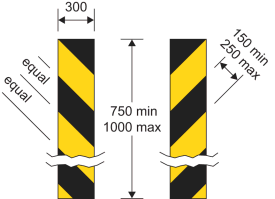 | 9 | ||
| 2 | Diagram 530A Maximum headroom available at hazard, with height indicated in both metric and imperial units |  | 1, 3, 4 or 5 | 6, 12 | |
| 3 | Diagram 531.1A Maximum headroom available at arch bridge ahead |  | 2 or 5 | 6, 12 | 3 |
| 4 | Diagram 1024.1 Road marking indicating path to be taken by high vehicles under a low bridge or to avoid an overhanging structure |  | 11, 13 | ||
| 5 | F62Diagram 629.2A Vehicles exceeding height indicated in metric and imperial units prohibited from passing under, into or through a bridge, tunnel or other structure |  | 4 | 1, 2, 6, 12 |
PART 5 Associated plates and structure warning markings for signs in Part 4
(1) Item | (2) Description | (3) Diagram | (4) Variants | (5) Applicable provisions in Part 7 |
|---|---|---|---|---|
| 1 | Diagram 530.1 Reduced headroom over part of road due to overhanging building or structure |  | 1. The legend may include— (a) a distance, with or without an arrow pointing to the left or to the right; (b) an arrow pointing to the left or to the right 2. “building” may be varied to “buildings” or “structure” | |
| 2 | Diagram 531.2 High vehicles to use middle of road at arch bridge ahead, |  | The legend may include an arrow pointing to the left or to the right | |
| 3 | Diagram 532.4 Upper: Extent of headroom available at the side of and in the centre of a road at an arch bridge. Lower: Marking highlighting reduced headroom at an arch bridge. |  | 1. The position and number of chord markings in the upper part of the diagram may be varied as appropriate 2. The black and yellow marking may be omitted | 7, 9 |
| 4 | Diagram 530.2 Reduced headroom at a hazard (Alternative types) | 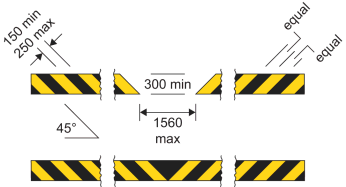 | 7, 9 | |
| 5 | Diagram 572 Distance ahead to hazard |  | 1. The distance may be varied to another distance 2. The legend may include an arrow pointing to the left or to the right |
PART 6 Other warning signs
(1) Item | (2) Description | (3) Diagram | (4) Variants | (5) Applicable provisions in Part 7 | (6) Schedule 2 General Directions |
|---|---|---|---|---|---|
| 1 | Diagram 501 Junction ahead controlled by a “GIVE WAY” or “STOP” sign, wherean indication may be given that the junction iswith a dual carriageway road | 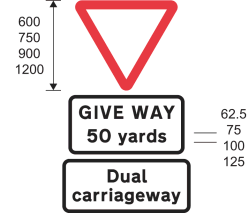 | 1. In the upper plate “GIVE WAY” is varied to “STOP” if the stop sign is placed at a junction ahead 2. The lower associated plate may be omitted 3. In the upper plate the distance may be varied | 6 | 4 |
| 2 | Diagram 560 Edge of carriageway or obstruction near that edge (Alternative types) |  | 1. The colour of the circular sign or the rectangular sign may be varied to white or amber 2. The surface of the rectangular sign may be curved | 4 | 5 |
| 3 | Diagram 515 Sharp deviation of route | 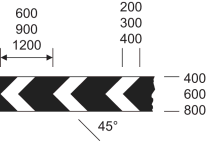 | 1. The chevrons may be reversed to point to the right 2. The number of chevrons may be varied 3. The corners of the sign may be rounded, with a radius not greater than 10 mm 4. The sign may be formed of a series of vertical flexible elements that need not have a horizontal cross section that is flat, provided that the elements extend to ground level to form the support for the sign and the support is coloured black 5. Where vertical flexible elements are used, the horizontal distance between the pointed ends of two consecutive chevrons may be increased by up to 4% of the dimensions shown in the diagram 6. Where vertical flexible elements are used, a yellow border may be added to the outside edge of the part of the sign that comprises the chevrons 7. Where vertical flexible elements are used, the sign may include a white arrow on a blue circular background as shown by the diagram in column 3 at item 1 of the sign table in Part 2 of Schedule 3. This is to be placed over the chevrons and any yellow border, and formed as part of those elements | 8, 9 | |
| 4 | Diagram 774 Location of a railway or tramway level crossing without gate or barrier |  | |||
| 5 | Diagram 781 Load gauge giving audible warning to drivers where vehicles exceed safe height under electrified overhead cables | 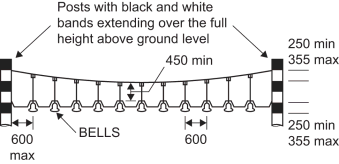 | 1. The number of bells may be increased or decreased according to the width of the road over which the sign is placed 2. The bells may be of any colour, provided each bell is of the same colour | 10 | |
| 6 | Diagrams 789, 789.1, 789.2 Countdown markers to railway or tramway level crossing |  | Each sign may be reversed |
PART 7 Provisions applicable to signs
PART 8 The Schedule 2 General Directions
SCHEDULE 3 
Upright signs that indicate regulatory requirements for moving traffic
Regulation 3, Direction 3
PART 1 Provisions applicable to Parts 2, 3 and 4
I630PART 2 Circular signs and supplementary plates including regulatory requirements

(1) Item | (2) Description | (3) Diagram | (4) Sign diameter | (5) Associated plate legend F63(by reference to a paragraph number in Part 3) | (6) Applicable provisions in Part 4 | (7) Schedule 3 General Directions |
|---|---|---|---|---|---|---|
| 1 | Diagram 606 Vehicular traffic must proceed in the direction indicated by the arrow (Alternative types) |  | 270, 300, 450, 600, 750, 900, 1200, 1500 | 1, 2 or 3 | 1, 2, 4 | 1, 2 |
| 2 | Diagram 609 Vehicular traffic must turn ahead in the direction indicated by the arrow (Alternative types) |  | 450, 600, 750, 900, 1200 | 1, 2 or 3 | 1, 2, 4 | 1 |
| 3 | Diagram 610 Vehicular traffic must comply with the requirements described in paragraph 3 of Part 4 (Alternative types) |  | 270, 300, 450, 600, 750, 900, 1200, 1500 | 2 | 1, 2, 3, 4 | 2 |
| 4 | Diagram 642 No stopping on main carriageway |  | 300, 450, 600, 750, 900, 1200 | 4 or 5 | 2, 4 | 1 |
| 5 | Diagram 632 No overtaking |  | 600, 750, 900, 1200 | 4, 5, 6 or 7 | 4 | 1 |
| 6 | Diagram 614 No U-turns for vehicular traffic |  | 270, 300, 450, 600, 750, 900, 1200 | 4 or 5 | 2, 4 | 1, 2 |
| 7 | Diagram 612 No right turn for vehicular traffic |  | 270, 300, 450, 600, 750, 900, 1200 | 3, 8, or both 3 and 8 | 2, 4 | 1, 2 |
| 8 | Diagram 613 No left turn for vehicular traffic |  | 270, 300, 450, 600, 750, 900, 1200 | 3, 8, or both 3 and 8 | 2, 4 | 1, 2 |
| 9 | Diagram 615 Priority must be given to vehicles from the opposite direction |  | 600, 750, 900, 1200 | 5, 9 or 10 | 1, 4 | 3 |
| 10 | Diagram 616 No entry for vehicular traffic |  | 270, 300, 450, 600, 750, 900, 1200 | 11 | F641, 2, 4, 9 | 1, 2 |
| 11 | Diagram 617 All vehicles prohibited except non-mechanically propelled vehicles pushed by pedestrians |  | 450, 600, 750, 900, 1200 | 12, 13 or 14; 8 and 14; 14 and 15; or 8, 14 and 15 | 4 (with plate legend 14) or 5 (with plate legend 12 or 13) | 1, 3 |
| 12 | Diagram 619 Motor vehicles prohibited , except for electric scooters being used in a trial |  | 450, 600, 750, 900, 1200 | 8, 15, or both 8 and 15 | 4 | 1 |
| 13 | Diagram 622.1A Goods vehicles exceeding the maximum gross weight indicated prohibited |  | 450, 600, 750, 900, 1200, 1500 | 6, 8, 15, or both 8 and 15 | 4, 6 | 1 |
| 14 | Diagram 622.2 End of prohibition of goods vehicles indicated by the sign provided for at item 13 |  | 450, 600, 750, 900 | 4 | 1 | |
| 15 | Diagram 622.4 Articulated or track laying vehicles prohibited (Alternative types) |  | 600, 750, 900 | 6 | 4 | 1 |
| 16 | Diagram 622.8 Vehicles carrying explosives prohibited |  | 450, 600, 750, 900, 1200 | 16 A second plate with a legend from 8 or 15, or both 8 and 15, may be added | 4 | 1, 3 |
| 17 | Diagram 952 Buses prohibited |  | 450, 600, 750, 900, 1200 | 8, 15, or both 8 and 15 | 4 | 1 |
| 18 | Diagram 619.1 Motor vehicles except solo motor cycles prohibited |  | 450, 600, 750, 900, 1200 | 8, 15, or both 8 and 15 | 4 | 1 |
| 19 | Diagram 622.7 Towed caravans prohibited |  | 450, 600, 750, 900, 1200 | 8, 15, or both 8 and 15 | 4 | 1 |
| 20 | Diagram 619.2 Solo motor cycles prohibited , except for electric scooters being used in a trial |  | 450, 600, 750, 900, 1200 | 8, 15, or both 8 and 15 | 4 | 1 |
| 21 | Diagram 951 Riding of pedal cycles and electric scooters being used in a trial, prohibited |  | 150, 270, 300, 450, 600 | 4 (but only sub-paragraph (5)) | 1, 2 | |
| 22 | Diagram 625.1 Pedestrians prohibited |  | 150, 300, 450, 600 | 5 | 1 | |
| 23 | Diagram 622.5 Horse-drawn vehicles prohibited |  | 150, 300, 450, 600 | 8, 15, or both 8 and 15 | 5 | 1 |
| 24 | Diagram 622.6 Ridden or accompanied horses prohibited |  | 150, 300, 450, 600 | 8, 15, or both 8 and 15 | 5 | 1 |
| 25 | Diagram 629.1 Vehicles or combinations of vehicles exceeding the length indicated prohibited |  | 600, 750, 900 | 6, 8, 15, or both 8 and 15 | 4, 6 | 1, 4 |
| 26 | Diagram 629A Vehicles exceeding the width indicated prohibited in both metric and imperial units |  | 750, 900, 1200 | 6, 8, 15 or both 8 and 15 | 4, 6 | 1 |
| 27 | F65Diagram 629.2A Vehicles exceeding height indicated in metric and imperial units prohibited in circumstances not covered by the description in column 2 of item 5 of the sign table in Part 4 of Schedule 2 (which relates to bridges, tunnels and other structures) |  | 750, 900, 1200, 1500 | 4, 6 | 1 | |
| 28 | Diagram 955 Route for use by pedal cycles and electric scooters being used in a trial, only |  | 100, 150, 270, 300, 450, 600 | 4 (but only sub-paragraph (5)) | 1, 2 | |
| 29 | Diagram 956 Route for use by pedal cycles , electric scooters being used in a trial and pedestrians only |  | 100, 150, 270, 300, 450, 600 | 4 (but only sub-paragraph (5)) | 1, 2 | |
| 30 | Diagram 956.1 Route for use by pedal cycles, electric scooters being used in a trial, horses and pedestrians only |  | 100, 150, 270, 300, 450, 600, 750 | 4 (but only sub-paragraph (5)) | 1, 2 | |
| 31 | Diagram 956.2 Route for use by pedal cycles, electric scooters being used in a trial, horse-drawn vehicles and pedestrians only |  | 100, 150, 270, 300, 450, 600, 750 | 4 (but only sub-paragraph (5)) | 1, 2 | |
| 32 | Diagram 957 Route comprising two ways for use by pedal cycles and electric scooters being used in a trial, only and by pedestrians only, with those ways separated by the marking provided for at item 7 or 8 of the table in Part 6 of Schedule 9, or by physical means, (Alternative types) |  | 100, 150, 270, 300, 450, 600 | 4 (but only sub-paragraph (5)) | 1, 2 | |
| 33 | Diagram 953 Route for use by buses, pedal cycles , electric scooters being used in a trial and taxis only (Alternative types) |  | 450, 600, 750, 900 | 8, 17, or both 8 and 17 | 1, 4, 7, 8 | 1 |
| 34 | Diagram 953A Route for use by buses, pedal cycles and solo motor cycles only (Alternative types) |  | 450, 600, 750, 900 | 8, 17 or both | 1, 4 | 1 |
| 35 | Diagram 953B Route for use by buses, pedal cycles, solo motor cycles and taxis only (Alternative types) |  | 600, 750, 900, 1200 | 8, 17 or both | 1, 4 | 1 |
| 36 | Diagram 953.1 Route for use by tramcars only |  | 450, 600, 750, 900 | 8, 17, or both | 1, 4 | 1 |
| 37 | Diagram 953.1 (variant) Route for use by tramcars and buses only (Alternative types) |  | 450, 600, 750, 900 | 8, 17, or both | 1, 4 | 1 |
| 38 | Diagram 953.1A Route for use by tramcars, buses , electric scooters being used in a trial and pedal cycles only (Alternative types) |  | 600, 750, 900, 1200 | 8, 17, or both | 1, 4 | 1 |
| 39 | Diagram 953.1B Route for use by tramcars, buses, pedal cycles , electric scooters being used in a trial and taxis only (Alternative types) |  | 600, 750, 900, 1200 | 8, 17, or both | 1, 4 | 1 |
| 40 | Diagram 953.1C Route for use by tramcars, buses, pedal cycles, solo motor cycles and taxis only (Alternative types) |  | 600, 750, 900, 1200 | 8, 17, or both | 1, 4, 7 | 1 |
PART 3 Legends for plates associated with circular signs
PART 4 Provisions applicable to signs in Part 2
PART 5 The Schedule 3 General Directions
SCHEDULE 4 
Upright signs that control waiting, loading and parking along a road
Regulation 3, Direction 3
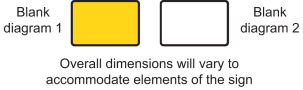
I651PART 1 Blank panel diagram
PART 2 On-street parking control signs
Yellow panel signs
White panel signs
Signs consisting of multiple panels
Provisions applying where the sign is made up of more than one panel
I15924 Height of legends to be proportionate
I16025 Illumination
I652PART 3 Symbols and legends used in combination with a yellow panel
(1) Item | (2) Description | (3) Symbol | (4) Legend | (5) Variant of legend | (6) Legend height (by reference to x-height) |
|---|---|---|---|---|---|
| 1 | Waiting prohibited for a time that is not continuous throughout the year |  | A time period | The legend may include either or both of— (a) “No waiting”; and (b) “except” followed by one or more of “taxis”, “ambulances”, “police vehicles”, and where more than one exception is provided for “and” or “&” must precede the final exception | Not less than 15 mm and not more than 40 mm |
| 2 | Stopping prohibited |  | 1. “No stopping”; and 2. “except” followed by— (a) “buses”; (b) “local buses”; or (c) one or more of “taxis”, “ambulances”, “police vehicles”, and where more than one exception is provided for “and” or “&” must precede the final exception | 1. The legend may include a time period 2. The legend may include “taxis” with a time period 3. The legend may include “BUS STAND” provided it is displayed above “No Stopping” and used in combination with “except buses” or “except local buses” | Not less than 15 mm and not more than 40 mm |
| 3 | Waiting of goods vehicles over the maximum gross weight shown or buses (or both) prohibited The lorry symbols are alternative types The bus symbols are alternative types | 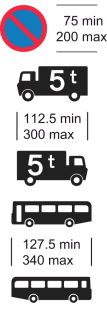 | A time period | Not less than 15 mm and not more than 40 mm | |
| 4 | Waiting prohibited in a Pedestrian Zone or a Restricted Parking Zone |  | 1. “Pedestrian Zone” or “Restricted Parking Zone”; and 2. A time period | 25 mm | |
| 5 | Waiting prohibited on a verge or on a footway |  | “At any time on” followed by “verge or footway”, “footway” or “verge” | Not less than 20 mm and not more than 40 mm | |
| 6 | Stopping prohibited on a verge or on a footway |  | “At any time on” followed by “verge or footway”, “footway” or “verge” | Not less than 20 mm and not more than 40 mm | |
| 7 | Entrance to a designated off-road loading area |  | 1. “Loading area”; 2. “Except by permitted vehicles”; and 3. A time period | 1. 50 mm for “Loading area” 2. 40 mm for “Except by permitted vehicles” 3. 40 mm for the time period | |
| 8 | Waiting prohibited in a designated off-road loading area |  | 1. “Except by permitted vehicles”; and 2. A time period | 40 mm | |
| 9 | Stopping prohibited in a lay-by except in emergency |  | “No stopping except in emergency” | 37.5 mm or 50 mm | |
| 10 | Stopping prohibited on entrance markings |  | 1. “No stopping”; and 2. “on entrance markings” | A time period may be included | 1. 50 mm for “No stopping” 2. 40 mm for “on entrance markings” 3. 40 mm for any time period |
I653PART 4 Symbols and legends used in combination with a white panel
(1) Item | (2) Description | (3) Symbol | (4) Required legends | (5) Variants to column 4 legends, or legends that may be included | (6) Legend height (by reference to x-height) | (7) Applicable Part 5 item |
|---|---|---|---|---|---|---|
| 1 | Loading prohibited | 1. “No loading” 2. A time period | Not less than 15 mm and not more than 40 mm | |||
| 2 | Parking place |  | 1. A time period may be included 2. A permitted parking expression may be included 3. A type or types of user may be included and, where the user is a type of permit holder, a permit identifier may be included 4. A legend provided for at 3 above may be varied by the addition of “only” or “only at all times” 5. The name of the traffic authority may be included 6. A parking place identifier or a zone identifier may be included | Not less than 15 mm and not more than 40 mm | 1, 2, 3, 4, 5, 6, 7, 8 | |
| 3 | Parking place where vehicles may be parked partially on the verge or footway (Alternative types) | 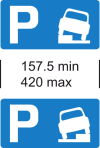 | 1. A time period may be included 2. A permitted parking expression may be included 3. A type or types of user may be included and, where the user is a type of permit holder, a permit identifier may be included 4. A legend provided for at 3. above may be varied by the addition of “only” or “only at all times” 5. The name of the traffic authority may be included in the sign 6. A parking place identifier or a zone identifier may be included in the sign | Not less than 15 mm and not more than 40 mm | 2, 4, 5, 7, 8 | |
| 4 | Parking place where vehicles may be parked wholly on the verge or footway (Alternative types) |  | 1. A time period may be included 2. A permitted parking expression may be included 3. A type or types of user may be included and, where the user is a type of permit holder, a permit identifier may be included 4. A legend provided for at 3 above may be varied by the addition of “only” or “only at all times” 5. The name of the traffic authority may be included 6. A parking place identifier or a zone identifier may be included | Not less than 15 mm and not more than 40 mm | 2, 4, 5, 7, 8 | |
| 5 | Parking place reserved for loading and unloading |  | “Loading only” | 1. “Loading only” may be varied to “Loading”, “Goods vehicles loading” or “Goods vehicles loading only” 2. The legend may be varied to include— (a) a time period; (b) a permitted parking expression; or (c) both 3. The name of the traffic authority may be included 4. A parking place identifier may be included | Not less than 15 mm and not more than 40 mm | |
| 6 | Parking not subject to payment conditions | | “Free” | The permitted variants at item 2 apply | Not less than 15 mm and not more than 40 mm | 1, 2, 3, 4, 5, 6, 7, 8 |
| 7 | Parking subject to payment conditions | | “Pay at machine” | 1. The permitted variants at item 2 apply 2. “Pay at machine” may be varied to any of the following or any appropriate combination of the following— (a) “Pay here at machine” (b) “Pay at machine across road” (c) “Pay at machine opposite” (d) “Pay at machine” and a location (e) “Pay at” and a description of the ticket machine in any coloured letters (f) “Display ticket” (g) “Pay by phone” and a telephone number and “or text” and a text number and “quoting location” and a location number (h) “Pay by phone” and a telephone number and “quoting location” and a location number (i) “Pay by text” and a text number and “quoting location” and a location number (j) Disc Zone”, “Disc parking”, “Ticket Zone” or “Ticket parking” 3. “Pay” in the legend “Pay at machine”, or in any of the legends referred to in entry 2, may be varied to “For longer stay pay” 4. Where the legend refers to a ticket machine, the legend may include an arrow pointing horizontally to the left or to the right, or one arrow pointing to the left and one to the right, to indicate the location of the machine or machines | Not less than 15 mm and not more than 40 mm | 1, 2, 3, 4, 5, 6, 7, 8 |
| 8 | Drivers must obtain and display parking tickets | | “Have you paid and displayed?” | Not less than 15 mm and not more than 40 mm |
I644PART 5 Symbols to be used with Part 4 symbols on a white panel
(1) Item | (2) Description | (3) Symbol | (4) Legend | (5) Legend height (by reference to x-height) | |
|---|---|---|---|---|---|
| 1 | Parking place reserved for solo motor cycles other than electric scooters being used in a trial |  | |||
| 2 | Parking place reserved for motor cars |  | |||
| 3 | Parking place reserved for buses (Alternative types) | 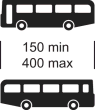 | |||
| 4 | Parking place reserved for disabled badge holders |  | 1. “Disabled badge holders”; 2. “Disabled badge holders only”; 3. “Disabled badge holders only at all times”; 4. “Disabled badge holder” and a permit identifier; or 5. “Disabled badge holder only” and a permit identifier | Not less than 15 mm and not more than 40 mm | |
| 5 | Parking place reserved for car club permit holders |  | “Car club permit holders only” | Not less than 15 mm and not more than 40 mm | |
| 6 | Parking place reserved for the recharging of electric solo motor cycles other than electric scooters being used in a trial |  | 1. “Electric solo motor cycle recharging point only”; or 2. “Electric solo motor cycle recharging point” and “Permit holders only” with or without a permit identifier | Not less than 15 mm and not more than 40 mm | |
| 7 | Parking place reserved for the recharging of electric vehicles other than electric scooters being used in a trial | 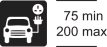 | 1. “Electric vehicle recharging point only”; or 2. “Electric vehicle recharging point” and “Permit holders only” with or without a permit identifier, | Not less than 15 mm and not more than 40 mm | |
| 8 | Parking place reserved for vehicles displaying an appropriate voucher |  | 1. “Voucher parking only”; 2. “Voucher parking and permits only”; 3. “Voucher parking and resident permits only”; 4. “Voucher parking and business permits only”; or 5. a legend provided for at 2, 3, or 4 with a permit identifier | Not less than 15 mm and not more than 40 mm | |
PART 6 The Schedule 4 General Direction
SCHEDULE 5 
Signs to indicate parking places and areas subject to parking controls
Regulation 3, Direction 3
PART 1 Parking place signs and plates
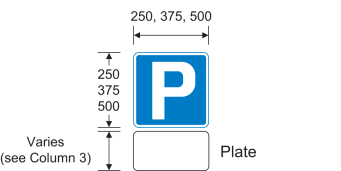
(1) Item | (2) Description | (3) Plate | (1) Item | (2) Description | (3) Plate | |
|---|---|---|---|---|---|---|
| 1 | Parking place | 2 | Diagram 804.4 Parking place reserved for solo motor cycles other than electric scooters being used in a trial | 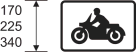 | ||
| 3 | Diagram 804.2 Parking place reserved for motor cars | 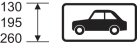 | 4 | Diagram 804.3 Parking place reserved for motorised caravans or caravans drawn by motor vehicles | 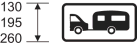 | |
| 5 | Diagram 804.1 Parking place reserved for goods vehicles |  | 6 | Diagram 969 Parking place reserved for buses | 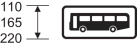 |
PART 2 Entrance to a zone or area (other than a pedestrian, or a pedestrian and cycle, zone) where parking controls apply

I631PART 3 The upper panel and provision on inclusion of the lower panel
(1) Item | (2) Description | (3) Symbol | (4) Legend | (5) Height and location of legend | (6) Permitted variants | (7) Inclusion of a lower panel |
|---|---|---|---|---|---|---|
| 1 | Entrance to a controlled parking zone applying to all vehicles |  | “Controlled ZONE” | x-height: 1. 60 mm or 80 mm for “Controlled” 2. 75 mm or 100 mm for “ZONE” Location: Above the symbol | 1. The name of the traffic authority may be added above any other legend 2. A zone identifier may be added— (a) where the identifier is a name, at the top of the panel (but below the name of the traffic authority if used); (b) where the identifier is a code, to the right of the legend in column 4 3. The legend “No loading” may be added below the symbol if that legend is of the same size as the legend at column 4 4. “Controlled” may be varied to “Meter”, “Disc”, “Ticket”, “Disc and Meter”, “Disc and Ticket” or “Pay and Display | A lower panel may be included showing a legend specified in the Part 4 sign table at item 1 |
| 2 | Entrance to a restricted parking zone |  | “Restricted parking ZONE” | x-height: 1. 60 mm or 80 mm for “Restricted parking” 2. 75 mm or 100 mm for “ZONE” Location: Above the symbol | 1. The name of the traffic authority may be added above any other legend 2. A zone identifier may be added— (a) where the identifier is a name, at the top of the panel (but below the name of the traffic authority if used); (b) where the identifier is a code, to the right of “ZONE” 3. The legend “No loading” may be added below the symbol if that legend is of the same size as “Restricted parking” | A lower panel may be included showing a legend specified in the Part 4 sign table at item 2 |
| 3 | Entrance to a voucher parking zone |  | “Voucher parking ZONE” | x-height: 1. 60 mm or 80 mm for “Voucher parking” 2. 75 mm or 100 mm for “ZONE” Location: Between the upper and lower symbol | 1. The legend “No loading” may be added below the lower symbol if that legend is of the same size as the legend at column 4 2. The name of the traffic authority may be added at the top of the panel 3. A zone identifier may be added— (a) where the identifier is a name, at the top of the panel (but below the name of the traffic authority if used). (b) where the identifier is a code, to the right of “ZONE” 4. The upper symbol may be varied to an appropriate symbol identifying the voucher parking area in question 5. “Voucher parking” may be varied to “Voucher parking and Meter” or “Voucher parking and Ticket” | A lower panel may be included showing a legend specified in the Part 4 sign table at item 1 |
| 4 | Entrance to a controlled parking zone applying to goods vehicles over the maximum gross weight shown or buses (or both) | 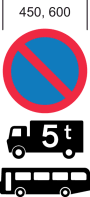 | “ZONE” | x-height: 75 mm or 100 mm for “ZONE” Location: Below the symbols | 1. The number on the lorry symbol may be varied 2. Either the lorry symbol or the bus symbol may be omitted 3. The name of the traffic authority may be added at the top of the panel | A lower panel may be included showing a legend specified in the Part 4 sign table at item 1 |
| 5 | Entrance to a permit parking area |  | F8F67... “Permit holders parking only past this point” F8F67... | x-height: 40 mm Location: Below the symbol | 1. A time period may be added 2. The name of the traffic authority may be added at the top of the panel 3. Permit identifiers may be added either to the right of the symbol or proximate to “permit holders” 4. “Permit holders parking only past this point” may be varied to “Resident permit holders parking only past this point”, “Permit holders parking only in” and a street name or “Resident permit holders parking only in” and a street name | A lower panel may be included showing the legend specified in the Part 4 sign table at item 3 |
| 6 | Entrance to a loading only area |  | “Loading only past this point” or “Goods vehicle loading only past this point” | x-height: 40 mm Location: Below the symbol | 1. A time period may be included after the legend 2. The name of the traffic authority may be added at the top of the panel | A lower panel must not be included |
| 7 | Entrance to an area where parking on the verge or footway is prohibited | 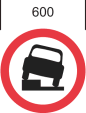 | The name of a zone, city, town, village, area or road | x-height: 50 mm Location: Above the symbol | 1. The symbol may be reversed 2. The legend may be omitted | A lower panel must be included showing the legend specified in the Part 4 sign table at item 4 |
I654PART 4 Legends and symbols in the lower panel
(1) Item | (2) Legend | (3) Height of legend or symbol | (4) Permitted variants |
|---|---|---|---|
| 1 | A time period | x-height: 37.5 or 50 mm | |
| 2 | A time period | x-height: 37.5 or 50 mm | 1. “Except in signed bay” instead of the time period at column 2 2. “except in signed bay” to follow the time period at column 2 3. “bays” may be used instead of “bay” |
| 3 | “Except in signed bay” | 1. Legend x-height: 40 mm 2. A height of 200 mm in respect of a symbol | 1. “Except” followed by either or both of the disabled badge holder symbol and the loading symbol (the symbol in column 3 of item 6 of the Part 3 sign table), to be followed by “in signed bay”. If both symbols are included “and” or “&” must be inserted between them 2. A time period may follow the column 2 legend or permitted variant 1 3. “bays” may be used instead of “bay” |
| 4 | “No motor vehicle parking on verge or footway except where signed” | x-height: 50 mm | 1. “motor vehicle” or “except where signed”, or both, may be omitted 2. “verge or footway” may be varied to “verge” or “footway” |
PART 5 The Schedule 5 General Direction
SCHEDULE 6 
Upright signs for red routes
Regulation 3, Direction 3
PART 1 Provisions applying to Part 2

I645PART 2 Symbols and legends used on a bottom panel
(1) Item | (2) Description | (3) Symbol | (4) Additional legend | (5) Permitted variants |
|---|---|---|---|---|
| 1 | Parking place |  | 1. A time period may be added 2. A permitted parking expression may be added 3. A type or types of user may be added and, where the user is a type of permit holder, a permit identifier may be added | |
| 2 | Parking place where vehicles may be parked partially on the verge or footway (Alternative types) |  | 1. A time period may be added 2. A permitted parking expression may be added 3. A type or types of user may be added and, where the user is a type of permit holder, a permit identifier may be added | |
| 3 | Parking place where vehicles may be parked wholly on the verge or footway (Alternative types) | 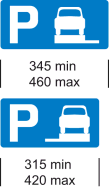 | 1. A time period may be added 2. A permitted parking expression may be added 3. A type or types of user may be added and, where the user is a type of permit holder, a permit identifier may be added | |
| 4 | Parking place reserved for solo motor cycles other than electric scooters being used in a trial May only be used in conjunction with the symbol at item 1, 13 or 14 |  | ||
| 5 | Parking place reserved for motor cars May only be used in conjunction with the symbol at item 1, 2, 3, 13 or 14 |  | ||
| 6 | Parking place reserved for buses May only be used in conjunction with the symbol at item 1, 13 or 14 |  | ||
| 7 | Parking place reserved for disabled badge holders |  | 1. A time period may be added 2. A permitted parking expression may be added 3. “Permit holder” or “Permit holders” may be added and, in either case, any permit identifier as appropriate | |
| 8 | Parking place reserved for car club permit holders May only be used in conjunction with the symbol at item 1, 2, 3, 13 or 14 |  | “Car club permit holders only” | |
| 9 | Parking place reserved for the recharging of electric solo motor cycles other than electric scooters being used in a trial May only be used in conjunction with the symbol at item 1, 13 or 14 | 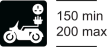 | “Electric solo motor cycle recharging point only” | The legend may be varied to “Electric solo motor cycle recharging point” and “Permit holders only”, with or without a permit identifier |
| 10 | Parking place reserved for the recharging of electric vehicles other than electric scooters being used in a trial May only be used in conjunction with the symbol at item 1, 2, 3, 13 or 14 |  | “Electric vehicle recharging point only” | The legend may be varied to “Electric vehicle recharging point” and “Permit holders only”, with or without a permit identifier |
| 11 | Parking place reserved for vehicles displaying an appropriate voucher May only be used in conjunction with the symbol at item 1, 2, 3, 13 or 14 |  | “Voucher parking” | 1. The voucher symbol may be varied to correspond with the design on the approved voucher within the size shown 2. The legend may be varied to “Voucher parking and permits only”, “Voucher parking and resident permits only” or “Voucher parking and business permits only” 3. The legend provided for at 2 above may be varied to include a permit identifier 4. An additional white panel may be added to the sign to show information on the voucher parking scheme |
| 12 | Parking place reserved for loading and unloading |  | “Loading” | 1. The legend may be varied to “Goods vehicles loading” 2. The legend may be varied to include— (a) a time period; or (b) a permitted parking expression, or both |
| 13 | Parking place not subject to payment conditions | | “Free” | 1. The permitted variants at item 1 2. The symbol may be varied to that at item 2 or 3, except when used in combination with the symbol at item 4 or 6 |
| 14 | Parking place subject to payment conditions | | “Pay at machine” | 1. The permitted variants at item 1 2. The symbol may be varied to that at item 2 or 3, except when used in combination with the symbol at item 4 or 6 3. “Pay at machine” may be varied to any of the following or any appropriate combination of the following— (a) “Pay by phone” (b) “Pay by text” (c) “Pay by phone or text” (d) “Disc Zone”, “Disc parking”, “Ticket Zone” or “Ticket parking” 4. “Pay” in the legend “Pay at machine”, or in any of the legends at entry 3, may be varied to “For longer stay pay” |
PART 3 The Schedule 6 General Direction
SCHEDULE 7 
Road markings and miscellaneous upright signs that indicate stopping, waiting, loading and parking controls
Regulation 3, Direction 3
PART 1 Provisions applying to Part 2
I655PART 2 Regulatory signs for stopping, waiting, loading and parking controls
(1) Item | (2) Description | (3) Sign diagram | (4) Permitted variants |
|---|---|---|---|
| 1 | Diagram 664 End of controlled, voucher or restricted parking zone |  | |
| 2 | Diagram 666 End of controlled parking zone applying to goods vehicles over the maximum gross weight shown or buses (or both) |  | 1. The number on the lorry symbol may be varied 2. The lorry symbol or the bus symbol may be omitted |
| 3 | Diagram 664.1 End of permit parking area |  | |
| 4 | Diagram 664.2 End of loading only area |  | |
| 5 | Diagram 640.5 End of designated off-road loading area | 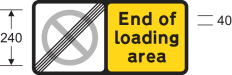 | |
| 6 | Diagram 646 No stopping during time periods indicated except for so long as may be necessary for the purpose of picking up or setting down passengers |  | 1. Days of the week may be varied 2. The time periods shown in the “am” and “pm” panels may be varied to any other periods |
| 7 | Diagram 647 End of the restriction on stopping indicated by the sign at item 6 |  | |
| 8 | Diagram 642.4 Stopping of vehicles prohibited at all times on a red route clearway (and conveying to drivers that this prohibition is not indicated by double red lines) | 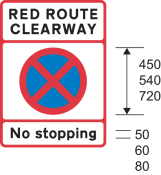 | |
| 9 | Diagram 642.5 End of prohibition on stopping indicated by the sign at item 8 |  | |
| 10 | Diagram 663.4 Reminder to drivers that parking on the verge or footway is prohibited (Alternative types) |  | |
| 11 | Diagram 664.3 End of area where parking on verge or footway is prohibited (Alternative types) |  | |
| 12 | Diagram 667 Vehicles may be parked partially on the verge or footway (Alternative types) |  | An arrow pointing to the left or to the right may be added |
| 13 | Diagram 668 Vehicles may be parked wholly on the verge or footway (Alternative types) | 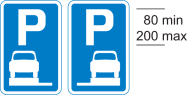 | An arrow pointing to the left or to the right may be added |
| 14 | Diagram 667.1 Vehicles may be parked partially on the verge or footway during the period indicated (Alternative types) |  | 1. An arrow pointing to the left or to the right may be added in the lower panel 2. “In marked bays” may be added to or substituted for the times shown in the lower panel 3. The time period may be varied to another time period |
| 15 | Diagram 668.1 Vehicles may be parked wholly on the verge or footway during the period indicated (Alternative types) | 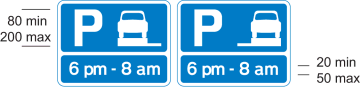 | 1. An arrow pointing to the left or to the right may be added in the lower panel 2. “In marked bays” may be added to or substituted for the times shown in the lower panel 3. The time period may be varied to another time period |
| 16 | Diagram 667.2 End of area where vehicles may be parked partially on the verge or footway (Alternative types) |  | |
| 17 | Diagram 668.2 End of area where vehicles may be parked wholly on the verge or footway (Alternative types) | 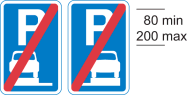 |
PART 3 Provisions applying to road markings in Part 4
I656PART 4 Road markings for stopping, waiting, loading and parking controls
(1) Item | (2) Description | (3) Diagram | (4) Variants in Part 5 |
|---|---|---|---|
| 1 | Diagram 1018.1 (a) Waiting of vehicles prohibited at all times or (b) stopping of vehicles in a lay-by prohibited except in emergency | 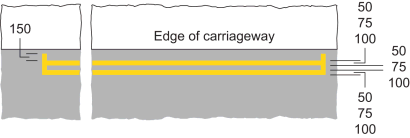 | 3 |
| 2 | Diagram 1017 Waiting of vehicles prohibited for a time that is not continuous throughout the year | 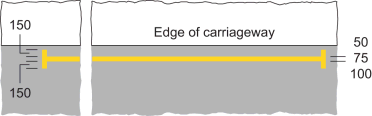 | 3 |
| 3 | Diagram 1020.1 Loading and unloading of vehicles prohibited at all times | 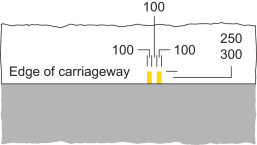 | 4 |
| 4 | Diagram 1019 Loading and unloading of vehicles prohibited for a time that is not continuous through the year |  | 4 |
| 5 | Diagram 1028.2 Area of carriageway reserved for taxis or, where the legend is varied as indicated in column 4, reserved for ambulances or police vehicles, where waiting by other vehicles is prohibited (Alternative types) |  | 6, 7, 10 |
| 6 | Diagram 1028.4 Alternative types of parking bay— (a) at the edge of the carriageway and situated wholly on either the carriageway or footway; or (b) in the centre of the carriageway or partly on the carriageway and partly on the footway | 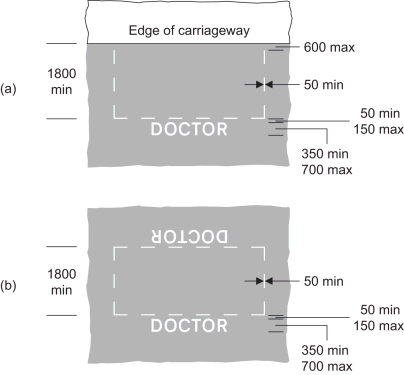 | 1, 2, 5, 7, 10 |
| 7 | Diagram 1028.5 Area of carriageway reserved for taxis or, where the legend is varied as indicated in column (4), reserved for ambulances or police vehicles, where stopping by other vehicles is prohibited | 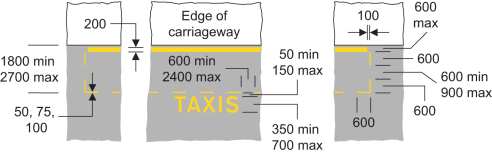 | 6, 7, 8, 10 |
| 8 | Diagram 1028.6 Parking bay for use by all vehicles or, where indicated by upright signs, by specified vehicles, and where at certain times, as indicated by upright signs, the bay is reserved for taxis, ambulances or police vehicles, where stopping by other vehicles is prohibited | 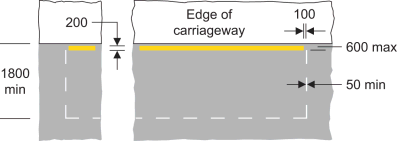 | 2, 5, 7, 8 |
| 9 | Diagram 1025.1 Clearway at which, as described in paragraph 1 of Part 6, vehicles must not stop (exceptions apply for buses and taxis) |  | 7, 9, 10, 11, 12, 13 |
| 10 | Diagram 1027.1 Part of the carriageway outside an entrance where, as described in paragraph 2 or 3 (as applicable) of Part 6, vehicles should, or must, not stop | 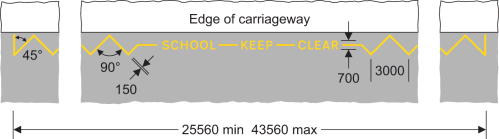 | 14, 15, 16 |
| 11 | Diagram 1018.2 Stopping of vehicles prohibited at all times |  | 3 |
| 12 | Diagram 1017.1 Stopping of vehicles prohibited for a time that is not continuous throughout the year | 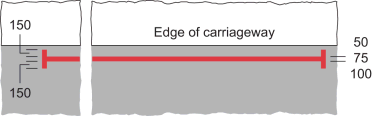 | 3 |
PART 5 Required or permitted variants
PART 6 The significance of particular road markings
I2021 Clearways (diagram 1025.1)
School etc entrances (diagram 1027.1)
I2034 Exceptions applicable to paragraphs 1 and 3
PART 7 The Schedule 7 General Directions
SCHEDULE 8 
Signs indicating the entrance to and the end of a pedestrian, or pedestrian and cycle, zone, and signs for charging schemes and low emission zone schemes
Regulation 3, Direction 3
PART 1 Provisions applying to signs in Part 2
I646PART 2 Signs indicating pedestrian and pedestrian and cycle zones
(1) Item | (2) Sign description | (3) Sign diagram | (4) Permitted variants |
|---|---|---|---|
| 1 | Diagram 618.3B Entry to, and waiting in, a pedestrian zone restricted |  | 1. The time period in the upper panel may be omitted or varied 2. The following symbols and legends may be included in the middle panel to provide for exceptions (including in any combination, provided there is an “and” or “&” before the last exception)— (a) the legend “buses” or “local buses” (b) the legend “taxis” (c) the legend “for access”, “for loading”, or “for loading by” and the goods vehicle symbol (d) the legend “permit holders”, “permit holder”, and, if appropriate, a permit identifier or identifiers (e) the disabled badge holder symbol 3. The middle panel may include a time period 4. The time period in the lower panel may be varied 5. The lower panel may be omitted 6. The middle panel may be omitted when the lower panel is omitted |
| 1A | Diagram 618.3BA Entry to, and waiting in, a pedestrian zone restricted: version incorporating flashing lights (alternative to item 1) |  | 1. The following symbols and legends may be included in the middle panel to provide for exceptions (including in any combination, provided there is an “and” or “&” before the last exception)— (a) the legend “buses” or “local buses” (b) the legend “taxis” (c) the legend “for access”, “for loading”, or “for loading by” and the goods vehicle symbol (d) the legend “permit holders”, “permit holder”, and, if appropriate, a permit identifier or identifiers (e) the disabled badge holder symbol. 2. The middle panel may include a time period. 3. The time period in the lower panel may be varied. 4. The lower panel may be omitted. 5. The middle panel may be omitted when the lower panel is omitted. |
| 2 | Diagram 618.3C Entry to, and waiting in, a pedestrian and cycle zone restricted for motor vehicles, other than electric scooters being used in a trial |  | 1. The time period in the upper panel may be omitted or varied 2. The following symbols and legends may be included in the middle panel to provide for exceptions (including in any combination, provided there is an “and” or”&” before the last exception)— (a) the legend “buses” or “local buses” (b) the legend “taxis” (c) the legend “for access”, “for loading”, or “for loading by” and the goods vehicle symbol (d) the legend “permit holders”, “permit holder”, and, if appropriate, a permit identifier or identifiers (e) the disabled badge holder symbol 3. The middle panel may include a time period 4. The time period in the lower panel may be varied 5. The lower panel may be omitted 6. The middle panel may be omitted when the lower panel is omitted |
| 2A | Diagram 618.3D Entry to, and waiting in, a pedestrian and cycle zone restricted: version incorporating flashing lights (alternative to item 2) |  | 1. The following symbols and legends may be included in the middle panel to provide for exceptions (including in any combination, provided there is an “and” or “&” before the last exception)— (a) the legend “buses” or “local buses” (b) the legend “taxis” (c) the legend “for access”, “for loading”, or “for loading by” and the goods vehicle symbol (d) the legend “permit holders”, “permit holder”, and, if appropriate, a permit identifier or identifiers (e) the disabled badge holder symbol. 2. The middle panel may include a time period. 3. The time period in the lower panel may be varied. 4. The lower panel may be omitted. 5. The middle panel may be omitted when the lower panel is omitted. |
| 3 | Diagram 618.4A End of restrictions associated with a pedestrian zone |  | |
| 4 | Diagram 618.4B End of restrictions associated with a pedestrian and cycle zone |  |
PART 3 Provisions applying to signs in Part 4
I657PART 4 Signs and markings indicating a congestion charging zone
(1) Item | (2) Sign description | (3) Sign diagram | (4) Permitted variants |
|---|---|---|---|
| 1 | Diagram 677 Entrance to a congestion charging zone |  | 1. The name and logo of the traffic authority in the upper panel may be varied as appropriate or the panel omitted 2. In the middle panel “Central” may be varied to the name of the zone as appropriate 3. In the lower panel— (a) the time period may be varied; and (b)(i) the amount of the charge and “Pay on entry” or “Pay on exit” or “per day” or “per vehicle” may be included above the time period; or (ii) “Pay on entry” or “Pay on exit”, without the amount of the charge, may be included above the time period |
| 2 | Diagram 678 Entrance to a congestion charging zone (alternative to item 1) |  | 1. In the upper panel “Axtley” may be varied to the name of the zone or to “Congestion” as appropriate 2. In the lower panel— (a) the amount of the charge may be varied or omitted; (b) “Pay on exit” may be varied to— (i)”Pay on entry”; or (ii) if the amount of the charge is not omitted, “per day” or “per vehicle”; (c) “£2 Pay on exit” may be omitted; and (d) the time period may be varied |
| 3 | Diagram 818.6 Advance indication of a congestion charging zone | 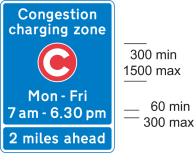 | 1. In the upper panel the time period may be varied 2. In the lower panel— (a) the distance may be varied; (b) “ahead” may be placed centrally below the distance; (c) “ahead” may be omitted and an arrow pointing horizontally to the left or to the right placed centrally below the distance |
| 4 | Diagram 818.7 Advance indication of a congestion charging zone (alternative to item 3) |  | 1. In the upper panel— (a) the amount of the charge may be varied; (b) “day” may be varied to “vehicle”; (c) the time period may be varied 2. In the lower panel— (a) the distance may be varied; (b) “ahead” may be placed centrally below the distance; and (c) “ahead” may be omitted and an arrow pointing horizontally to the left or to the right placed centrally below the distance |
| 5 | Diagram 894 Reminder to drivers within a congestion charging zone in which cameras are used to enforce traffic regulations |  | 1. The “C” symbol may be placed to the left of the camera symbol 2. A legend may be added giving the name, and any logo, of the enforcement authority |
| 6 | Diagram 679 End of congestion charging zone | 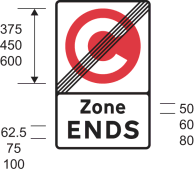 | |
| 7 | Diagram 1068 Road marking indicating the commencement of a congestion charging zone |  | |
| 8 | Diagram 1069 Road marking giving advance warning of a congestion charging zone |  |
PART 4A Provisions applying to signs in Part 4B
PART 4B Signs and markings indicating a low emission zone
Sign table — Schedule 8, Part 4B1 
2 
3 
4 
PART 5 The Schedule 8 General Directions
SCHEDULE 9 
Regulatory signs at junctions and miscellaneous regulatory signs
Regulation 3, Direction 3
PART 1 Provisions applicable to signs in Part 2
I658PART 2 Signs at junctions
(1) Item | (2) Description | (3) Diagram | (4) Permitted sizes | (5) Applicable provisions in Part 8 | (6) Schedule 9 General Directions |
|---|---|---|---|---|---|
| 1 | Diagram 601.1 Vehicular traffic must comply with the requirements specified in paragraph 1 or 2 of Part 7 |  | Sign height 750, 900, 1200 | 1, 2, 7 | 3, 4, 8 |
| 2 | Diagram 602 Vehicular traffic must comply with the requirements specified in paragraph 3 or 4 of Part 7 |  | Sign height 600, 750, 900, 1200, 1500 | 1, 7 | 5, 8 |
| 3 | Diagram 608 Dual carriageway road (associated plate for items 1 and 2) |  | x-height of legend: 50, 62.5, 75, 100, 125 | 10 | |
| 4 | Diagram 778 Open railway level crossing without light signals (associated plate for item 2) |  | Sign height 420, 525, 630 | 11 | |
| 5 | Diagram 778.1 Open tramway level crossing without light signals (associated plate for item 2) |  | Sign height 300, 375, 450 | 11 | |
| 6 | Diagram 611.1 Vehicles entering the junction must comply with the requirements prescribed in paragraph 5 of Part 7 |  | Sign height 600, 750, 900 | 1, 3, 7 | 6, 8 |
PART 3 Provisions applicable to signs in Part 4
I639PART 4 Other regulatory signs
(1) Item | (2) Description | (3) Diagram | (4) Permitted variants | (5) Applicable provisions in Part 8 | (6) Schedule 9 General Directions |
|---|---|---|---|---|---|
| 1 | Diagram 651 Use of verge maintained in mown or ornamental condition by specified traffic prohibited |  | 1. “animals”, or the right hand symbol and “pedestrians”, may be omitted, or that symbol and both words may be omitted 2. The arrow may be varied to point horizontally to the right, or may be omitted | 8 | 1, 13 |
| 2 | Diagram 626.2A Vehicles exceeding the maximum gross weight indicated prohibited from crossing the bridge or other structure with exemption for empty vehicles |  | 1. “18t” may be varied to “3t”, “7.5t”, “10t”, “13t”, “26t” or “33t” 2. “WEAK BRIDGE” may be varied to “WEAK ROAD” 3. The bottom panel may be omitted | 1, 7 | 2 |
| 3 | Diagram 622.10 Vehicles carrying dangerous goods within the tunnel restriction code indicated by the sign prohibited | 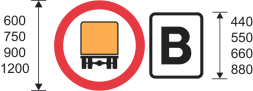 | The tunnel restriction code letter “B” may be varied to “C”, “D” or “E” as appropriate | 7 | 1 |
| 4 | Diagram 784.1 Drivers of large or slow vehicles must stop and telephone in accordance with the provisions of paragraph 6 of Part 7 before using a level crossing |  | The words “must phone” may be varied to “must use SOS phone” | 1, 2, 7 | |
| 5 | Diagram 652 One-way traffic |  | 7 | 1 | |
| 6 | Diagram 960.1 One-way road with a mandatory contraflow cycle lane |  | The number of upward pointing arrows may be varied to indicate the number of lanes available to all traffic | 1 | |
| 7 | Diagram 960.2 One-way road with contraflow pedal cycles and electric scooters being used in a trial |  | 1 | ||
| 8 | Diagram 960 One-way road with a contraflow bus and cycle lane | 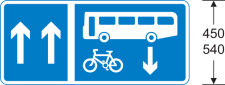 | 1. The number of upward pointing arrows may be varied to indicate the number of lanes available to all traffic 2. The cycle symbol may be omitted and the downward pointing arrow centred below the bus symbol 3. The bus symbol may be varied to the local bus symbol shown in the diagram at item 10 | 1 | |
| 9 | Diagram 959.1 With-flow cycle lane with indication of times of operation |  | 1. In the upper panel— (a) the position of the vertical line and symbol may be varied to reflect the layout of the road marking at item 7 in the sign table in Part 6; and (b) an additional vertical line may be added 2. The time period may be varied 3. The bottom panel may be omitted | ||
| 10 | Diagram 959B Nearside with-flow bus lane, which authorised vehicles, taxis, solo motor cycles , pedal cycles and electric scooters being used in a trial may also use, with indication of times of operation |  | 1. In the upper panel— (a) “authorised vehicles” or “taxi” or both may be omitted; (b) the solo motor cycle symbol may be omitted; (c) the local bus symbol may be varied to the bus symbol shown at item 8; (d) the position of the vertical line and symbols may be varied to reflect the layout of the road marking at item 11 in the sign table in Part 6; and (e) an additional vertical line may be added 2. The time period may be varied 3. The bottom panel may be omitted | 1 | |
| 11 | Diagram 964 End of with-flow bus lane | 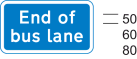 | 1 | ||
| 12 | Diagram 2602.3 The number of a route for pedal cycles and electric scooters being used in a trial forming part of a national or regional cycle route network | 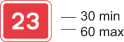 | 1. The route number may be varied as appropriate and may include capital letters 2. The route number may be shown in brackets 3. Additional route numbers, in brackets, may be shown 4. The background colour may be varied to blue when placed on a regional cycle route 5. When indicating a route other than a national or regional cycle route network, the route number, background and border may be in any contrasting colours | 7 | |
| 13 | Diagram 2901 Regulations in force under section 17 of the 1984 Act start to apply to the road at this point |  | 1. The motorway number may be varied as appropriate and may be placed centrally above the motorway symbol 2. The motorway number may be shown in brackets 3. The motorway number may be expressed in the form “A 123 (M)” and “(M)” may be placed centrally below “A 123” | 7 | |
| 14 | Diagram 2930 Regulations referred to in this column in respect of item 13 cease to apply ahead |  | “1 mile” may be varied to “½ mile” | 7 | |
| 15 | Diagram 2931 Regulations referred to in this column in respect of item 13 cease to apply at this point |  | 7 | ||
| 16 | Diagram 2932 Entrance to a motorway service area, maintenance compound or similar facility contained within a length of a motorway and indicating that Regulations in force under section 17 of the 1984 Act cease to apply at this point | 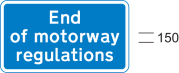 |
PART 5 Provisions applicable to road markings in Part 6
I632PART 6 Regulatory road markings
(1) Item | (2) Description | (3) Diagram | (4) Applicable provisions in Part 8 | (5) Schedule 9 General Directions |
|---|---|---|---|---|
| 1 | Diagram 1002.1 Vehicular traffic must not proceed beyond the line when required to stop by the stop sign |  | 13 | 4 |
| 2 | Diagram 1022 Approach to a road junction or level crossing at or near which is placed the marking at item 1 of this table and the stop sign |  | 13 | 4 |
| 3 | Diagram 1003A Vehicular traffic must give way in accordance with the requirements in paragraph 7 of Part 7 |  | 1, 13 | 3 |
| 4 | Diagram 1023A Approach to a road junction, level crossing or road narrowing at or near which is placed the marking in item 3 or 6 of this table | 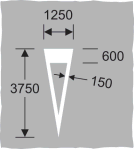 | 13 | 12 |
| 5 | Diagram 1003.4 Marking used in conjunction with the sign at item 6 of the sign table in Part 2 for conveying the requirements in paragraph 5 of Part 7 (Alternative sizes) |  | 4, 13 | 6 |
| 6 | Diagram 1003.3 Vehicular traffic approaching a roundabout with a small central island or approaching a junction indicated by the marking shown in item 5 of this sign table should give way at, or immediately beyond, the line to traffic circulating on the carriageway of the roundabout | 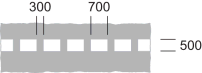 | 13 | |
| 7 | Diagram 1049B Boundary of a mandatory cycle lane or division of a route into that part reserved for pedal cycles and electric scooters being used in a trial and that part reserved for pedestrians conveying the requirements at paragraph 12 of Part 7 (Longitudinal marking) |  | 1, 9 | 1 |
| F9F688 | Diagram 1049.1 Division of a route into that part reserved for pedal cycles and electric scooters being used in a trial and that part reserved for pedestrians (Longitudinal marking) |  | 6 | 1 |
| 9 | Diagram 1003B Cyclists and drivers of electric scooters being used in a trial must give way in accordance with the requirements prescribed in paragraph 8 of Part 7 |  | 1 | |
| 10 | Diagram 1023B Approach to a road junction on a cycle lane or track, or a place where cyclists and drivers of electric scooters being used in a trial must give way to pedestrians, at or near which is also placed the marking at item 9 |  | 14 | |
| 11 | Diagram 1049A Boundary of a bus lane or other designated lane used by motor vehicles (Longitudinal marking) |  | 13 | 1 |
| 12 | Diagram 1050 Direction of possible traffic movements at the end of a nearside with-flow bus lane or other designated lane, or where there is an intermediate discontinuation of the lane on the approach to a junction (alternative types) |  | 1 | |
| 13 | Diagram 1050.1 Direction of possible traffic movements at the end of an off side with-flow bus lane or other designated lane, or where there is an intermediate discontinuation of the lane on the approach to a junction (alternative types) |  | 1 | |
| 14 | Diagram 1048 Traffic lane reserved for buses and other vehicles as indicated on the sign at item 8 or 10 in the sign table in Part 4 | 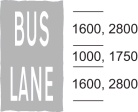 | 1 | |
| 15 | Diagram 1048.5 Road or part of a road with access permitted only for buses and other vehicles when so indicated by any of the signs at items 10, 33 to 35 and 37 to 40 in the sign table in Part 2 of Schedule 3 (Alternative types) |  | 1 | |
| 16 | Diagram 1048.2A Road or part of a road with access permitted only for tramcars | 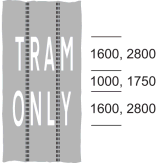 | 1 | |
| 17 | Diagram 1046 No entry for vehicular traffic (Alternative types) |  | 13 | 1 |
| 18 | Diagram 1046.1 Entry by vehicular traffic to a play street restricted (Alternative types) |  | 13 | 1 |
| 19 | Diagram 1036.1 Vehicular traffic must turn left (Alternative types) | 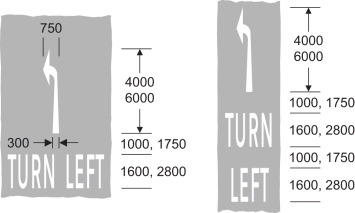 | 13 | 1 |
| 20 | Diagram 1036.2 Vehicular traffic must only proceed ahead (Alternative types) |  | 13 | 1 |
| 21 | Diagram 1037.1 Vehicular traffic must turn right (Alternative types) |  | 13 | 1 |
| 22 | Diagram 1042 Division of traffic lanes on a length of carriageway, or between the main carriageway and slip road, of a motorway or all-purpose dual carriageway road, or part of the carriageway between two lanes at a roundabout which vehicular traffic must not enter except in emergency (alternative types) |  | 1, 12, 13, 14 | |
| 23 | Diagram 1013.1 Alternative methods of indicating to vehicular traffic the requirements and the warning in paragraphs 9 and 10 of Part 7 |  | 1, 2, 10, 13 | |
| 24 | Diagram 1013.5 Division of traffic lanes on a length indicating to vehicular traffic the requirements in paragraph 9 of Part 7 and used in the circumstances for which the signs at items 17 to 20 in the Part 2 sign table in Schedule 11 are used |  | 1, 2, 11, 13 | |
| 25 | Diagram 1043 Marking conveying the requirements in paragraph 11 of Part 7 |  | 1, 5 | 9 |
| 26 | Diagram 1045 Area of carriageway, subject to two-way traffic, at a level crossing which vehicles must not enter in a manner which then causes any part of the vehicle to remain at rest within the marked area due to the presence of stationary vehicles |  | 1, 15 | |
| 27 | Diagram 1045.1 Area of carriageway, subject to one-way traffic, at a level crossing which vehicles must not enter in a manner which then causes any part of the vehicle to remain at rest within the marked area due to the presence of stationary vehicles |  | 1, 16 |
PART 7 The significance of particular signs in Schedule 9
Stop sign
Give way sign
I2265 Priority to right sign
I2276 Permission to cross sign
I297 Give way marking
The requirements conveyed to vehicular traffic on roads by a road marking provided for at item 3 of the sign table in Part 6 of this Schedule are—I308 Cyclists and drivers of electric scooters being used in a trial to give way
A cycle or electric scooter being used in a trial must not be ridden across the transverse line provided for at item 9 of the sign table in Part 6 of this Schedule in a manner or at a time that is likely to endanger any person, or to cause the driver of another vehicle to change its speed or course in order to avoid an accident.No stopping or crossing white line marking
I22911 Box junctions
I3112 Mandatory with flow cycle lanes
PART 8 Provisions applicable to signs in Parts 2, 4 and 6
PART 9 The Schedule 9 General Directions
SCHEDULE 10 
Signs for speed limits
Regulation 3, Direction 3
PART 1 Provisions applying to signs in Part 2
I659PART 2 Signs and road markings indicating speed limits
(1) Item | (2) Description | (3) Diagram | (4) Permitted variants | (5) Applicable provision in Part 3 | (6) Schedule 10 General Directions |
|---|---|---|---|---|---|
| 1 | Diagram 670 Maximum speed limit in mph | 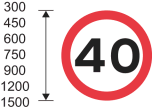 | 1. The numerals may be varied 2. The diameter of the sign may be varied to 1300 mm when displayed as a variable message sign by means of light emitting characters and symbols | 1, 2, 3 | 2, 4, 6 |
| 2 | Diagram 671 National speed limits apply | 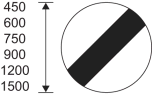 | 2, 3 | 3, 4 | |
| 3 | Diagram 672 Minimum speed limit in mph | 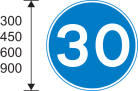 | The numerals may be varied | 2, 3 | 4 |
| 4 | Diagram 673 End of minimum speed limit | 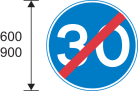 | The numerals may be varied | 2, 3 | 4 |
| 5 | Diagram 674 In relation to England, entrance to a zone where a maximum speed limit of 20 mph is in force | 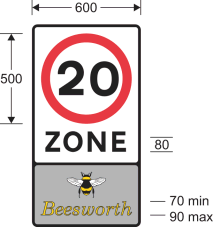 | 1. The place name may be varied, omitted or varied to a road safety slogan 2. The symbol or pictogram in the lower panel may be varied or omitted 3. The place name may be in any style of lettering. Any contrasting colours except red may be used for the place name and the background of that part of the sign. Advertising material or political slogans must not be included on the sign 4 The lower panel may be omitted | 3 | 1, 4 |
| 6 | Diagram 675A In relation to England, end of a 20 mph speed limit zone with indication of maximum speed limit in mph | 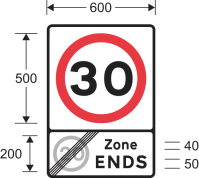 | The numerals in the upper panel may be varied | 3 | 4 |
| 7 | Diagram 675B In relation to England, end of a 20 mph speed limit zone with indication that national speed limits apply | 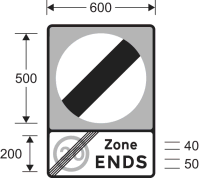 | 3 | 4 | |
| 8 | Diagram 676 Entrance to a zone where a maximum speed limit of 40 mph is in force | 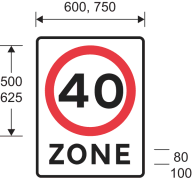 | 2, 3 | 4 | |
| 9 | Diagram 1065 Road marking indicating the maximum speed limit (Alternative sizes) | 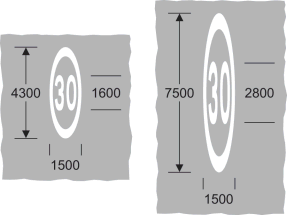 | The numerals may be varied | 4 | 2, 4(a), 5 |
PART 3 Provisions applying to signs in Part 2
PART 4 The Schedule 10 General Directions
SCHEDULE 11 
Signs that give information, are advisory or guide traffic
Regulation 3, Direction 3
PART 1 Provisions applying to signs in Part 2
I633PART 2 F69 Upright signs
(1) Item | (2) Description | (3) Diagram | (4) Variants by reference to Part 5 | (5) Applicable provisions in Part 6 | (6) Schedule 11 General Directions |
|---|---|---|---|---|---|
| 1 | Diagram 811A and 811B Beginning and end of section of road where traffic has priority over vehicles from the opposite direction | 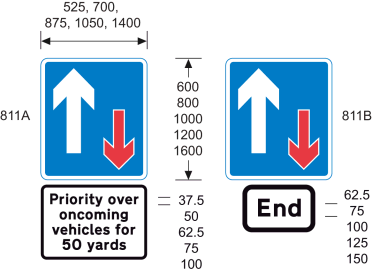 | 1, 2 | ||
| 2 | Diagram 810 One-way traffic (Sign for pedestrians) (Alternative types) | 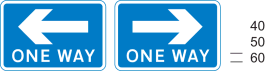 | 5 | ||
| 3 | Diagrams 814.2 and 814.4 Ramped access to or from a pedestrian subway or overbridge | 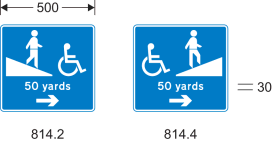 | 1, 2, 4, 5, 54 | 5 | |
| 4 | Diagrams 814.1 and 814.3 Stepped access to and from a pedestrian subway or overbridge | 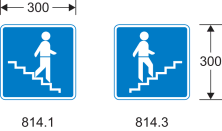 | 4 | 5 | |
| 5 | Diagram 816 No through road for vehicular traffic (Alternative types) | 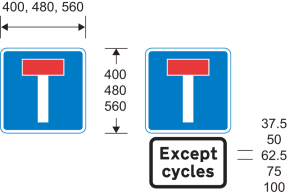 | |||
| 6 | Diagram 816.1 Alternative to the sign shown at item 5 with a street nameplate | 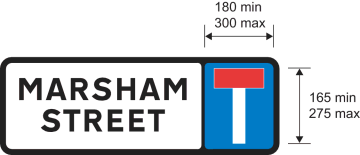 | 7 | 5 | |
| 7 | Diagram 817 No through road for vehicular traffic in direction indicated from junction ahead (Alternative types) | 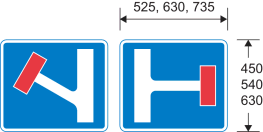 | 6 | ||
| 8 | Diagram 821 Road ahead only wide enough for one line of vehicles, and providing information about passing places (Alternative types) | 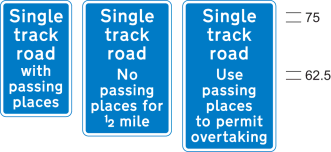 | 1 | ||
| 9 | Diagram 822 Passing place on narrow road | 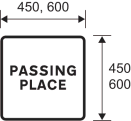 | |||
| 10 | Diagrams 892 and 893 Name and length of a tunnel on a motorway (892) or all‑purpose road (893) | 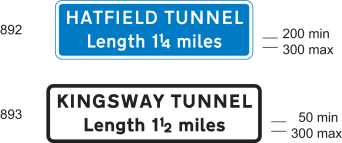 | 8 | ||
| 11 | Diagram 818.1 Section of dual carriageway road ahead | 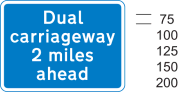 | 1, 2 | ||
| 12 | Diagram 818.1A Distance over which a short length of dual carriageway road beginning directly ahead extends (Alternative types) | 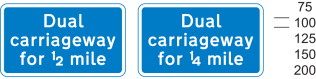 | |||
| 13 | Diagram 820.1 Absence of hard shoulder for the distance shown (Alternative types) | 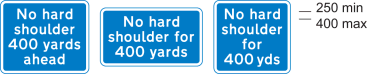 | 1 | ||
| 14 | Diagrams 873 and 874 Additional traffic joining from the left or right ahead (diagram shows blue background – for use on motorways) | 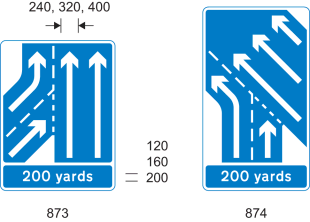 | 1, 2, 6, 26, 27 | ||
| 15 | Diagram 872.1 The number of traffic lanes reduces ahead (diagram shows blue background – for use on motorways) (Alternative types) | 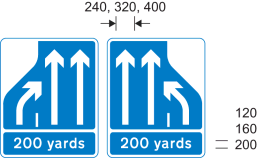 | 1, 2, 6, 26, 27 | ||
| 16 | Diagram 887 Overtaking lane ahead | 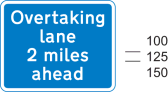 | 1, 2 | ||
| 17 | Diagram 888 Indication of length of road over which an overtaking lane is available on a single carriageway road, with a single traffic lane in the opposite direction (diagram shows green background – for use on primary routes) | 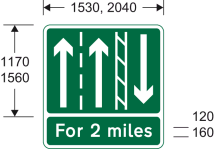 | 1, 27 | ||
| 18 | Diagram 889 Indication that only one lane of traffic, with no overtaking, is available on a single carriageway road with two traffic lanes in the opposite direction (diagram shows green background – for use on primary routes) | 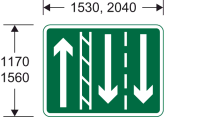 | 27 | ||
| 19 | Diagram 890 Distance ahead to a point where an overtaking lane ends on a single carriageway road (diagram shows green background – for use on primary routes) | 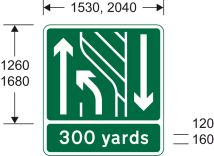 | 1, 2, 27 | ||
| 20 | Diagram 891 Distance ahead to a point where an overtaking lane ends on a single carriageway road on the approach to a dual carriageway road with only one traffic lane in each direction (diagram shows green background – for use on primary routes) | 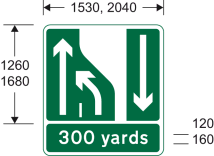 | 1, 2, 27 | ||
| 21 | Diagrams 823, 824 and 825 Distance in hundreds of yards to a roundabout or the next point at which traffic may leave a route (diagram shows blue background – for use on motorways) | 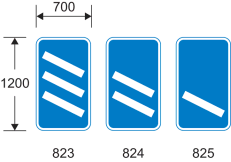 | 4, 26, 27 | ||
| 21A | Diagrams 823.1, 824.1 and 825.1 Distance in hundreds of yards to the point that a reduced maximum speed limit begins (diagram shows dark green background for use on primary routes) |  | 4, 59, 60 | 16 | |
| 22 | Diagram 877 Appropriate traffic lanes for different manoeuvres at a junction ahead (diagram shows white background – for use on non-primary routes) (Alternative types) | 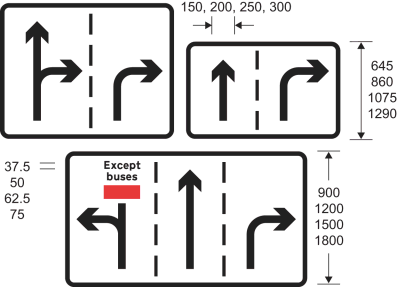 | 9, 26, 28 | ||
| 23 | Diagram 820 Route unsuitable for type of vehicle indicated (Alternative types) | 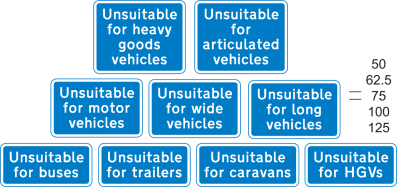 | 5(1) | ||
| 24 | Diagram 820A Road unsuitable for heavy goods vehicles (Alternative types) | 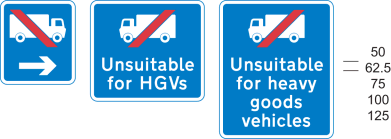 | 4, 5(1) | ||
| 25 | Diagram 829.5 Area where police carry out checks on the speed of vehicles | 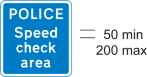 | |||
| 26 | Diagram 829.6 Waiting place for police or authorised vehicles only (Alternative types) |  | |||
| 27 | Diagram 881 | 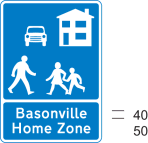 | 24 | ||
| 28 | Diagram 882 End of a home zone indicated by the sign at item 27 | 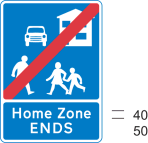 | |||
| 29 | Diagram 886 Road ahead where motorists, cyclists , drivers of electric scooters being used in a trial and pedestrians should expect to share the same space | 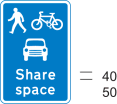 | |||
| 30 | Diagram 884 Start of a quiet lane in England designated under section 268 of the Transport Act 2000 | 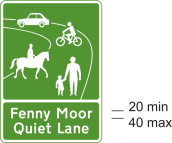 | 24 | ||
| 31 | Diagram 885 End of designated quiet lane in England | 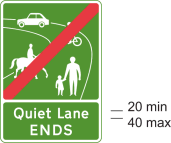 | |||
| 32 | Diagram 883 Indication of the start of area with traffic calming features (within the meaning of paragraph 1(3) of the Schedule 10 General Directions) | 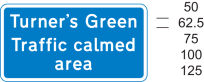 | 1, 5(1), 24 | ||
| 32A | Diagram 883.1 In relation to Wales, end of traffic calmed area |  | |||
| 33 | Diagram 953.3 Entrance to a bus station, depot or garage |  | 5 | ||
| 34 | Diagram 962 Bus lane or lanes on a road at junction ahead, with indication of times of operation (Alternative types) | 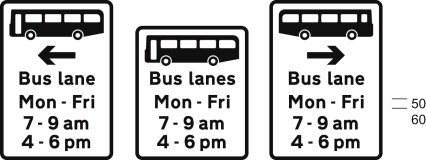 | 10 | ||
| 35 | Diagram 962.1 Cycle lane on a road at junction ahead or, if applicable, a cycle track crossing road, or a way that would be a cycle track but for it being accessible, under a temporary statutory provision, by electric scooters being used in a trial, with indication of times of operation | 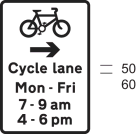 | 4, 10, 12 | ||
| 36 | Diagram 962.2 Contraflow bus lane ahead on a road at a junction which pedal cycles and electric scooters being used in a trial may also use (Alternative types) | 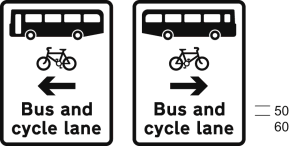 | |||
| 37 | Diagram 958 With-flow bus lane ahead which authorised vehicles, solo motor cycles, pedal cycles , electric scooters being used in a trial and taxis may also use, with indication of times of operation and where the pedal cycle symbol represents, where relevant, electric scooters being used in a trial | 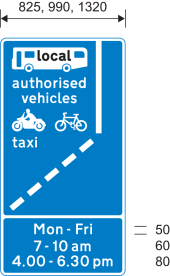 | 10, 11, 13, 14 | ||
| 38 | Diagram 958.1 With-flow mandatory cycle lane ahead, with indication of times of operation | 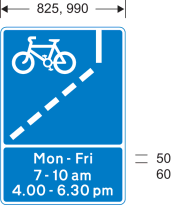 | 10, 14 | ||
| 39 | Diagram 2602.2 Numbered route for pedal cycles and electric scooters being used in a trial forming part of a regional (blue number patch) or national (red number patch) cycle route network (Alternative types) |  | 25 | 5 | |
| 40 | Diagram 963 Direction in which pedestrians should look for approaching traffic when crossing a bus lane (Alternative types) | 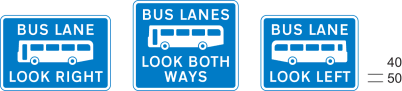 | 5 | ||
| 41 | Diagram 963.1 Direction in which pedestrians should look for approaching pedal cycles and electric scooters being used in a trial when crossing a cycle lane or, if applicable, cycle track, or a way that would be a cycle track but for it being accessible, under a temporary statutory provision, by electric scooters being used in a trial (Alternative types) | 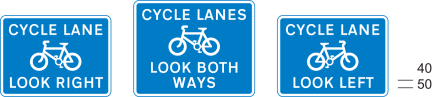 | 15 | 5 | |
| 42 | Diagram 963.2 Direction in which pedestrians should look for approaching traffic when crossing a contraflow bus lane which pedal cycles and electric scooters being used in a trial may also use (Alternative types) | 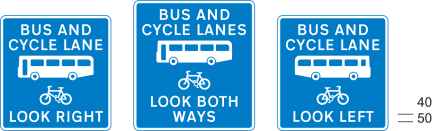 | 5 | ||
| 43 | Diagram 963.3 Direction in which pedestrians should look for approaching tramcars when crossing a tramway (Alternative types) | 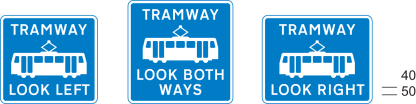 | 5 | ||
| 44 | Diagram 967 Route recommended for pedal cycles and electric scooters being used in a trial on the main carriageway of a road | 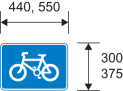 | 5 | ||
| 45 | Diagram 965 End of cycle lane, track or route | 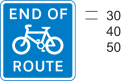 | 5 | ||
| 46 | Diagram 966 Pedal cyclists and drivers of electric scooters being used in a trial to rejoin main carriageway or dismount at the end of, or at a break in, a cycle track or route (Alternative types) |  | 5 | ||
| 47 | Diagram 968 and 968.1 Parking place for pedal cycles | 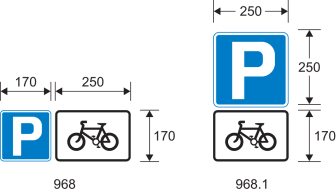 | 5 | ||
| 48 | Diagram 857.1 Information relating to a taxi rank for the number of taxis specified | 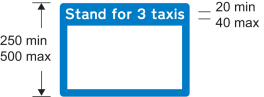 | 16 | 5 | |
| 49 | Diagram 2934 Drivers should keep or check their distance from the vehicle in front (Alternative types) |  | |||
| 50 | Diagram 2933 Drivers should keep a distance of two chevron markings (the markings provided for at item 34 of the table in Part 4) from the vehicle in front | 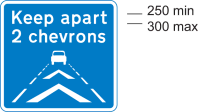 | |||
| 51 | Diagrams 2032 and 2130 Primary route (2032) or non‑primary route (2130) forming part of a ring road | 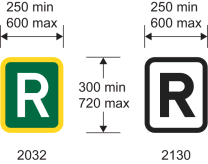 | |||
| 52 | Diagram 972 Stopping place for buses used for carrying tourists to allow passengers to take photographs | 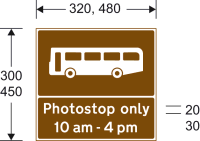 | 17, 34 | 5 | 2 |
| 53 | Diagram 857A Information for pedestrians about tourist destinations and leisure facilities in a nearby place or area | 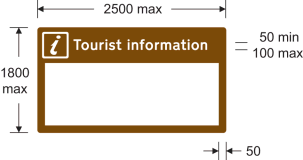 | 18, 19 | 5 | |
| 54 | Diagram 857B Information for pedestrians about tourist destinations and leisure facilities in a nearby place or area | 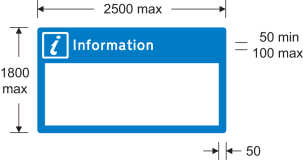 | 18 | 5 | |
| 55 | Diagram 2501 Distance to a parking place ahead | 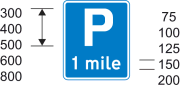 | 1 1A , 5(1) | ||
| 56 | Diagram 801 Parking place | 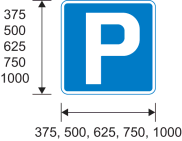 | |||
| 57 | Diagram 2713.1 Distance ahead to emergency telephone in a parking place or emergency lay‑by (Alternative types) | 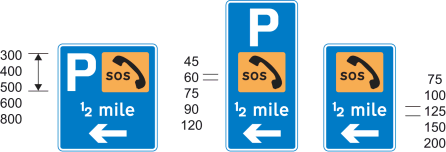 | 1, 2, 5 | ||
| 58 | Diagram 2713 Direction to nearest emergency telephone on same side of the road(diagram shows blue background – for use on motorways) (Alternative types) | 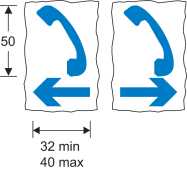 | 53 | 5 | |
| 59 | Diagram 2714 Side of emergency telephone box (Alternative types) | 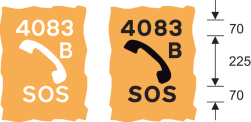 | 29, 55 | 2, 6 | |
| 60 | Diagram 2715 Back of emergency telephone box (Alternative types) | 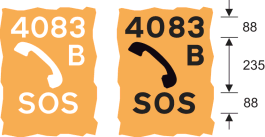 | 29, 55 | 2, 6 | |
| 61 | Diagram 2718 Route number and location reference | 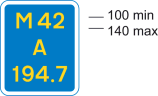 | 29 | ||
| 62 | Diagram 2712 Location of fire rendezvous point (Alternative types) | 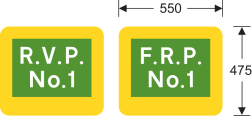 | 20 | 5 | |
| 63 | Diagram 878 Area in which enforcement cameras are in use (Alternative types) | 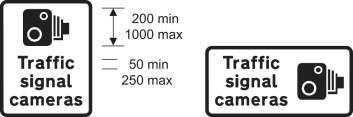 | 21 | ||
| 64 | Diagram 880 In relation to England, speed camera ahead on a lit road and reminder of 30 mph speed limit | 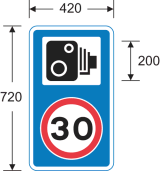 | 21(2) | ||
| 64A | Diagram 880.2 In relation to Wales, speed camera ahead on a lit road and reminder of 20 mph speed limit |  | 21 (2) | ||
| 65 | Diagram 880.1 Speed camera ahead on an unlit road and reminder that a national speed limit applies | 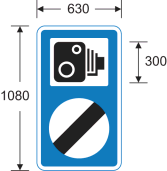 | 21(2) | ||
| 66 | Diagrams 827.1, 827.2 and 827.3 Hospital ahead | 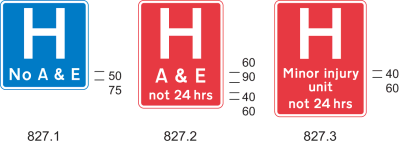 | 22 | ||
| 67 | Diagram 775 Vehicular traffic must not stop within the area of a railway or tramway level crossing | 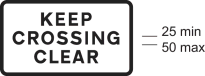 | |||
| 68 | Diagram 783 Drivers of long low, large or slow vehicles must telephone to obtain permission before using a railway or tramway level crossing (Alternative types) |  | |||
| 69 | Diagram 785.1 Name of level crossing and details of telephone number for contacting railway or tramway operator | 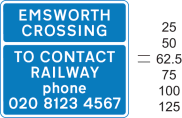 | 23 | ||
| 70 | Diagram 786 Place where large, slow or long low vehicles should wait near a railway or tramway level crossing while the driver obtains permission by telephone to cross or confirms he or she has crossed (Alternative types) | 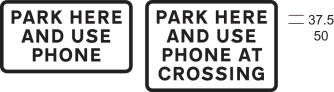 | 56 | ||
| 71 | Diagram 787 Site of telephone or emergency telephone at or near a railway or tramway level crossing (Alternative types) | 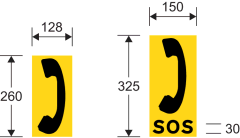 | |||
| 72 | Diagram 788 Direction to telephone or emergency telephone at or near a railway or tramway level crossing (Alternative types) | 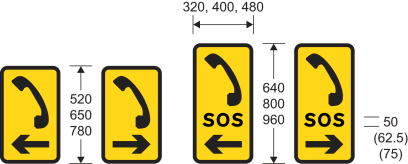 | |||
| 73 | Diagram 611 Vehicular traffic may reach the same destination by proceeding either side of the sign | 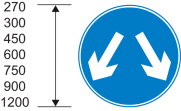 | 1, 4 | 1 | |
| 74 | Diagrams 833, 834, 835 and 836 Signs regulating the movement of vehicular traffic into and out of premises with more than one access to a road | 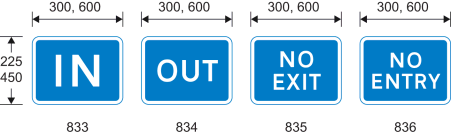 | 5 | ||
| 75 | Traffic mirror for providing additional visibility (not for use with traffic signals) | The mirror must be convex and any frame must be of a single colour, being black, grey, yellow or white | 13 | ||
| 76 | Diagram 970 Stopping place for buses | 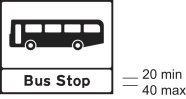 | 30, 31, 34 | 5 | 2 |
| 77 | Diagrams 973.2 and 973.3 Stopping place for buses operated by or on behalf of, or under agreement with, Transport for London | 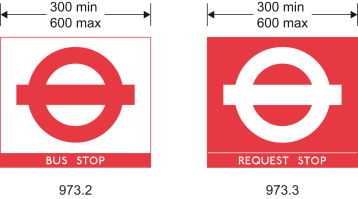 | 30, 32, 34 | 5 | 2 |
| 78 | Diagram 971 Stopping place for tramcars | 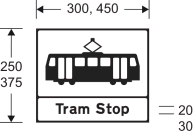 | 30, 33, 34 | 5 | 2 |
| 79 | Diagram 2928 Motorway sign indicating the boundary of an administrative area, a ceremonial area or an historic county area (Alternative types) | 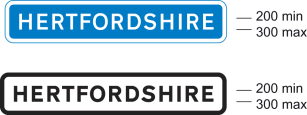 | 35 | ||
| 80 | Diagram 2401 Primary or non‑primary route sign indicating the boundary of an administrative area, a ceremonial area or an historic county area | 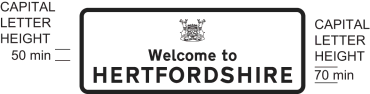 | 30, 36 | 5 | |
| 81 | Diagram 2402.1 Primary or non‑primary route sign indicating the name of a city, town or village commencing immediately ahead (Alternative types) | 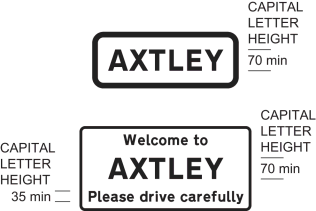 | 37 | 5 | 3 |
| 82 | Diagram 2403.1 Primary or non-primary route sign indicating the name of a city, town or village immediately ahead, together with extra local information | 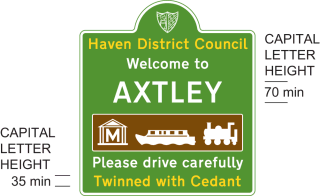 | 30, 38 | 5 | 4 |
| 83 | Diagram 2404 Primary or non-primary route sign indicating the name of a city, town, village, an administrative area, a ceremonial area or an historic county area immediately ahead, together with phrase and image that is representative of the city, town, village or area | 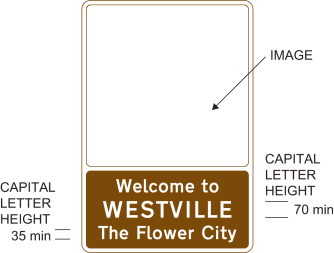 | 39 | 5 | 4 |
| 84 | Diagram 976 Maximum speed limit for tramcars in kilometres per hour | 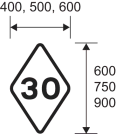 | 40 | 5 | |
| 85 | Diagram 864.2 Vehicle testing station approved by the Driver and Vehicle Standards Agency | 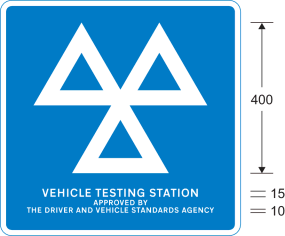 | 58 | 5 | |
| 86 | Diagram 865 Motor cycle test centre |  | 5 |
PART 3 Provisions applicable to markings in Part 4
I634PART 4 F70Road markings 
(1) Item | (2) Description and diagram | (3) Permitted or required variants in Part 5 | (4) Requirements applicable in Part 6 |
|---|---|---|---|
| 1 | Diagram 1003.1 Vehicular traffic approaching a roundabout should give way at or immediately beyond the line to vehicular traffic circulating on the carriageway of the roundabout 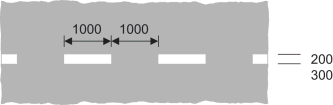 | 7 | |
| 2 | Diagram 1004 Vehicular traffic should not cross or straddle the line unless it is safe to do so and when the line is used to indicate a cycle lane, motor vehicles should not enter that lane unless it is clear of pedal cycles and electric scooters being used in a trial (Longitudinal marking) 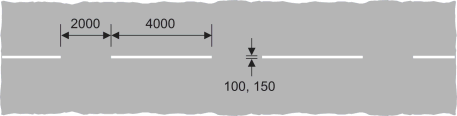 | 57 | 7, 8, 10, 12 |
| 3 | Diagram 1004.1 Vehicular traffic should not cross or straddle the line unless it is safe to do so and when the line is used to indicate a cycle lane, motor vehicles should not enter that lane unless it is clear of pedal cycles and electric scooters being used in a trial (Longitudinal marking) 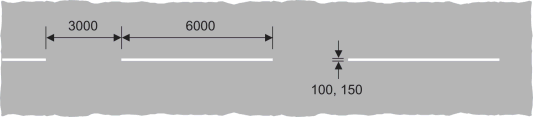 | 7, 8, 10, 12 | |
| 4 | Diagram 1005 Division of carriageway into traffic lanes on part of the carriageway where vehicles normally proceed in the same direction other than at places where the marking at item 2 of this table is used (Longitudinal marking) 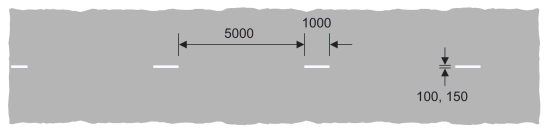 | 7, 8, 10, 12 | |
| 5 | Diagram 1005.1 As the marking at item 4 other than at places where the marking at item 3 is used (Longitudinal marking) 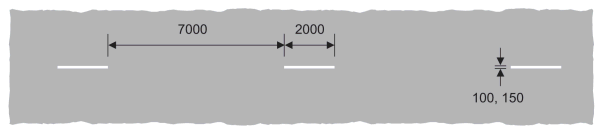 | 7, 8, 10, 12 | |
| 6 | Diagram 1008 Division between opposing flows of traffic on a carriageway other than at places where the marking at item 2 is used (Longitudinal marking) 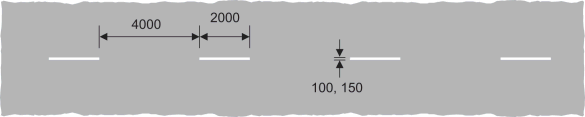 | 57 | 7, 8, 10, 12 |
| 7 | Diagram 1008.1 Division between opposing flows of traffic on a carriageway other than at places where the marking at item 3 is used (Longitudinal marking) 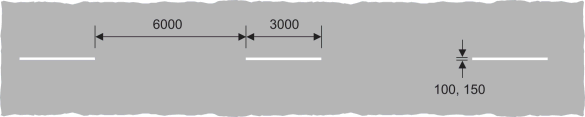 | 7, 8, 10, 12 | |
| 8 | Diagram 1009A Edge of the carriageway at a road junction, exit from a private drive onto a public road, or the start of a cycle lane (Longitudinal marking) 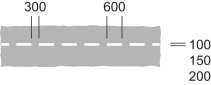 | 7 | |
| 9 | Diagram 1009B Edge of the carriageway at a junction of a cycle track , or a way that would be a cycle track but for it being accessible, under a temporary statutory provision, by electric scooters being used in a trial, and another road (Longitudinal marking) 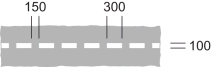 | ||
| 10 | Diagram 1010 (a) edge of the carriageway at a road junction or a lay-by, or at an exit from a private drive onto a public road; (b) the start of a traffic lane, the boundary of which is indicated by the road marking shown at item 11 of the table in Part 6 of Schedule 9; (c) when used in conjunction with the road marking at item 4 of the sign table in Part 4 of Schedule 2, the most suitable path to be taken by high vehicles under a low bridge or to avoid an overhanging structure; (d) when laid alongside rails used by tramcars, the edge of the part of the carriageway used by the tramcars; (e) the division between the main carriageway and a traffic lane which leaves the main carriageway at a junction ahead; (f) the boundary between the main carriageway and either a diverging or merging traffic lane at a road junction; (g) the boundary between an emergency refuge area and either an actively managed hard shoulder or the edge of carriageway of a motorway; or (h) the division between the main carriageway and a cycle lane through a junction (Longitudinal marking) 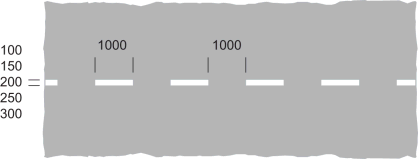 | 41 | 7, 8, 11, 12 |
| 11 | Diagram 1012.1 (a) edge of the carriageway available for through traffic other than at a road junction, an exit from a private drive onto a public road, lay-by or emergency refuge area; (b) the back edge of a hard shoulder; (c) the edge of a footway where it passes over a railway or tramway level crossing; or (d) the boundary between the carriageway of a motorway and an actively managed hard shoulder (Longitudinal marking) 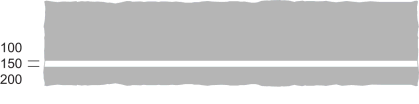 | 7, 9, 11, 12 | |
| 12 | Diagram 1012.2 (a) edge of carriageway of a motorway other than at an emergency refuge area or a junction with a slip road; or (b) the back edge of an actively managed hard shoulder; and, in both cases, incorporating an audible and tactile warning (Longitudinal marking) 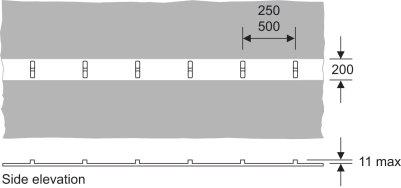 | 42 | 3, 7, 9, 11, 12 |
| 13 | Diagram 1012.3 Edge of carriageway of a road that is not a motorway and which has hard strips or hard shoulders, other than at a junction with a slip road, and incorporating an audible and tactile warning (Longitudinal marking) 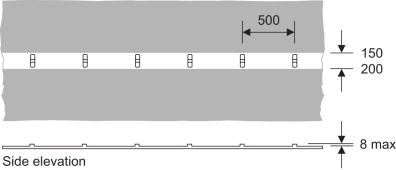 | 43 | 3, 7, 9, 11, 12 |
| 14 | Diagram 1014 (a) Direction in which vehicular traffic should pass a road marking shown at item 7, 11 or 23 of the sign table in Part 6 of Schedule 9 or at item 23, 24 or 25 of the sign table in Part 4 of this Schedule; (b) obstruction on the carriageway ahead; (c) reduction in the number to traffic lanes in the carriageway ahead; or (d) path to be taken by vehicular traffic to avoid a route available for tramcars only (Longitudinal marking) (Alternative types) 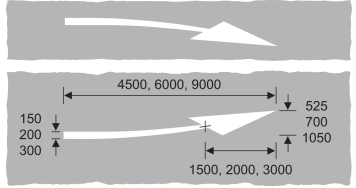 | 7 | |
| 15 | Diagram 1024 Vehicular traffic should proceed with caution because of potential danger ahead 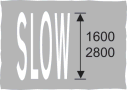 | 7 | |
| 16 | Diagram 1026 Part of the carriageway which should be kept clear of stationary vehicles (Alternative types) 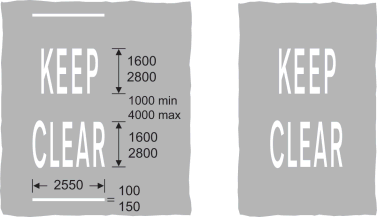 | ||
| 17 | Diagram 1026.1 Part of the carriageway outside a vehicular entrance to adjacent premises or a private drive, or where the kerb is dropped to provide a convenient crossing place for pedestrians, which should be kept clear of waiting vehicles 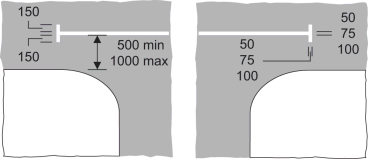 | ||
| 18 | Diagram 1029 Direction in which pedestrians should look for approaching traffic 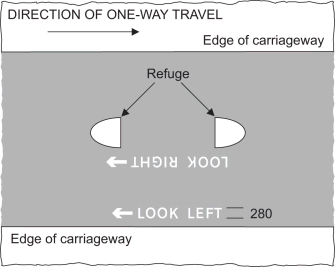 | 44 | |
| 19 | Diagram 1035 Appropriate traffic lanes for different destinations (Alternative types) 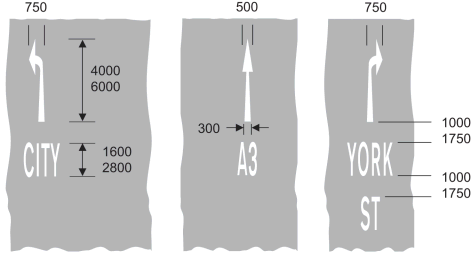 | 45 | |
| 20 | Diagram 1038 Appropriate traffic lanes for different manoeuvres (Longitudinal marking) (Alternative types) 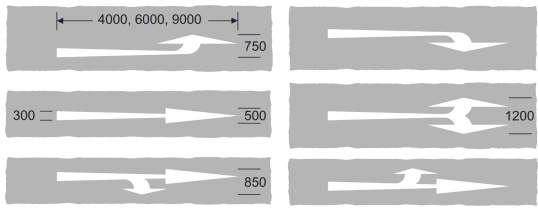 | ||
| 21 | Diagram 1038.1 Appropriate direction to be taken by traffic turning within a junction (Alternative types) 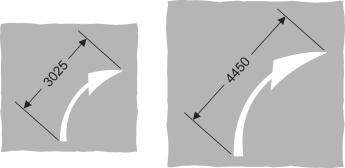 | 46 | |
| 22 | Diagram 1039 Place where traffic streams divide or bifurcate (Longitudinal marking) (Alternative types) 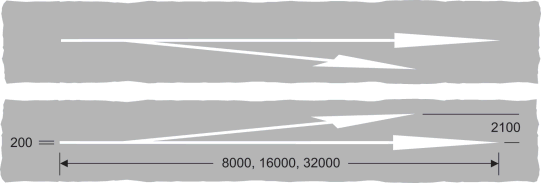 | 7 | |
| 23 | Diagram 1040 Part of the carriageway which vehicular traffic should not enter unless it is seen by the driver to be safe to do so (Alternative types) 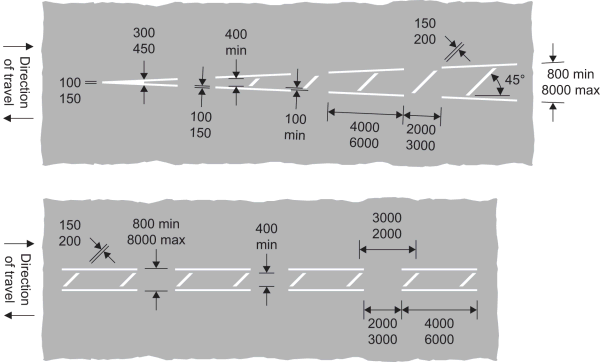 | 47 | 7, 8, 10, 12 |
| 24 | Diagram 1040.3 Reduction in the number of lanes, or area not available to traffic, on the main carriageway or slip road of a motorway or all-purpose dual carriageway road 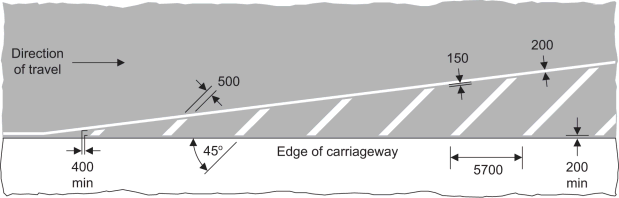 | 48 | 7, 8, 11, 12 |
| 25 | Diagram 1040.4 Part of the carriageway adjacent to the edge which vehicular traffic should not enter unless it is seen by the driver to be safe to do so 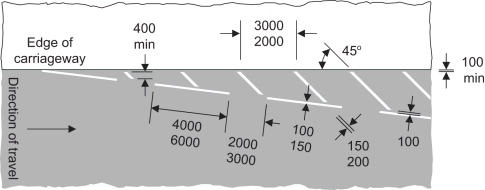 | 49 | 7, 8, 11, 12 |
| 26 | Diagram 1040.5 End of a hard shoulder 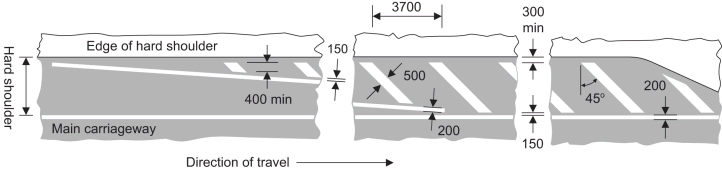 | 50 | 7, 8, 11, 12 |
| 27 | Diagram 1041 Part of the carriageway where vehicular traffic passes in the same direction on both sides of the marking, and should not enter the area covered by the marking unless it is seen by the driver to be safe to do so (Alternative types) 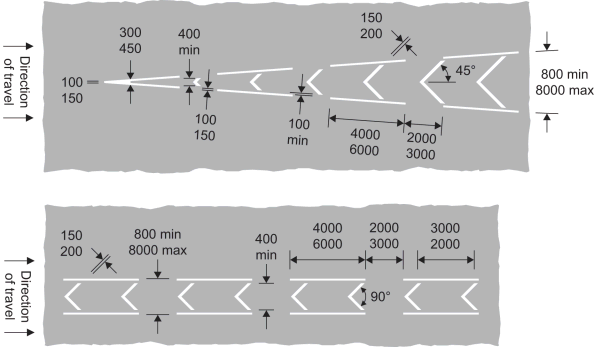 | 51 | 7, 8, 11, 12 |
| 28 | Diagram 1057 Cycle lane, track , route, or a way that would be a cycle track but for it being accessible, under a temporary statutory provision, by electric scooters being used in a trial (Alternative types) 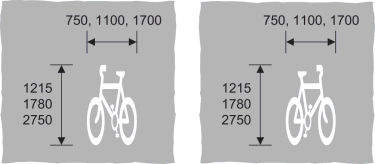 | ||
| 29 | Diagram 1057.1 Number of a cycle route (Alternative types) 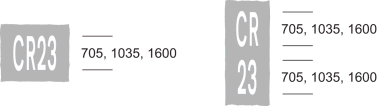 | 29 | |
| 30 | Diagram 1058 End of a cycle lane, track , route, or a way that would be a cycle track but for it being accessible, under a temporary statutory provision, by electric scooters being used in a trial 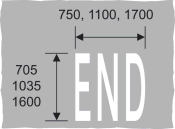 | ||
| 31 | Diagram 1058.1 Pedal cycles and electric scooters being used in a trial should proceed with caution because of potential danger ahead 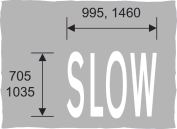 | ||
| 32 | Diagram 1059 Directions in which pedal cycles and electric scooters being used in a trial should travel along a cycle lane, track , route, or a way that would be a cycle track but for it being accessible, under a temporary statutory provision, by electric scooters being used in a trial (Alternative types) 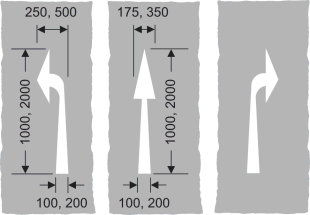 | ||
| 33 | Diagram 1062 Road hump 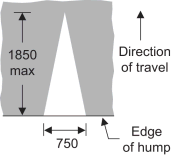 | 7 | |
| 34 | Diagram 1064 Marking used in conjunction with the sign shown at item 50 of the sign table in Part 2 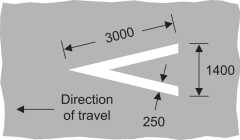 | 7 | |
| 35 | Diagram 1067 Transverse yellow bar markings for use only on approaches to roundabouts on motorways and dual carriageway roads subject to the national speed limit, either on the main carriageway or on an exit slip road 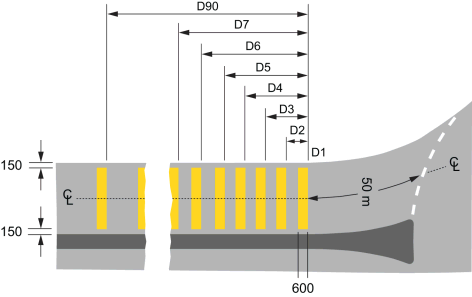 | 52 | 14, 15 |
| 36 | Diagram 1066 Edge of part of the road used by tramcars (Longitudinal marking) 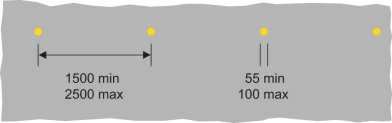 |
PART 5 Permitted variants of the signs in Parts 2 and 4
PART 6 Requirements applying to signs in Parts 2 and 4
| Bar no. | D2 | D3 | D4 | D5 | D6 | D7 | D8 | D9 | D10 | D11 | D12 | D13 | D14 | D15 | |
| Distance to D1 (m) | 2.75 | 5.50 | 8.25 | 11.05 | 13.90 | 16.80 | 19.70 | 22.60 | 25.55 | 28.55 | 31.60 | 34.65 | 37.70 | 40.80 | |
| Bar no. | D16 | D17 | D18 | D19 | D20 | D21 | D22 | D23 | D24 | D25 | D26 | D27 | D28 | D29 | D30 |
| Distance to D1 (m) | 43.95 | 47.15 | 50.35 | 53.55 | 56.80 | 60.10 | 63.45 | 66.80 | 70.15 | 73.60 | 77.05 | 80.55 | 84.10 | 87.65 | 91.30 |
| Bar no. | D31 | D32 | D33 | D34 | D35 | D36 | D37 | D38 | D39 | D40 | D41 | D42 | D43 | D44 | D45 |
| Distance to D1 (m) | 94.95 | 98.65 | 102.40 | 106.15 | 110.00 | 113.85 | 117.75 | 121.70 | 125.65 | 129.70 | 133.75 | 137.85 | 142.00 | 146.15 | 150.40 |
| Bar no. | D46 | D47 | D48 | D49 | D50 | D51 | D52 | D53 | D54 | D55 | D56 | D57 | D58 | D59 | D60 |
| Distance to D1 (m) | 154.65 | 158.95 | 163.35 | 167.75 | 172.25 | 176.75 | 181.30 | 185.95 | 190.60 | 195.35 | 200.10 | 204.90 | 209.80 | 214.70 | 219.70 |
| Bar no. | D61 | D62 | D63 | D64 | D65 | D66 | D67 | D68 | D69 | D70 | D71 | D72 | D73 | D74 | D75 |
| Distance to D1 (m) | 224.70 | 229.80 | 234.90 | 240.10 | 245.40 | 250.70 | 256.10 | 261.50 | 267.00 | 272.60 | 278.20 | 283.90 | 289.60 | 295.45 | 301.30 |
| Bar no. | D76 | D77 | D78 | D79 | D80 | D81 | D82 | D83 | D84 | D85 | D86 | D87 | D88 | D89 | D90 |
| Distance to D1 (m) | 307.25 | F104313.30 | 319.35 | 325.55 | 331.75 | 338.15 | 344.65 | 351.35 | 358.30 | 365.50 | 373.20 | 380.90 | 388.60 | 396.25 | 403.95 |
| Bar no. | D2 | D3 | D4 | D5 | D6 | D7 | D8 | D9 | D10 | D11 | D12 | D13 | D14 | D15 | |
| Distance to D1 (m) | 2.75 | 5.55 | 8.45 | 11.35 | 14.35 | 17.40 | 20.50 | 23.70 | 26.90 | 30.20 | 33.55 | 37.00 | 40.50 | 44.05 | |
| Bar no. | D16 | D17 | D18 | D19 | D20 | D21 | D22 | D23 | D24 | D25 | D26 | D27 | D28 | D29 | D30 |
| Distance to D1 (m) | 47.70 | 51.45 | 55.30 | 59.20 | 63.15 | 67.20 | 71.35 | 75.60 | 79.90 | 84.30 | 88.80 | 93.45 | 98.20 | 103.00 | 107.90 |
| Bar no. | D31 | D32 | D33 | D34 | D35 | D36 | D37 | D38 | D39 | D40 | D41 | D42 | D43 | D44 | D45 |
| Distance to D1 (m) | 112.90 | 118.00 | 123.30 | 128.70 | 134.20 | 139.80 | 145.50 | 151.35 | 157.40 | 163.60 | 170.00 | 176.70 | 183.90 | 191.60 | 199.30 |
PART 7 The Schedule 11 General Directions
SCHEDULE 12 
Directional signs
Regulation 3, Direction 3
PART 1 General provisions applying to Parts 2 to 20
I640PART 2 Sign background for directional signs for motorways, primary routes, non-primary routes, cyclists and pedestrians
(1) Item | (2) Description | (3) Sign background | (4) Height of legend and variants |
|---|---|---|---|
| 1 | Sign placed on or near a motorway or placed on or near another road at a junction indicating a route leading directly to a motorway (Type A and B) |  | An x-height that is not less than 100 mm and not more than 400 mm |
| 2 | Sign placed on or near a primary route (Type A and B) |  | An x-height that is not less than 50 mm and not more than 300 mm |
| 3 | Sign placed on or near a non-primary route (Type A and B) |  | An x-height that is not less than 50 mm and not more than 300 mm |
| 4 | Sign placed on a motorway, primary or non-primary route showing only parking place destinations (Type A and B) |  | An x-height that is not less than 50 mm and not more than 400 mm |
| 5 | Sign placed on a motorway, primary or non-primary route showing only tourist destinations or leisure facilities (Type A and B) |  | An x-height that is not less than 50 mm and not more than 400 mm |
| 6 | Sign placed on a primary or non-primary route showing only Ministry of Defence establishments (Type A and B) |  | An x-height that is not less than 50 mm and not more than 300 mm |
| 7 | Sign placed on a motorway, primary or non-primary route showing only recommended routes for goods vehicles ahead (Type A and B) |  | An x-height that is not less than 50 mm and not more than 400 mm |
| 8 | Sign placed on a road, other than a motorway, showing routes for cyclists and drivers of electric scooters being used in a trial (Type A and B) |  | 1. An x-height that is not less than 25 mm and not more than 60 mm 2. The background may be varied to brown when the sign shows only tourist destinations or leisure facilities |
| 9 | Sign placed on a road, other than on a motorway, showing routes for pedestrians or equestrians (Type A and B) | | 1. An x-height that is not less than 25 mm and not more than 60 mm 2. The background, border and any chevron, legend, symbol or logo may be in any contrasting colours 3. The border, chevron or both may be omitted 4. The shape of the pointed end of diagram B may be varied |
PART 3 Legends that may be shown on signs in Part 2
(1) Item | (2) Description | (3) Legends, restrictions and connected provisions |
|---|---|---|
1 | Destination, direction or type of route | A legend provided for at entry 3 of this item must only be used on a sign with a background provided for at item 9 of the sign table in Part 2. |
2 | Indication of alternative routes | A legend provided for at this item must only be used together with a legend provided for at item 1 or 3 of this table |
3 | Additional legends for signs showing only tourist destinations and leisure facilities | A legend provided for at this item may be used on its own or together with a legend provided for at item 1, 2, 5, 6 or 9 of this table but only on a background provided for at item 5, 8 or 9 of the Part 2 sign table |
4 | Route identification | A legend provided for in this item may be used on its own (except entries 7 and 8) or together with a legend provided for at item 1 of this table. A legend provided for at entries 1 to 7 may be placed on a background provided for at item 1, 2, 3 or 7 of the Part 2 sign table |
5 | Distances | A legend provided for at this item may only be used on a sign that includes a legend provided for at item 1 or 3 of this table except that where the distance to a junction forms part of an overhead sign assembly it may be shown as a separate sign |
6 | Journey times | A legend provided for at this item may only be used together with a legend provided for at item 1 or 3 of this table but only on a background provided for at item 8 or 9 of the Part 2 sign table |
7 | Junction identification | A legend provided for at this item may only be used on a sign that includes a legend provided for at item 1 of this table |
8 | Route to be followed |
|
9 | Type of road | The legend provided for at this item may only be used together with a legend provided for at item 1 or 3 of this table The legend “Single track road” may be placed on a directional sign |
PART 4 Provisions applicable to Part 5
I660PART 5 Arrows and lane marking symbols that may be incorporated in diagram A signs
(1) Item | (2) Description | (3) Arrow and lane marking symbols | (4) Permitted background (by reference to item number in the Part 2 sign table) | (5) Variants |
|---|---|---|---|---|
| 1 | Arrow indicating the direction of a route (Alternative types) |  | 1 to 9 | 1. The direction in which the arrow shown by diagram A points may be varied 2. The arrow must be white when appearing on the background provided for at item 1, 2, 5, 7 or 8 of the table in Part 2 of this Schedule 3. The arrow must be red when appearing on the background provided for at item 6 of the sign table in Part 2 4. The arrow must be in any contrasting colour when appearing on the background provided for at item 9 of the sign table in Part 2 |
| 2 | Arrow indicating a U-turn at a roundabout ahead |  | 2 to 7 | 1. The arrow must be white when appearing on a background provided for at item 2, 5 or 7 of the sign table in Part 2 of this Schedule 2. The arrow must be red when appearing on a background provided for at item 6 of the sign table in Part 2 |
| 3 | Indication of appropriate traffic lanes and direction in which to turn at a junction ahead (destinations placed above the arrows and horizontal bars) |  | 1 to 7 | 1. The number of traffic lanes and arrows, the widths of individual lanes and the lengths of horizontal bars may be varied as appropriate 2. The horizontal bars must be omitted where only one lane leads to a particular destination 3. The number of marks in the lane line symbols may be varied as appropriate and a shorter mark may be added at the top or bottom of the sign 4. The arrows, lane line symbols and horizontal bars must be white when appearing on a background provided for at item 1, 2, 5 or 7 of the sign table in Part 2 of this Schedule and red when appearing on a background provided for at item 6 of that table |
| 4 | Indication of appropriate traffic lanes at a junction or at a junction ahead where the left hand lane leads to one route and the two right hand lanes lead to another (destinations placed above the arrows and horizontal bar) |  | 1 to 7 | 1. The number of traffic lanes and arrows, the widths of individual lanes and the lengths of horizontal bars may be varied as appropriate 2. The horizontal bar must be omitted where only one lane leads to a particular destination 3. The number of marks in the lane line symbols may be varied as appropriate; a shorter mark may be added at the top or bottom of the sign 4. The arrows, lane line symbols and horizontal bars must be white when placed on a blue, dark green, brown or black background and red when appearing on a background provided for at item 6 of the sign table in Part 2 of this Schedule |
| 5 | Indication of appropriate traffic lanes at a junction or at a junction ahead where the routes reached from both the left hand and right hand lanes can also be reached from the centre lane (destinations placed above the horizontal bars) |  | 1 to 7 | 1. The number of traffic lanes and arrows, the widths of individual lanes, the lengths of horizontal bars and the arrangement of shared lanes may be varied as appropriate 2. The number of marks in the lane line symbols may be varied as appropriate; a shorter mark may be added where appropriate 3. The arrows, lane line symbols and horizontal bars must be white when placed on a blue, dark green, brown or black background, and red when appearing on a background provided for at item 6 of the sign table in Part 2 of this Schedule |
| 6 | Indication of appropriate traffic lanes that diverge at a junction (destinations placed above the arrows and horizontal bar) (Alternative types) |  | 1 to 7 | 1. The number of traffic lanes and arrows, the widths of individual lanes and the lengths of horizontal bars may be varied as appropriate; symbol “A” may be reversed in a mirror image 2. The horizontal bar must be omitted where only one lane leads to a particular destination 3. The vertical position of the chevron road marking symbol may be varied as appropriate and the broken lane line symbol adjusted as appropriate 4. The arrows, lane line symbols and horizontal bars must be white when placed on a blue, dark green, brown or black background and red when appearing on a background provided for at item 6 of the sign table in Part 2 of this Schedule |
| 7 | Indication of appropriate traffic lanes at a junction or at a junction ahead where the centre lane divides into two directions (destinations placed above the horizontal bars) |  | 1 to 7 | 1. The number of single curved arrows, the length of the arrows and the spacing between the arrows may be varied as appropriate 2. The horizontal bar must be omitted where only one lane leads to a particular destination 3. The arrows and horizontal bars must be white when placed on a blue, dark green, brown or black background and red when appearing on a background provided for at item 6 of the sign table in Part 2 of this Schedule |
| 8 | Indication on an overhead sign of a traffic lane at a junction or at a junction ahead (destinations placed above the horizontal bar) (Forms part of a sign assembly) |  | 1 to 3 | 1. A downward pointing arrow must be added for each additional lane that leads to the same destination 2. The length of the horizontal bar may be varied 3. The arrow, without the horizontal bar, may be shown on a borderless rectangular supplementary plate placed below the sign with which it is associated; the plate must have the same background colour as that sign 4. The arrow and horizontal bar must be white when placed on a blue or dark green background part of the sign |
PART 6 Provisions applicable to Part 7
I661PART 7 Route symbols, indicating the junction layout incorporated in diagram “A”
(1) Item | (2) Description | (3) Route symbol | (4) Variants |
|---|---|---|---|
| 1 | Route symbol indicating a road junction ahead |  | |
| 2 | Route symbol indicating a roundabout ahead |  | |
| 3 | Route symbol indicating a roundabout ahead with a dedicated lane to the first exit |  | |
| 4 | Route symbol indicating a mini‑roundabout ahead (Alternative types) |  | |
| 5 | Route symbol indicating a through route through a town or village that has been by‑passed (name of by-passed town or village is placed in the gap within the curved route arm) |  | |
| 6 | Route symbol where no destination is shown |  | |
| 7 | No-through road symbol incorporated in diagram A of items 1, 2, 5 and 7 of the sign table in Part 2 |  | |
| 8 | No-through road symbol incorporated in diagram A in respect of items 3, 4 and 6 of the sign table in Part 2 |  | |
| 9 | Route symbol indicating a grade separated junction where the number of lanes remain the same through the junction |  | |
| 10 | Route symbol indicating a roundabout approached from an exit slip road at a grade separated junction |  | |
| 11 | Route symbol indicating a partial roundabout approached from an exit slip road at a grade separated junction |  |
PART 8 Provisions applicable to Part 9
I641PART 9 Destination panels that may appear on plates in Part 2
(1) Item | (2) Description | (3) Destination panels | (4) Item number in Part 2 sign table | (5) Variants |
|---|---|---|---|---|
| 1 | Destination panel indicating a route leading directly onto a motorway showing the junction number on a black patch |  | 2, 3 | 1. Destinations, motorway number and junction number may be varied in accordance with any appropriate entry in column 3 of the sign table in Part 3 2. A motorway number indicating another motorway to which the motorway leads may be added provided that the number is in brackets 3. The junction number patch may be omitted 4. Where space permits, a rectangular recess may be provided in one of the corners of the panel to accommodate an exit route arm shown by a diagram in column 3 of the sign table in Part 7 5. The panel may incorporate any symbol shown by a diagram in column 3 of the sign table in Part 11 at item 6 or 13 of the table as appropriate |
| 2 | Destination panel indicating a route leading directly onto a primary route |  | 1, 3 | 1. The legend may be varied in accordance with any appropriate entry in column 3 of the sign table in Part 3 2. The route number may be positioned alongside and to right of the destination or below and on the right hand side of the destination 3. The panel may incorporate any symbol shown by a diagram in column 3 of the sign table in Part 11 at items 6 to 23 4. Where the panel incorporates one or more symbol shown by a diagram in Part 5, the symbols shown in the diagrams in Part 20 may be added to the panel as appropriate 5. Where space permits, a rectangular recess may be provided in one of the corners of the panel to accommodate an exit route arm shown by a diagram in column 3 of the sign table in Part 7 |
| 3 | Destination panel indicating a route leading directly onto a non‑primary route (shown on a primary route sign) |  | 1, 2 | 1. The legend may be varied in accordance with any appropriate entry in column 3 of the sign table in Part 3 2. The route number may positioned alongside and to right of the destination or below and on the right hand side of the destination 3. The panel may incorporate any symbol shown by a diagram in column 3 of the sign table in Part 11 at items 6 to 23 of the table as appropriate 4. Where a panel incorporates one or more symbols shown by a diagram in column 3 in the sign table in Part 5, any of the symbols shown by a diagram in column 3 in the sign table in Part 20 may be added to the panel as appropriate 5. Where space permits, a rectangular recess may be provided in one of the corners of the panel to accommodate an exit route arm shown by a diagram in column 3 of the sign table in Part 7 |
| 4 | Panel indicating tourist destination or leisure facility |  | 1. The symbol may be varied to any symbol shown in a diagram in Parts 14 to 18 and the name of the attraction or facility may be varied and may include the legends shown in the Part 3 sign table at item 3 2. Either the symbol or the name may be omitted 3. The direction in which the symbol faces and the relative positions of the symbol and name may be reversed as appropriate and the symbol may be placed centrally below the name 4. The distance to the tourist destination or leisure facility may be shown in accordance with the entries 1 and 2 in column 3 at item 5 of the Part 3 sign table 5. More than one tourist destination or leisure facility may be shown 6. A phrase relating to the route to be followed may be shown in accordance with the entries in column 2 and 3 in the sign table in Part 3 at item 2, may be added 7. The symbols shown in the diagram in column 3 of the sign table in Part 11 at item 25 or 26 may be added 8. Where space permits, a rectangular recess may be provided in one of the corners of the panel to accommodate an exit route arm shown by a diagram in column 3 of the Part 7 sign table 9. Where a panel incorporates one or more symbols shown by a diagram in column 3 in the Part 5 sign table, any of the symbols shown by a diagram in column 3 in the Part 20 sign table may be added to the panel as appropriate | |
| 5 | Panel indicating a route recommended for goods vehicles |  | 1, 2, 3 | 1. The name of the destination may be omitted or varied in accordance with the entry in column 3 of the sign table in Part 3 at item 1 and more than one destination may be shown 2. The distance to the named destination may be shown in accordance with column 3 of the sign table in Part 3 at item 5 3. A phrase relating to the route to be followed, as detailed in column 3 of the sign table in Part 3 at item 2, may be added 4. Identification numbers of routes to which the recommended route leads may be added in accordance with column 3 of the sign table in Part 3 at item 4; route numbers for non-primary routes must be in white characters on the black background 5. The lorry symbol may be reversed 6. The lorry symbol may be placed alongside of the named destination 7. The panel may be varied to the word “Truckstop” or a geographical name and “truckstop”, with or without the lorry symbol 8. Where space permits, a rectangular recess may be provided in one of the corners of the panel to accommodate an exit route arm shown by a diagram in column 3 of the sign table in Part 7 |
| 6 | Panel indicating a route to a Ministry of Defence establishment |  | 1, 2, 3 | 1. The destination may be varied in accordance with the entry in column 3 of the sign table in Part 3 at item 1 and more than one destination may be shown 2. The distance to the destination may be shown in accordance with column 3 of the sign table in Part 3 at item 5 3. Where space permits, a rectangular recess may be provided in one of the corners of the panel to accommodate an exit route arm shown by a diagram in column 3 of the sign table in Part 7 |
| 7 | Panel indicating a route recommended for pedal cyclists and drivers of electric scooters being used in a trial, together with a national cycle route number |  | 2, 3 | 1. The destination may be varied in accordance with the entry in column 3 of the sign table in Part 3 at item 1 and more than one destination may be shown 2. A symbol in column 3 of the sign table in Part 11 representing a destination may be added 3. The distance to the destination may be shown in accordance with column 3 of the sign table in Part 3 at item 5 4. The cycle route number may be varied in accordance with column 3 of the sign table in Part 11 at item 3, or omitted 5. The cycle symbol may be reversed and placed to the right of any cycle route number 6. The cycle symbol and route number may be placed alongside the destination 7. Where space permits, a rectangular recess may be provided in one of the corners of the panel to accommodate an exit route arm shown by a diagram in column 3 of the sign table in Part 7 |
| 8 | Panel indicating a route to a motorway service area, access to which is reached from a primary or non-primary route |  | 2, 3 | 1. “Services” may be varied to a geographical name and “services” 2. “Services” may be varied to “Rest area” or a geographical name and “rest area” 3. Where space permits, a rectangular recess may be provided in one of the corners of the panel to accommodate an exit route arm shown by a diagram in column 3 of the sign table in Part 7 |
| 9 | Panel indicating a route to services on a primary or non‑primary route (Shown on a primary route sign) |  | 2, 3 | 1. “Services” may be varied to a geographical name and “services” 2. Where space permits, a rectangular recess may be provided in one of the corners of the panel to accommodate an exit route arm shown by a diagram in column 3 of the sign table in Part 7 3. If the legend appears on the background shown by diagram A at item 3 of the sign table in Part 2 the white panel must be omitted |
PART 10 Provisions applying to Parts 11 and 12
I642PART 11 General symbols that may be appear on plates in Part 2
(1) Item | (2) Description | (3) Symbol | (4) Part 2 sign table item number | (5) Variants |
|---|---|---|---|---|
| 1 | Route leading directly to a motorway (for use on signs indicating a motorway entry slip road) |  | 1 | |
| 2 | Route for goods vehicles |  | 7 | The symbol may be reversed |
| 3 | Route for pedal cycles and electric scooters being used in a trial with an indication of a national cycle route number (Alternative types) |  | 8 | 1. The cycle route numbers may be varied and may include capital letters and, where indicating another route to which the route leads, shown in brackets, or omitted. Additional route numbers in separate patches may be shown alongside the route number patch 2. The background colour of the route number patch must be varied to blue when the route forms part of a regional cycle route network 3. When indicating a route other than a national or regional cycle route network, the route number and background of the route number patch may be in any contrasting colours. Where the route number patch has a light background the white edge to the patch must be omitted 4. The background may be varied to brown when the symbol is incorporated in a sign which shows only tourist destinations and leisure facilities |
| 4 | Route for pedestrians |  | 8, 9 | 1. The symbol may be reversed 2. The background may be varied to brown when the symbol is incorporated in a sign provided for at item 8 of the sign table in Part 2 and which shows only tourist destinations and leisure facilities 3. The background and symbol may be of any contrasting colours when incorporated in the sign provided for at item 9 of the sign table in Part 2 |
| 5 | Route for ridden horses (bridleway) with an indication of a route number (Alternative types) |  | 8, 9 | 1. The route numbers may be varied and, where indicating another route to which the route leads, shown in brackets, or omitted. Additional route numbers in separate patches may be shown alongside the route number patch 2. The route number and background of the route number patch may be in any contrasting colours. Where the route number patch has a light background the white edge to the patch must be omitted 3. The background must be varied to blue or brown when the symbol is incorporated in a sign provided for at item 8 of the sign table in Part 2 4. The background and symbol may be of any contrasting colours when incorporated in the sign provided for at item 9 of the sign table in Part 2 |
| 6 | Airport |  | 1 to 3 | 1. The direction in which the symbol points may be varied, but it must not point downwards 2. The symbol must be white when placed on a part of a sign having a blue or dark green background |
| 7 | National railway station |  | Diagram A plate: 1 to 5, 8, 9 Diagram B plate: 2 to 5, 8, 9 | A white border may be added around the symbol to ensure adequate contrast between the symbol and the background of the sign |
| 8 | London Underground railway station |  | 2 to 5, 8, 9 | The symbol may be placed on a white rectangular patch to ensure adequate contrast between the symbol and the background of the sign |
| 9 | London bus stop or bus station |  | 2 to 5, 8, 9 | 1. A bus stop code in white characters on a red circle may be shown with the symbol 2. The symbol may be placed on a white rectangular patch and a white border added around the red circle of any bus stop code to ensure adequate contrast between the symbol and bus stop code and the background of the sign |
| 10 | (a) A symbol or logo representing a stopping place for tramcars or vehicles forming part of a light railway transit system, or boarding place for river services, each being operated by or on behalf of, or under agreement with, Transport for London (b) A symbol representing public transport services outside London operated by or on behalf of a Passenger Transport Executive or traffic authority | May be of any appropriate design and colour with a height of 10 stroke widths | 2 to 5, 8, 9 | The symbol may be placed on a white rectangular patch, or a white border added, to ensure adequate contrast between the symbol and the background of the sign |
| 11 | Vehicular ferry |  | Diagram A plate: 1 to 5, 8, 9 Diagram B plate: 2 to 5, 8, 9 | 1. The symbol may be varied to show two cars or two lorries and may be reversed in a mirror image 2. The symbol may be white with black vehicles to ensure adequate contrast between the symbol and the background of the sign |
| 12 | Pedestrian ferry |  | Diagram A plate: 1 to 5, 8, 9 Diagram B plate: 2 to 5, 8, 9 | The symbol may be white with black legend to ensure adequate contrast between the symbol and the background of the sign |
| 13 | Indication of a diversionary route (Alternative types) |  | 1 to 3 | |
| 14 | Recycling centre |  | 2 to 4, 8, 9 | The symbol may be placed on a white rectangular patch to ensure adequate contrast between the symbol and the background of the sign |
| 15 | Public toilets |  | 2 to 5, 8, 9 | 1. The symbol may be white to ensure adequate contrast between the symbol and the background of the sign 2. The symbol background must be the same colour as that part of the sign on which it is placed 3. The legend “Ladies” or “Gents” may be added |
| 16 | Facilities for disabled persons |  | 2 to 5, 8, 9 | 1. The symbol may be reversed 2. The black patch must be omitted when the symbol is placed on a dark background, in which case the size of the wheelchair symbol must be increased proportionally to a height of 14 stroke widths |
| 17 | Shopmobility |  | 2 to 5, 8, 9 | 1. The word “Shopmobility” must always be used in combination with the symbol 2. The symbol may be reversed 3. The black patch must be omitted when the symbol is placed on a dark background, in which case the size of the wheelchair and basket symbol must be increased proportionally to a height of 14 stroke widths |
| 18 | Public telephone |  | 2 to 5, 8, 9 | 1. The symbol may be reversed 2. The symbol may be white to ensure adequate contrast between the symbol and the background of the sign 3. The legend “Payphone” or “Cardphone” may be added |
| 19 | Road charging zone |  | 2, 3 | If the symbol is placed on a dark green background part of a sign a white border must be added around the symbol |
| 20 | Police station |  | 2 to 4, 8, 9 | A white border may be added around the symbol to ensure adequate contrast between the symbol and the background of the sign |
| 21 | Hospital with accident and emergency facilities (Alternative types) |  | Diagram A plate: 1 to 4, 8, 9 Diagram B plate: 2 to 4, 8, 9 | 1. The “A & E” plate in each case may be placed to the right of the “H” symbol 2. A white border may be added to the inside edge of the red “H” patch, with the letter “H” remaining the same size, and to the outside of the “A & E” plates to ensure adequate contrast between the symbol and the background of the sign |
| 22 | Hospital with no accident and emergency facilities |  | 2 to 4, 8, 9 | 1. The “No A & E” plate may be placed to the right of the “H” symbol 2. A white border may be added to the inside edge of the blue “H” patch, with the letter “H” remaining the same size, and to the outside of the “No A & E” plate to ensure adequate contrast between the symbol and the background of the sign |
| 23 | Hospital with facilities for treating minor injuries (Alternative types) |  | 2 to 4, 8, 9 | 1. The “Minor injury unit” plate in each case may be placed to the right of the “H” symbol or shown on its own 2. A white border may be added to the inside edge of the red “H” patch, with the letter “H” remaining the same size, and to the outside of the “Minor injury unit” plates to ensure adequate contrast between the symbol and the background of the sign |
| 24 | Park and Ride scheme providing onward travel by public transport (Alternative types) |  | 2 to 5, 8, 9 | 1. The symbol depicting the type of onward travel may be varied to the symbol described in item 10 of this table 2. The symbol must always be used with the legend “Park and Ride” or “Park & Ride”; an additional legend may be added in any combination to indicate the location of the “Park and Ride” site and a time period relating to the days and hours of operation; “Free” may be added 3. The symbol and associated legend may be shown on a white panel to ensure adequate contrast between the symbol and the background of the sign |
| 25 | Parking place |  | 2 to 5, 8, 9 | 1. The symbol and associated legend may be shown on a white panel to ensure adequate contrast between the symbol and the background of the sign 2. Where the symbol is shown by itself a white border may be added to the inside edge of the blue patch, with the letter “P” remaining the same size, to ensure adequate contrast between the symbol and the background of the sign |
| 26 | Secure parking place approved by the police under the Park Mark safer parking scheme (Alternative types) |  | 2 to 5, 8, 9 | 1. The symbol and associated legend may be shown on a white panel to ensure adequate contrast between the symbol and the background of the sign 2. Where the symbol is shown by itself a white border may be added to the inside edge of the blue “P” patch, with the letter “P” remaining the same size, and to the outside of the “Park Mark” plate to ensure adequate contrast between the symbol and the background of the sign |
| 27 | Parking place for solo motor cycles (for use only in combination with the parking place symbol at item 24 or 25) |  | 2 to 5, 8, 9 | 1. The symbol may be reversed 2. The size of the motor cycle symbol may be varied proportionally when used in combination with a symbol shown at item 28, 29, 30, 31 or 32 |
| 28 | Parking place for motor cars (for use only in combination with the parking place symbol at item 24 or 25) |  | 2 to 5, 8, 9 | 1. The symbol may be reversed 2. The size of the symbol may be varied proportionally when used in combination with a symbol shown at item 27, 30, 31 or 32 |
| 29 | Parking place for motorised caravans or caravans drawn by motor vehicles (for use only in combination with the parking place symbol shown in item 24 or 25) |  | 2 to 5, 8, 9 | 1. The symbol may be reversed 2. The size of the symbol may be varied proportionally when used in combination with a symbol shown at items 27, 30, 31 and 32 |
| 30 | Parking place for buses (Alternative types) (for use only in combination with the parking place symbol shown in item 24 or 25) |  | 2 to 5, 8, 9 | 1. The size of the symbol may be varied proportionally when used in combination with a symbol shown at items 27, 28, 29, 31 and 32 |
| 31 | Parking place for goods vehicles (for use only in combination with the parking place symbol shown in item 24 or 25) |  | 2 to 5, 8, 9 | 1. The symbol may be reversed 2. The size of the symbol may be varied proportionally when used in combination with a symbol shown at items 27, 28, 29, 30 and 32 |
| 32 | Parking place for pedal cycles (for use only in combination with the parking place symbol shown in item 24 or 25) |  | 2 to 5, 8, 9 | 1. The symbol may be reversed 2. The size of the symbol may be varied proportionally when used in combination with a symbol shown at items 27, 28, 29, 30 and 31 |
| 33 | Parking place with information point (for use only in combination with the parking place symbol shown in item 24 or 25) |  | 2 to 5, 8, 9 | |
| 34 | Parking place with facilities for recharging electric vehicles (for use only in combination with the parking place symbol shown in item 24 or 25) |  | 2 to 5, 8, 9 | |
| 35 | Parking place for pedal cycles |  | 8 | The cycle symbol may be reversed provided that it remains to the right of the “P” symbol |
| 36 | A logo or pictorial representation of a local landmark or historical feature | May be of any appropriate design and colour with a height not exceeding 14 stroke widths | 9 | |
| 37 | Service point for motorhomes |  | 2 to 5, 8, 9 | 1. The symbol may be reversed. 2. The symbol may be white to ensure adequate contrast between the symbol and the background of the sign |
I662PART 12 Legends for the parking symbols shown in items 25 and 26 of Part 11
(1) Item | (2) Legend | (1) Item | (2) Legend | |
|---|---|---|---|---|
| 1 | The following may be used in any appropriate combination— (a) Name or location of the parking place (b) “Free” or “Pay and Display” (c) “Shoppers” or “Commuters” (d) “Long stay” or “Short stay” (e) “Multi-storey” (f) A time period | 2 | The total number of spaces in the parking place may be indicated on the “P” symbol at item 25 or 26 as shown below, with the numerals varied as appropriate—  | |
| 3 | The following may be displayed as variable legends in red or green characters on the white background of the sign— (a) “FULL”; (b) “CLOSED” (c) “SPACES” | 4 | The following, in any appropriate style, may be displayed as variable legends in white or yellow characters on a black background— (a) “FULL” (b) “CLOSED” (c) “SPACES” (d) The number of available spaces at any one time |
PART 13 Provisions applying to Parts 14 to 18
I663PART 14 Symbols indicating types of tourist destinations and leisure facilities in England, Scotland or Wales
(1) Item | (2) Description | (3) Symbol | (4) Variants | (1) Item | (2) Description | (3) Symbol | (4) Permitted variants | |
|---|---|---|---|---|---|---|---|---|
| 1 | T 1 Tourist Information Centre or Point |  | 2. | T 2 Castle of historic or architectural interest |  | |||
| 3 | T 3 House of historic or architectural interest |  | 4 | T 4 Picnic area (Leisure facility) |  | |||
| 5 | T 5 Youth Hostel (Leisure facility) |  | 6. | T 6 Caravan site which has at least 20 pitches for casual overnight use (where the site is both a caravan and a camping site, the reference to the number of pitches includes both pitches for caravans and for tents) (Leisure facility) |  | |||
| 7 | T 7 Camping site which has at least 20 pitches for casual overnight use (where the site is both a caravan and a camping site, the reference to the number of pitches includes both pitches for caravans and for tents) (Leisure facility) |  | 8. | T 8 Woodland recreation area (Leisure facility) |  | |||
| 9 | T 9 Viewpoint (Leisure facility) |  | The symbol may be reversed | 10. | T 10 Light refreshment facilities (Leisure facility) |  | ||
| 11 | T 11 Restaurant (Leisure facility) |  | 12. | T 12 Hotel or other overnight accommodation (Leisure facility) |  | The symbol may be reversed |
I664PART 15 Symbols indicating types of tourist destinations and leisure facilities in England or Wales
(1) Item | (2) Description | (3) Symbol | (4) Permitted variants | (1) Item | (2) Description | (3) Symbol | (4) Permitted variants | |
|---|---|---|---|---|---|---|---|---|
| 1 | T 101 National Trust97 property |  | 2 | T 102 Flower garden or horticultural exhibition |  | The symbol may be reversed | ||
| 3 | T 103 Preserved railway, tourist railway or railway museum |  | The symbol may be reversed | 4 | T 104 Water sport activities (Leisure facility) |  | The symbol may be reversed | |
| 5 | T105 Church of historic or architectural interest |  | 6 | T106 Cathedral of historic or architectural interest |  | |||
| 7 | T107 Wildlife park |  | 8 | T108 Windmill of historic or architectural interest |  | |||
| 9 | T109 Zoo |  | The symbol may be reversed | 10 | T110 Agricultural museum |  | The symbol may be reversed | |
| 11 | T111 Equestrian centre |  | 12 | T112 Country park (Leisure facility) |  | |||
| 13 | T113 Bird garden |  | The symbol may be reversed | 14 | T114 Pleasure or theme park |  | Both trees may be of the same type, and either or both trees may be omitted | |
| 15 | T 115 Nature reserve |  | The symbol may be reversed | 16 | T 116 Historic dockyard or attraction of maritime interest |  | The symbol may be reversed | |
| 17 | T 117 Air museum |  | 18 | T118 Beach (Leisure facility) |  | |||
| 19 | T119 Farm park |  | The symbol may be reversed | 20 | T 120 Pottery or craft centre |  | ||
| 21 | T121 Prehistoric site or monument |  | 22 | T122 Butterfly farm |  | |||
| 23 | T123 Canal-side attraction |  | The symbol may be reversed | 24 | T124 Industrial heritage museum or attraction |  | ||
| 25 | T125 Watermill of historic or architectural interest |  | 26 | T126 Aquarium or oceanarium |  | The symbol may be reversed | ||
| 27 | T 127 Site with Roman remains |  | The symbol may be reversed | 28 | T 128 Heavy horse centre |  | The symbol may be reversed | |
| 29 | T 129 Motor museum |  | The symbol may be reversed | 30 | T 130 Craft centre or forge |  | The symbol may be reversed | |
| 31 | T 131 Spa, spring or fountain of particular interest |  | 32 | T 132 Farm trail |  | |||
| 33 | T 133 Vineyard |  | 34 | T 134 Golf course (Leisure facility) |  | The symbol may be reversed | ||
| 35 | T 135 Race course (Leisure facility) |  | The symbol may be reversed | 36 | T 136 Motor sport (Leisure facility) |  | ||
| 37 | T137 Cricket ground (Leisure facility) |  | 38 | T138 Football ground (Leisure facility) |  | |||
| 39 | T139 Canoeing |  | The symbol may be reversed | 40 | T140 Fishing |  | The symbol may be reversed | |
| 41 | T141 Boat hire |  | The symbol may be reversed | 42 | T142 Cycle hire |  | The symbol may be reversed | |
| 43 | T 143 Woodland walk in a coniferous forest (Leisure facility) |  | The symbol may be reversed | 44 | T 144 Woodland walk in a deciduous or mixed forest (Leisure facility) |  | The symbol may be reversed | |
| 45 | T 145 Outdoor pursuits centre |  | The symbol may be reversed | 46 | T146 Roller skating |  | The symbol may be reversed | |
| 47 | T147 Ice skating |  | The symbol may be reversed | 48 | T148 Ski slope |  | The symbol may be reversed | |
| 49 | T 149 Ten pin bowling |  | 50 | T 150 Birds of prey centre |  | The symbol may be reversed | ||
| 51 | T 151.1 A bird reserve under the control of the Royal Society for the Protection of Birds98 |  | 52 | T152 Centre approved by the Rare Breeds Survival Trust99 |  | |||
| 53 | T 153 Safari park |  | The symbol may be reversed | 54 | T154 Battlefield site |  | ||
| 55 | T 155 Brass rubbing centre |  | 56 | T 156 Tower or folly of historic or architectural interest |  | |||
| 57 | T 157 Historic building |  | 58 | T 158 Lighthouse open to the public |  | |||
| 59 | T 159 Pier |  | The symbol may be reversed | 60 | T 160 Swimming pool or indoor water sports centre (Leisure facility) |  | The symbol may be reversed | |
| 61 | T161 Tram museum |  | The symbol may be reversed | 62 | T162 Bus museum |  | The symbol may be reversed | |
| 63 | T163 Cinema (Leisure facility) |  | The symbol may be reversed | 64 | T164 Theatre or concert hall (Leisure facility) |  | ||
| 65 | T165 Brewing museum or exhibition |  | 66 | T 166 Cider farm or museum |  | |||
| 67 | T 167 Rugby ground (Leisure facility) |  | 68 | T 168 Military museum |  | The symbol may be reversed | ||
| 69 | T169 Antiques centre |  |
I665PART 16 Symbols indicating types of tourist destinations and leisure facilities in England
(1) Item | (2) Description | (3) Symbol | (4) Permitted variants | (1) Item | (2) Description | (3) Symbol | (4) Permitted variants | |
|---|---|---|---|---|---|---|---|---|
| 1 | T 201 Tourist destination recognised by the national promoter of tourism for England |  | 2 | T 202 Property in the care of English Heritage100 |  | |||
| 3 | T 203 Museum or art gallery |  | 4 | T 204 Sports centre (Leisure facility) |  | |||
| 5 | T 205 National Nature Reserve designated by Natural England |  | 6 | T 206 Forestry Commission England property |  |
I648PART 17 Symbols indicating types of tourist destinations and leisure facilities in Scotland
(1) Item | (2) Description | (3) Symbol | (4) Permitted variants | (1) Item | (2) Description | (3) Symbol | (4) Permitted variants | |
|---|---|---|---|---|---|---|---|---|
| 1 | T 301.1 Tourist destination recognised by the national promoter of tourism for Scotland |  | The thistle symbol may be shown in white on a brown sign indicating a National Tourist Route | 2 | T 302 Property in the care of Historic Scotland101 |  | The legend “Historic Scotland” may be added | |
| 3 | T 303.1 National Trust for Scotland102 property (incorporates symbol T 301.1) |  | The thistle symbol may be placed to the left of the “National Trust for Scotland” symbol and legend | 4 | T304.1 Property managed by Forestry and Land Scotland |  | ||
| 5 | T305 A nature reserve managed by Royal Society for the Protection of Birds (RSPB) Scotland |  |
I666PART 18 Symbols indicating types of tourist destinations and leisure facilities in Wales
(1) Item | (2) Description | (3) Symbol | (4) Permitted variants | (1) Item | (2) Description | (3) Symbol | (4) Permitted variants | |
|---|---|---|---|---|---|---|---|---|
| 1 | T 401 Tourist destination recognised by the national promoter of tourism for Wales |  | The symbol may be reduced proportionally to a height of 12 stroke widths | 2 | T 402 Museum or art gallery |  | ||
| 3 | T 403.1 Property in the care of the Welsh Ministers and managed by that part of the Welsh Government responsible for Wales’ historic environment103 |  | 4 | T 404 Sports centre (Leisure facility) |  | The symbol may be reversed |
PART 19 Provisions applying to Part 20
I635PART 20 Warning and regulatory symbols that may be incorporated on directional signs
(1) Item | (2) Description | (3) Symbol | (4) Variants |
|---|---|---|---|
| 1 | Warning of a steep hill downwards |  | The numerals may be varied |
| 2 | Warning of a steep hill upwards |  | The numerals may be varied |
| 3 | Warning of a hump bridge |  | |
| 4 | Warning of an opening or swing bridge |  | |
| 5 | Warning of a tunnel |  | |
| 6 | Maximum headroom available at hazard (Metric and imperial units) |  | The numerals may be varied |
| 7 | Warning of a zebra crossing |  | |
| 8 | Warning of a cattle grid |  | |
| 9 | Worded warning symbol (Gate) |  | |
| 10 | Worded warning symbol (Gates) |  | |
| 11 | Worded warning symbol (Ford) |  | |
| 12 | Warning of a water course alongside road |  | The symbol may be reversed |
| 13 | Warning of a road hump or series of road humps |  | |
| 14 | Warning of a level crossing with gate or barrier |  | |
| 15 | Warning of a railway level crossing without gate or barrier |  | |
| 16 | Warning of tramcars crossing |  | |
| 17 | Warning of an electrified overhead cable |  | |
| 18 | Warning of a crossing for cycles and electric scooters being used in a trial |  | The symbol may be reversed |
| 19 | No right turn at all times |  | The symbol may be reversed |
| 20 | No U-turn at all times (only for use on the signs provided for at items 5 and 6 of the sign table in Part 28) |  | |
| 21 | No entry for vehicular traffic |  | |
| 22 | All vehicles prohibited except non-mechanically propelled vehicles pushed by pedestrians |  | 1. The distance may be varied 2. The distance may be omitted 3. “No vehicles” may be on two lines 4. “No vehicles” may be varied to “Play Street” with or without a time period and “except for access” 5. When “No vehicles” is shown a time period may be added 6. When “No vehicles” is shown, with or without a time period, the legend may include exceptions in accordance with paragraph 15 in Part 3 of Schedule 3 7. The black border of the rectangular plate symbol may be omitted when the plate is placed on a blue, dark green or brown background part of the sign |
| 23 | Motor vehicles prohibited , except for electric scooters being used in a trial |  | The motor cycle symbol may be reversed |
| 24 | Goods vehicles exceeding the maximum gross weight indicated prohibited (Alternative types) |  | The numerals may be varied |
| 25 | Vehicles exceeding the maximum gross weight indicated prohibited (Structural weight limit) |  | “18t” may be varied to “3t”, “7.5t”, “10t”, “13t”, “26t” or “33t” |
| 26 | Vehicles carrying explosives prohibited |  | |
| 27 | Vehicles carrying dangerous goods with the classification code indicated by the sign prohibited from proceeding through a tunnel ahead |  | 1. The classification letter “B” may be varied to “C”, “D” or “E” 2. The black border of the rectangular plate may be omitted when the plate is placed on a dark background |
| 28 | Buses prohibited (Alternative types) |  | |
| 29 | Motor vehicles except solo motor cycles prohibited |  | |
| 30 | Towed caravans prohibited |  | The symbol may be reversed |
| 31 | Solo motor cycles prohibited , except for electric scooters being used in a trial |  | The symbol may be reversed |
| 32 | Horse-drawn vehicles prohibited |  | The symbol may be reversed |
| 33 | Vehicles or combinations of vehicles exceeding the length indicated prohibited (Imperial and metric units) |  | 1. The numerals may be varied 2. The two lorry symbols may be reversed |
| 34 | Vehicles exceeding width indicated prohibited (Metric and imperial units) |  | The numerals may be varied |
| 35 | Vehicles exceeding height indicated prohibited (Metric and imperial units) |  | The numerals may be varied |
| 36 | Route for use by buses, pedal cycles , electric scooters being used in a trial and taxis only (Alternative types) |  | The cycle symbol, the word “taxi” or both may be omitted |
| 37 | Route for use by buses, pedal cycles and solo motor cycles only (Alternative types) |  | |
| 38 | Route for use by buses, pedal cycles, solo motor cycles and taxis only (Alternative types) |  | |
| 39 | Route for use by tramcars only |  | |
| 40 | Route for use by tramcars and buses only (Alternative types) |  | |
| 41 | Route for use by tramcars, buses , electric scooters being used in a trial and pedal cycles only (Alternative types) |  | |
| 42 | Route for use by tramcars, buses, pedal cycles , electric scooters being used in a trial and taxis only (Alternative types) |  | |
| 43 | Route for use by tramcars, buses, pedal cycles, solo motor cycles and taxis only (Alternative types) |  | The word “taxi” may be omitted |
| 44 | Optional symbol representing a supplementary plate for use with symbols at items 1 to 43, indicating the distance to a hazard or prohibition |  | 1. The distance may be varied 2. The black border must be omitted when the symbol is placed on a blue, dark green or brown background part of the sign. |
| 45 | Optional symbol representing a supplementary plate for use with circular symbols from this table F71(except items 22, 25, 27 and 35) , indicating conditions relating to a prohibition |  | 1. The legend may be varied in accordance with paragraphs 8 and 15, or a combination of both, in Part 3 of Schedule 3 2. The legend may be varied to “Except trams” when the symbol is used in combination with the symbol shown by the diagram at F72item 21 3. The legend may be varied to “No explosives” or “No inflammables or explosives” when the symbol is used in combination with the symbol at F73item 26 4. The legend may be varied to “and authorised vehicles” when the symbol is used in combination with a symbol at F74items 36 to 43 5. The black border may be omitted when the symbol is placed on a blue, dark green or brown background part of the sign |
| 46 | Low Emission Zone |  |
PART 21 Provisions applying to Part 22
I667PART 22 Sign background for signs indicating services
(1) Item | (2) Description | (3) Sign background | (4) Legend height, requirements and variants |
|---|---|---|---|
| 1 | Sign indicating a motorway service area or motorway rest area where parking, toilets and, in the case of a service area, fuel and refreshments are available 24 hours a day throughout the year (Type A and B) |  | 1. The x-height of the legend must be not less than 75 mm, nor more than 400 mm; 2. The legend “Services” must be included on the sign or it may be varied to “Rest area”, or a geographical name and “services” or “rest area”; 3. Diagram A may incorporate an arrow as shown at item 1 of the sign table in Part 24 and where indicating the exit from a motorway the sign may also incorporate the number of the route to which the exit leads; 4. Diagram A may incorporate a distance in accordance with paragraph 7 of Part 3 of Schedule 18; 5. Diagram B may be reversed to point right; 6. Where diagram A does not incorporate an arrow, it may incorporate the symbols shown in column 3 of the sign table in Part 24 at items 2 to 11 except that no more than six symbols, excluding that at item 9, may be shown; 7. Diagram A may incorporate either a panel shown at item 14 or 15 of the sign table in Part 24, except that the panel shown at item 14 must not be incorporated where the sign incorporates a symbol shown at item 11 of that table |
| 2 | Sign indicating services on a primary or non-primary route, other than a motorway service area, where fuel, parking, refreshments and toilets are available at least between 8 am and 8 pm on every day except Christmas Day, Boxing Day and New Year’s Day (Type A and B) |  | 1. The x-height of the legend must be not less than 75 mm, nor more than 300 mm; 2. The legend “Services” must be included on the sign or it may be varied to a geographical name and “services”; 3. Diagram A may incorporate the arrows and symbols shown in Part 24 of this Schedule as appropriate except that no more than six symbols, excluding that at item 12 of the sign table in that Part, may be shown; 4. Diagram A may incorporate a distance in accordance with paragraph 7 of Part 3 of Schedule 18; 5. Diagram A may incorporate either a panel provided for at item 16 or 17 of the sign table in Part 24 of this Schedule; 6. Diagram B may be reversed to point right |
| 3 | Sign indicating either a motorway truckstop where parking, refreshments, toilets and fuel are available 24 hours a day throughout the year, or a non-motorway truckstop where parking, refreshments and toilets are available, and fuel may be available, at least between 8 am and 8 pm on every day except Christmas Day, Boxing Day and New Year’s Day (Type A and B) |  | 1. The x-height of the legend must be not less than 75 mm, nor more than 400 mm; 2. The legend “Truckstop” must be included on the sign or it may be varied to a geographical name and “truckstop”; 3. Diagram A may incorporate an arrow shown at item 1 of the sign table in Part 24; 4. Where diagram A indicates a motorway truckstop and does not incorporate an arrow, the sign may incorporate the symbols shown at items 2 to 8 and 11 in the sign table in Part 24 except that no more than six of these symbols may be shown; 5. Where diagram A indicates a non-motorway truckstop it may incorporate the symbols shown at items 2 to 8 in column 3 of the sign table in Part 24 except that no more than six of these symbols may be shown; 6. Diagram A, when indicating a motorway truckstop, may incorporate a panel provided for at item 14 or 15 of the sign table in Part 24, except that the panel at item 14 must not be incorporated where the sign incorporates a symbol provided for at item 11 in that table; 7. Diagram A when indicating a non-motorway truckstop, may incorporate a panel provided for at item 16 or 17 of the sign table in Part 24; 8. Diagram A may incorporate a distance in accordance with paragraph 7 of Part 3 of Schedule 18; 9. Diagram B may be reversed to point right |
PART 23 Provisions applying to Part 24
I649PART 24 Arrows, symbols and panels that may be placed on a services sign
(1) Item | (2) Description | (3) Diagram | (4) Part 22 diagram A item number | (5) Variants and supplementary information |
|---|---|---|---|---|
| 1 | Directional arrow (Alternative types) |  | 1, 2, 3 | 1. The direction in which the arrow shown by diagram A points may be varied; 2. The arrow must be white when placed on a blue or black background part of the sign |
| 2 | Symbol: Restaurant |  | 1, 2, 3 | The symbol must be white when placed on a blue or black background part of the sign |
| 3 | Symbol: Light refreshment facilities |  | 1, 2, 3 | The symbol must be white when placed on a blue or black background part of the sign |
| 4 | Symbol: Picnic area with a minimum of ten tables, each with seating for six persons |  | 1, 2, 3 | The symbol must be white when placed on a blue or black background part of the sign |
| 5 | Symbol: Overnight accommodation |  | 1, 2, 3 | 1. The symbol must be reversed when incorporated on a sign with a right pointing arrow; 2. The symbol must be white when placed on a blue or black background part of the sign |
| 6 | Symbol: Tourist Information Centre or Point |  | 1, 2, 3 | 1. The symbol must be white when placed on a blue or black background part of the sign; 2. The background colour of the symbol must be the same as the background of the sign on which it is incorporated |
| 7 | Symbol: LPG fuel |  | 1, 2, 3 | 1. The symbol must be white when placed on a blue or black background part of the sign; 2. The background colour of the symbol must be the same as the background of the sign on which it is incorporated |
| 8 | Symbol: Fuel |  | 1, 2, 3 | 1. The symbol must not be used in combination with the unleaded petrol symbol shown in item 9; 2. The symbol must be white when placed on a blue or black background part of the sign |
| 9 | Symbol: Unleaded petrol |  | 1 | 1. The word “Petrol” must always be used in combination with and placed to the left of the symbol; 2. The price of unleaded petrol in pence must be shown to the right of the symbol, followed by the letter “p”; 3. The figures indicating the price of unleaded petrol may be displayed, in any appropriate style, as variable legends in white characters on the blue background of the sign or displayed as variable legends in white or yellow characters on a black background; 4. The symbol must not be used in combination with the fuel symbol shown in item 8 |
| 10 | Symbol: Facilities for recharging electric vehicles |  | 1, 2 | The black patch must be omitted when the symbol is placed on a blue background, in which case the size of the car and plug symbol must be increased proportionally to a height of 14 stroke widths |
| 11 | Symbol: Corporate identifier (more than one identifier may be shown on a sign) |  | 1, 3 | 1. The corporate identifier must be a logo of appropriate colours and design, contained within the white border of the square symbol; 2. The background of the symbol within the border may be of any colour appropriate to the logo; 3. The background colour on which the symbol is placed must be black on the sign provided for at item 3 of the sign table in Part 22 |
| 12 | Symbol: Facilities provided only for vehicles other than heavy goods vehicles |  | 2 | The symbol must be reversed when incorporated on a sign with a right pointing arrow |
| 13 | Symbol: Facilities provided only for heavy goods vehicles (truckstop) |  | 3 | 1. The symbol may be reversed; 2. “Lorries only” may be added below the lorry symbol |
| 14 | Panel: Name of operator (at the top of the sign) |  | 1, 3 | 1. The name of the operator may be varied, may be in any style of lettering and may include a logo; 2. The legend, logo, background and border may be in any contrasting colours; 3. The border may be omitted |
| 15 | Panel: Name of operator (at the top of the sign) |  | 1, 3 | 1. The name of the operator may be varied, may be in any style of lettering and may include a logo; 2. The legend, logo and background may be in any contrasting colours; 3. A white border may be added to the inside edge of the panel, to ensure adequate contrast between the panel and the background of the sign |
| 16 | Panel: Services not open for 24 hours (within the sign) |  | 2, 3 | The panel must have white letters on a black background with a white border when incorporated in diagram A at item 3 of the sign table in Part 22 |
| 17 | Panel: Fuel only available 24 hours a day (at the bottom of the sign) |  | 2, 3 | The panel must have white letters on a black background with a white border when incorporated in diagram A at item 3 of the sign table in Part 22 |
| 18 | Service point for motorhomes |  | 1, 2 | 1. The symbol must be reversed when incorporated on a sign with a right pointing arrow; 2. The symbol must be white when placed on a blue background. |
PART 25 Provisions applying to Part 26
I650PART 26 Miscellaneous signs indicating services and local facilities
(1) Item | (2) Description | (3) Diagram | (4) Permitted variants |
|---|---|---|---|
| 1 | Diagram 2917.1 Availability of motorway service areas ahead, including services for lorries only (truckstop), with distances in miles and geographical names |  | 1. The geographical names of the service areas and the words “NO SERVICES” may be varied or omitted as appropriate; 2. The lorry symbol and “only” may be omitted; 3. The numerals expressing distance may be varied with the only permitted distance that is less than a mile being “⅔ m” with distances greater than 1 mile being expressed to the nearest mile; 4. Motorway numbers, with or without compass points, may be varied or omitted as appropriate; 5. The number of service areas indicated may be varied; |
| 2 | Diagram 2917 Availability of motorway service areas ahead with distances in miles and names of operators |  | 1. The names of the service area operators and the words “NO SERVICES” may be varied or omitted as appropriate; 2. The numerals expressing distance may be varied with the only permitted distance that is less than a mile being “⅔ m” with distances greater than 1 mile being expressed to the nearest mile; 3. Motorway numbers, with or without compass points, may be varied or omitted as appropriate 4. The number of service areas indicated may be varied; |
| 3 | Diagram 2918 Distance to next motorway service area |  | The numeral may be varied with the distance expressed in miles to the nearest mile |
| 4 | Diagram 2918.1 Sign placed on or near a motorway indicating that services are not available |  | |
| 5 | Diagram 2330 Sign placed on or near a primary or non‑primary route indicating that services are not available on motorway ahead | 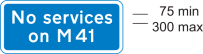 | 1. The motorway number may be varied and include a compass point as appropriate; 2. The motorway number may be varied to “motorway” |
| 6 | Diagram 2308.1 Junction ahead on a primary or non-primary route leading to a small town or village not on a main through route, which provides parking, public toilets, refreshments and fuel during normal shop opening hours at least which provides parking and public toilets or fuel during normal shop opening hours (Alternative types) |   | 1. The place name may be varied or omitted; 2. “local” must be varied to “Local” when the place name is omitted; 3. “local facilities” may be omitted; 4. A distance in accordance with Part 3 of Schedule 18 may be added except that the distance must not be expressed in yards; 5. The direction in which the arrow points may be varied and where the arrow points ahead and there is a single line of legend, the arrow shown by diagram B at item 1 of the table in Part 24 of this Schedule must be used; 6. Symbols other than the “WC”, petrol pump and cup (denoting light refreshments) may be omitted as appropriate; the wheelchair symbol (denoting facilities for disabled people), when shown, must always be placed to the right of the “WC” symbol; the “i”, spoon and fork, and bed symbols represent tourist information, restaurant and overnight accommodation respectively and symbols may be shown on a single line |
| 7 | Diagram 2309.1 Direction and distance in miles to a small town or village offering facilities indicated on the sign shown in item 5 of this table |  | 1. The place name may be varied or omitted; 2. “local” must be varied to “Local” when the place name is omitted; 3. The direction in which the sign points may be reversed; 4. The distance may be varied to another in accordance with Part 3 of Schedule 18 except that the distance must not be expressed in yards |
PART 27 Provisions applying to Part 28
I643PART 28 Other directional signs
(1) Item | (2) Description | (3) Diagram | (4) Variants |
|---|---|---|---|
| 1 | Diagram 2904.2 Indication of road layout at a junction ¾ mile ahead on a motorway, where the left hand lane leaves the main carriageway and where the same exit can be accessed from the centre lane | 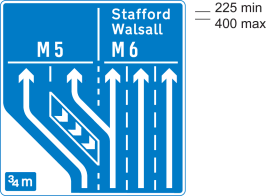 | 1. Destinations may be varied or added and may incorporate the legends shown in column 3 of the sign table in Part 3 at items 1 and 4, and the symbols shown in column 3 of the sign table in Part 11 at items 6, 7, 11, 12, 13 and 21; 2. The number of traffic lanes may be varied and the road marking symbols and arrows varied to represent the actual junction layout; where the two lanes shown for the junction exit lead to different destinations, the horizontal bar must be omitted and the broken line symbol representing the division of the lanes extended upwards; 3. The number of chevron symbols shown may be reduced from three to two, with the boundary line adjusted accordingly; 4. The distance to the junction may be omitted or varied in accordance with paragraph 7 of Part 3 of Schedule 18 |
| 2 | Diagram 2017.1 Indication of road layout at a junction ¾ mile ahead on a primary route, where the left hand lane leaves the main carriageway and where the same exit can be accessed from the centre lane |  | 1. Destinations may be varied or added and may incorporate the legends shown in column 3 of the sign table in Part 3 at items 1 and 4, the panels shown in column 3 of the sign table in Part 9 at items 1 and 3, and the symbols shown in Part 11 (other than items 1 to 5); 2. The number of traffic lanes may be varied and the road marking symbols and arrows varied to represent the actual junction layout. Where the two lanes shown for the junction exit lead to different destinations, the horizontal bar must be omitted and the broken line symbol representing the division of the lanes extended upwards; 3. The number of chevron symbols shown may be reduced from three to two, with the boundary line adjusted accordingly; 4. The distance to the junction may omitted or varied in accordance with paragraph 7 of Part 3 of Schedule 18 |
| 3 | Diagram 2019.1 Indication of appropriate traffic lanes at a junction or at a junction ahead where the right hand lane divides into two, the additional lane on the right leading to a different destination (diagram shows colours applicable to sign on a primary route) |  | 1. Destinations may be varied or added and may incorporate the legends shown in column 3 of the sign table in Part 3 at items 1, 2 and 4, the panels shown in Part 9 and the symbols shown in column 3 of the sign table in Parts 11 (other than items 1 to 5) and 20; 2. The number of traffic lanes and arrows, the widths of individual lanes and the lengths of horizontal bars, may be varied and may indicate an arrangement of shared lanes in a similar manner to column 3 of the sign table in Part 5 at item 5; 3. The route numbers must be white and the background blue when the sign is placed on a motorway exit slip road or the main carriageway of a motorway where it terminates at a junction ahead; 4. The legend, traffic lane symbols, arrows and sign border must be black and the background white when the sign is placed on a non-primary route |
| 4 | Diagram 2912 Junction ahead on a motorway with another motorway |  | 1. Route numbers may be varied in accordance with the entries in column 3 of the sign table in Part 3 at item 4; 2. The junction number in white numerals on the blue background may be added after the word “Junction”; 3. Numerals indicating the distance in miles may be varied with the distance being expressed in miles to the nearest mile |
| 5 | Diagrams 2010.1 and 2010.2 Prohibited movement ahead on a primary route with an indication of a route avoiding that prohibition |  | 1. Numerals in the upper panel of diagram 2010.1 indicating the distance to the prohibited turn may be varied; 2. The route symbols and representation of the road layout may be varied, except that the width of the route symbols must not be varied; 3. The “no right turn” symbol may be reversed to indicate a prohibited left turn or, in diagram 2010.1, varied to the “no U-turn” symbol shown in column 3 of the sign table in Part 20 at item 20; 4. Destinations may be varied or added and may incorporate the legends shown in column 3 of the sign table in Part 3 of this Schedule at items 1 and 4, the panels shown in Part 9 and the symbols shown in Part 11 (other than items 1 to 5); 5. The names of destinations and route numbers may be placed directly on the green background, with the white background omitted, provided destinations are in white lettering and the route numbers are in yellow. |
| 6 | Diagrams 2123 and 2124 Prohibited movement ahead on a non-primary route with an indication of a route avoiding that prohibition |  | 1. Numerals in the upper panel of diagram 2123 indicating the distance to the prohibited turn may be varied; 2. The route symbols and representation of the road layout may be varied as appropriate, except that the width of the route symbols must not be varied; 3. The “no right turn” symbol may be reversed to indicate a prohibited left turn or, in diagram 2123, varied to the “no U-turn” symbol shown in column 3 of the sign table in Part 20 at item 20; 4. Destinations may be varied or added and may incorporate the legends shown in column 3 of the sign table in Part 3 at items 1 and 4, the panels shown in Part 9 and the symbols shown in Part 11 (other than items 1 to 5) |
| 7 | Diagram 2141 Direction for traffic on a minor route to a destination reached along another minor route (Alternative types) |  | 1. Place names may be varied or added in accordance with column 3 of the sign table in Part 3 at item 1 in and may be shown in lower case letters with initial capitals; 2. A distance may be added; 3. The shape of the end of the sign may be varied; 4. A thin black border may be added or omitted as appropriate; 5. The sign may point to the left |
| 8 | Diagram 2215 Junction ahead leading to a place or geographical area containing several tourist destinations or leisure facilities (Alternative types) |  | 1. The place name and the name of the tourist destination or leisure facility may be varied in accordance with column 3 of the sign table in Part 3 at items 1 and 3; 2. The number of tourist destinations or leisure facilities shown on the lower part of the sign may be varied, but must not exceed five and, in the case of a sign placed on a motorway, must not exceed three; 3. The symbols may be varied to those shown in Parts 14 to 18; 4. A distance in relation to each destination shown on the sign may be added; 5. The direction in which the arrow points may be varied |
| 9 | Diagram 2205 Sign on a primary or non-primary route indicating location of a Tourist Information Centre or Point |  | 1. The name of a place or geographical area may be added in the same size of letters as “Tourist information centre”; 2. “centre” may be omitted; 3. The distance may be varied in accordance with Part 3 of Schedule 18; 4. The arrow may be reversed to point horizontally to the right; 5. The distance, the arrow or both may be omitted |
| 10 | Diagram 2307 Sign on a primary or non-primary route indicating distance ahead to a parking place with public toilets that has facilities for disabled persons, Tourist Information Centre or Point, public telephone, picnic area and viewpoint |  | 1. The name of the place may be varied (including to a geographical area) or omitted; 2. The recycling symbol shown in column 3 of the sign table in Part 11 at item 14 may be added; 3. Any of the symbols may be omitted but there must be at least two symbols on the sign including the “P” and either the “i”, picnic area or viewpoint symbol. The wheelchair symbol, when used, must be placed to the right of the “WC” symbol; it must not be included without the “WC” symbol; 4. The distance may be varied in accordance with Part 3 of Schedule 18; 5. An arrow pointing horizontally to the left or to the right may be added; 6. The wheelchair and viewpoint symbols must be reversed when an arrow pointing to the right is added; 7. The distance may be omitted when an arrow is added |
| 11 | Diagram 2301.1 Sign on a primary or non-primary route indicating distance and direction to a caravan site which has at least 20 pitches (where the site is both a caravan and a camping site, the reference to the number of pitches includes both pitches for caravans and for tents) |  | 1. The name of the caravan site may be varied or omitted; 2. The distance may be varied in accordance with Part 3 of Schedule 18; 3. The arrow may be reversed to point horizontally to the right; 4. The distance or the arrow, but not both, may be omitted |
| 12 | Diagram 2301.2 Sign on a primary or non-primary route indicating distance and direction to a camping site which has at least 20 pitches (where the site is both a caravan and a camping site, the reference to the number of pitches includes both pitches for caravans and for tents) |  | 1. The name of the camping site may be varied or omitted; 2. The distance may be varied in accordance with Part 3 of Schedule 18; 3. The arrow may be reversed to point horizontally to the right; 4. The distance or the arrow, but not both, may be omitted |
| 13 | Diagram 2303 Sign on a primary or non-primary route indicating distance and direction to a hostel |  | 1. “Youth Hostel” may be varied to “Tourist hostel” in which case the symbol must be omitted; 2. The distance may be varied in accordance with Part 3 of Schedule 18; 3. The arrow may be reversed to point horizontally to the right; 4. The distance or the arrow, but not both, may be omitted |
| 14 | Diagram 2305 Sign on a primary or non-primary route indicating distance and direction to a picnic area |  | 1. The name of the picnic area may be varied or omitted; 2. The distance may be varied in accordance with Part 3 of Schedule 18; 3. The arrow may be reversed to point horizontally to the right; 4. The distance or the arrow, but not both, may be omitted |
| 15 | Diagram 2703.1 Permanently mounted sign indicating a diversion route (Type A and B) |  | 1. The symbol may be varied to one shown in column 3 of the table in Part 11 at item 13; more than one symbol may be shown; 2. Where a symbol is placed above another, the size and proportions of the chevron in diagram B must be varied as appropriate; 3. The direction in which the arrow points in diagram A may be varied; when pointing to the left the arrow must be placed to the left of the symbol; 4. When the arrow in diagram A is pointing ahead it may be placed either to the left or to the right of the symbol and diagram B, shown in column 3 of the sign table in Part 5 at item 1, must be used where there is one symbol or a single row of symbols; 5. The arrow in diagram A may be varied to the arrow shown in column 3 of the sign table in Part 5 at item 2 ; 6. The sign shown by diagram B may be reversed to point left |
| 16 | Diagrams 2709 and 2710 Permanently mounted sign indicating a route for emergency vehicles to a named emergency services incident point |  | 1. The name of the incident point may be varied or omitted; 2. The direction in which the arrow points in diagram 2709 may be varied; 3. The arrow in diagram 2709 may be omitted and the U-turn arrow, in white, shown in column 3 of the sign table in Part 5 at item 2, placed to the right of the legend; 4. The sign shown by diagram 2710 may be reversed to point right |
| 17 | Diagram 2711.1 Direction and distance to emergency exit for pedestrians from a tunnel (Alternative types) |  | 1. The symbols and arrows may be reversed to indicate an exit to the left; 2. The arrow in diagram B may point vertically upwards with the symbol facing either to the left or to the right; 3. The distance may be varied or omitted; 4. Where emergency exits are more than 880 yards apart, distances must be expressed in miles, denoted by “miles” or “mile” as appropriate, and must be to the nearest ¼ mile with the fractions ¾, ½ and ¼ being used |
| 18 | Diagram 2922 Exit from a motorway for works traffic only |  | |
| 19 | Diagram 2801 and 2802 Sign on a primary or non-primary route indicating a route or direction to a testing station for goods vehicles |  | 1. The word “Goods” may be omitted or varied as appropriate to indicate the type or types of vehicle tested; 2. The testing station symbol may be omitted; 3. A distance may be added; 4. The direction in which the arrow points in diagram 2801 may be varied; when pointing to the right it must be placed on the right hand side of the sign with the symbol, if shown, placed to the left of the legend; 5. When the arrow in diagram 2801 is pointing ahead it may be placed either on the left hand or right hand side of the sign, with the symbol, if shown, placed at the opposite end of the sign; 6. The arrow in diagram 2801 may be omitted and the U-turn arrow shown in column 3 of the sign table in Part 5 at item 2, placed on the right hand side of the sign, with the symbol, if shown, placed to the left of the legend; 7. The sign shown by diagram 2802 may point to the left, with the symbol, if shown, placed to the right of the legend |
| 20 | Diagram 2601.2 Indication of a route for cyclists and drivers of electric scooters being used in a trial through a road junction ahead (Alternative types) |  | 1. Destinations may be omitted, varied or added and may incorporate the legends shown in column 3 of the sign table in Part 3 at item 1; 2. A distance may be added; 3. The symbols indicating the road layout and the route for cyclists may be varied as appropriate except the individual symbol widths |
| 21 | Diagram 2610.2 Direction along a public right of way, concessionary path or permissive path indicated by waymarks |  | 1. The direction in which the arrow points may be varied, the shaft may be extended and curved; 2. The colour of the arrow may be varied to indicate the type of route, with the background in any colour; 3. “Public Footpath”, “Footpath”, “Bridleway”, “Byway”, “Restricted Byway”, “Concessionary Path”, “Permissive Path” (or other appropriate description for conveying the direction of a public right of way, concessionary path or permissive path) may be added on, or adjacent to, the arrow; 4. The name of a destination, a route and an identifying symbol of a route, in any combination, may be added on or adjacent to the arrow; 5. A distance may be added; 6. A legend may be in any style, size and contrasting colour |
| 22 | Diagram 818.4 Nature and location of a prohibition, restriction or requirement with indication of alternative route |  | 1. The legend above the “weight limit” symbol, indicating the nature and location of the prohibition, restriction or requirement, may be varied as appropriate; 2. The “weight limit” numeral may be varied; 3. The “weight limit” symbol may be varied to a symbol shown in column 3 of the sign table in Part 20 at items 25, 27, 33, 34, 35 or 46 or omitted; 4. A distance to the location of the prohibition, restriction or requirement may be shown in accordance with Part 3 of Schedule 18; 5. An arrow pointing horizontally to the left or to the right may be added (and where an arrow pointing to the right is added, the lorry symbol is reversed); 6. “ahead” may be added after any distance where an arrow has not been added; 7. The legend below the “weight limit” symbol, indicating an alternative route, may be omitted or varied in accordance with column 3 of the sign table in Part 3 at item 8 and may include the words “Alternative route via” |
| 23 | Diagram 818.5 Location of a low bridge with indication of alternative route |  | 1. The legend “south of Maplebeck” may be varied as appropriate or omitted 2. The numerals giving a height may be varied 3. A distance to the low bridge may be shown in accordance with Part 3 of Schedule 18 4. An arrow pointing horizontally to the left or to the right may be added 5. “ahead” may be added after any distance where an arrow has not been added 6. The legend below the “height limit” symbol, indicating an alternative route, may be omitted or varied and may include the legends shown in column 3 of the sign table in Part 3 at item 8 |
| 24 | Diagram 2502 Sign on a primary or non-primary route indicating distance to a goods vehicles parking place ahead with public toilets and telephones |  | 1. The lorry, “WC” and telephone symbol may be omitted as appropriate 2. The recycling symbol shown in column 3 of the table in Part 11 at item 14 may be added 3. The “i” symbol shown in column 3 of the sign table in Part 11 at item 33 may be added where the parking place includes a general information point not associated with tourist destinations 4. The distance may be varied in accordance with Part 3 of Schedule 18 5. An arrow pointing horizontally to the left or to the right may be added 6. An arrow pointing horizontally to the right may be added provided that the lorry symbol, if shown, is reversed 7. The distance may be omitted when an arrow is added |
PART 29 The Schedule 12 General Directions
SCHEDULE 13 
Signs only for use in temporary situations
Regulation 3, Direction 3
PART 1 Provisions applying to signs in Part 2
I636PART 2 Signs for use in temporary situations

(1) Item | (2) Description | (3) Diagram | (4) First associated plate legend | (5) Supplementary associated plate by reference to item number in the Part 4 sign table | (6) Schedule 13 General Directions |
|---|---|---|---|---|---|
| 1 | Diagram 551.1 Migratory toad crossing ahead |  | “For” and a distance | ||
| 2 | Diagram 554A Worded warning sign (Flood) |  | 1. A distance with or without an arrow pointing to the left or to the right; or 2. An arrow pointing to the left or to the right | ||
| 3 | Diagram 554D Worded warning sign (No Smoking) |  | F75 1. A distance with or without an arrow pointing to the left or to the right; or 2. An arrow pointing to the left or to the right | ||
| 4 | Diagram 554.2 Risk of ice or packed snow ahead |  | 1. “Ice”; 2. “Ice for” and a distance; 3. “Snowdrifts”; or 4. “Snowdrifts for” and a distance | 1 | |
| 5 | Diagram 556 Uneven road ahead |  | “For” and a distance | 1 | |
| 6 | Diagram 557 Slippery road ahead |  | “For” and a distance | ||
| 7 | Diagram 562 Other danger ahead |  | 1. A word or phrase at paragraph 4; 2. A word or phrase at paragraph 4 followed by a distance; or 3. The legend at 1 or 2 with an arrow pointing to the left or to the right; 4. The words and phrases are— (a) Accident; (b) Census; (c) Dust cloud; (d) Fallen tree; (e) Frost damage; (f) Overhead cable repairs; (g) Runners in road; (g) Smoke; (h) Walkers in road | 1, 2 or 3 | 1, 2 |
| 8 | Diagram 950 Cycle race or test ahead (Alternative types) |  | 1. A phrase at paragraph 4; 2. A phrase at paragraph 4 followed by a distance; or 3. The legend at 1 or 2 with an arrow pointing to the left or to the right; 4. The phrases are— (a) Child cycle tests; (b) Child cycle tests; (c) Child cycle training; (d) Cycle event; | 1 | |
| 9 | Diagram 7001 Road works or temporary obstruction of carriageway ahead |  | 1. A distance; 2. “For” and a distance; 3. A word or phrase at paragraph 8 (where “End” indicates the end of all restrictions or prohibitions associated with road works); 4. A word or phrase at paragraph 8 (other than “End”) followed by a distance; 5. An arrow pointing to the left or to the right on its own or with the legend at 1, 3 or 4; 6. “On” and a route number, with or without a direction of travel; or 7. A route number with or without a direction of travel; 8. The words and phrases are— (a) Line painting; (b) At level crossing; (c) Blasting; (d) Ditching; (e) Grass cutting; (f) Gritting; (g) Gully emptying; (h) Hedge cutting; (i) Lighting maintenance; (j) Mobile road works; (k) On hard shoulder; (l) On slip road; (m) Overhead works; (n) Road sweeping; (o) Salting; (p) Sign erection; (q) Sign maintenance; (r) Snow ploughing; (s) Surveying; (t) Tree cutting; (u) Weed spraying; (v) End | 4, 6(1) | |
| 10 | Diagram 7009 Loose chippings on road ahead |  | 1. A distance; 2. “For” and a distance; or 3. An arrow pointing to the left or to the right on its own or with the legend at 1 or 2 | 2 or 3 | 3 |
PART 3 Provisions applying to plates in Part 4
I668PART 4 Optional supplementary plates used only in combination with signs shown in Part 2
(1) Item | (2) Description | (3) Sign diagram |
|---|---|---|
| 1 | Diagram 511 Reduction in speed necessary at a hazard ahead | 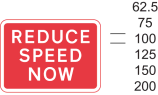 |
| 2 | Diagram 513.2 Maximum speed in mph advised at a hazard. | 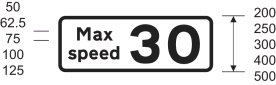 |
| 3 | Diagram 7009.1 Risk of skidding and maximum speed 20 mph advised on road with loose chippings | 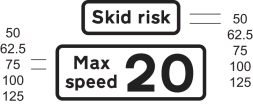 |
PART 5 Provisions applying to signs in Part 6
I637PART 6 Additional Temporary Signs
(1) Item | (2) Description | (3) Sign diagram | (4) Permitted variants | (5) Applicable requirements in Part 7 | (6) Schedule 13 General Directions |
|---|---|---|---|---|---|
| 1 | Diagram 7006.1 Information on telephone number to be used for enquiries about road works |  | 1. The Highways England logo may be varied to another logo used by Highways England or replaced by “Highways England”; 2. The logo may be varied to “Scottish Government”, “Welsh Government” or a logo of the Scottish or Welsh Government; 3. The logo may be varied to the name or logo of that part of the Scottish or Welsh Government that is, by virtue of the organisation of the government, responsible for the maintenance or improvement of the road; 4. The logo may be varied to the name or logo of another traffic authority; 5. The telephone number may be varied | 9 | 4 |
| 2 | Diagram 7007.1 Relevant particulars of major construction or improvement scheme being carried out on road ahead | 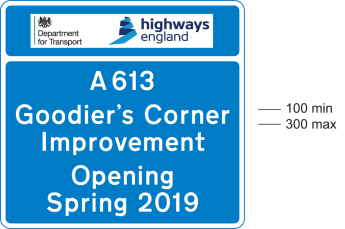 | 1. The Highways England logo may be varied to another logo used by Highways England or replaced by “Highways England”; 2. The Department for Transport logo may be varied to another logo used by the Department or replaced by “Department for Transport”; 3. The Department for Transport logo may be varied to the name or logo of another Department of Her Majesty’s Government; 3. Either or both logos may be omitted; 4. The Highways England or Department for Transport logo (or both) may be replaced by one or two of the following (provided that in total no more than two names or logos are shown)— (a) “Welsh Government” or a logo used by the Welsh Government; (b) “Scottish Government” or a logo used by the Scottish Government; (c) the name or logo of that part of the Scottish or Welsh Government that is, by virtue of the organisation of the government, responsible for the maintenance or improvement of the road; (d) the name or logo of another traffic authority; 5. The particulars of the construction or improvement scheme may be varied | 10 | 4 |
| 3 | Diagram 7008 Nature of street works, giving names of undertaker and contractor, emergency telephone number, and apology for in-convenience (Sign for pedestrians) | 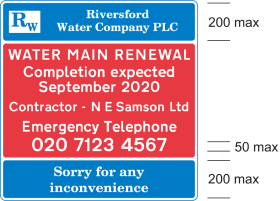 | 1. The name of the undertaker (and logo) and contractor, the nature of the works, the completion date and telephone number may be varied; 2. Each line of lettering may have a different x-height which must be smaller than the telephone number; 3. The description of the works, the completion date and the name of the contractor may be omitted; 4. The top and bottom panels may be in any colour and style of lettering; 5. A logo indicating membership of a national street works good practice scheme may be added to the top or bottom panel; 6. The bottom panel may be omitted; 7. The top panel may be omitted provided the undertaker’s name is shown on the red panel | 10 | 4 |
| 4 | Diagram 7101.1 Edge of a route for vehicle traffic through or past a temporary obstruction (Traffic cone) | 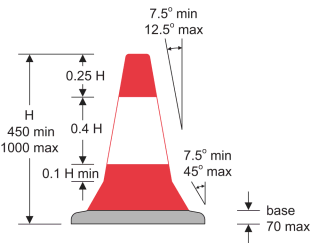 | The colour of the base may be varied in accordance with Part 8, F76paragraph 1 | 12 | 4 |
| 5 | Diagram 7102 Edge of a route for vehicular traffic through or past a temporary obstruction on a motorway or dual carriageway road (Flat traffic delineator) | 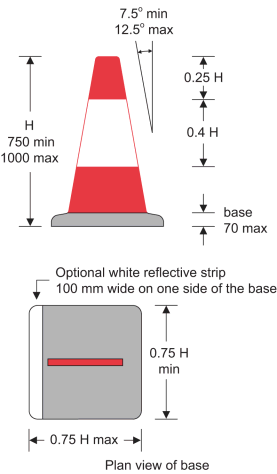 | F792. If the optional white reflective strip is not included, the minimum height is 450 | 2, 12 | 4 |
| 6 | Diagram 7103 Line of division of traffic flows on one carriageway, or to indicate the edge of a route for vehicular traffic through or past a temporary obstruction, or to mark a boundary between two carriageways of a dual carriageway road which may not be crossed except for fire and rescue authority, Scottish Fire and Rescue Service, ambulance or police purposes (Traffic cylinder) | 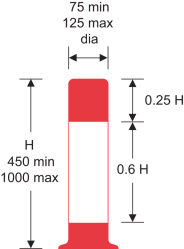 | |||
| 7 | Diagram 7104 Sharp deviation of route at or near road works or other temporary obstructions | 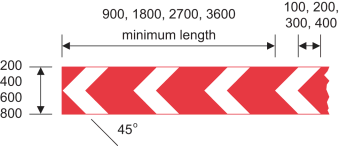 | The sign may be reversed to show a deviation to the right | 4, 8 | |
| 8 | Diagram 7105 Position of barrier to mark length of road closed to traffic or to guide traffic past an obstruction | 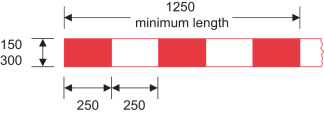 | 4, 8 | ||
| 9 | Diagram 7402 Lanes closed to traffic ahead by vehicles carrying out mobile road works (Alternative types) | 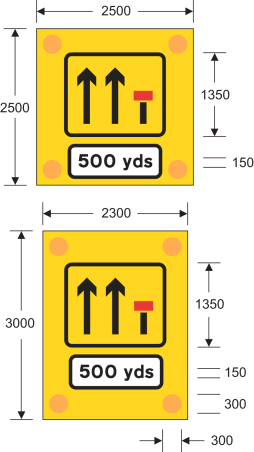 | 1. The number of arrows and symbols indicating the number of lanes and those which are open or closed to traffic may be varied; 2. “500 yds” may be varied to an alternative distance to the nearest 50 yards, to “Ahead” or, on the lower image, to “On slip road” on two lines; 3. The distance plate may be omitted | 9 | 4, 6(3) |
| 10 | Diagram 7403 Other traffic to keep to the right of vehicles carrying out mobile road works (Alternative types) | 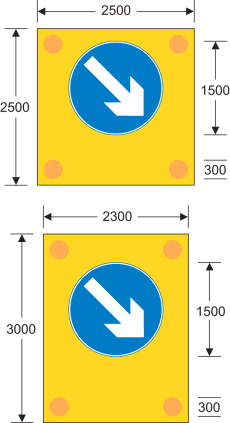 | The arrow may point downwards to the left | 1, 9 | 4, 6(3) |
| 11 | Diagram 610 Sign— (a) attached to the front or back of a road maintenance vehicle to indicate the side on which traffic should pass; or (b) placed in relation to an emergency or breakdown vehicle which is temporarily obstructing the road to warn other traffic of the obstruction and to indicate the way past the vehicle |  | 1. Arrow may point downwards to the left; 2. When attached to a vehicle, the diameter of the sign may be reduced to 1200 or 900 mm where it is not practicable to mount the 1500 millimetre diameter sign on the vehicle; 3. When placed in relation to an emergency or breakdown vehicle, the diameter may be reduced to 1200 or 900 mm | 1, 11 | 6(1), 6(2) |
| 12 | Diagram 7404 Nature of work being done by vehicle working on the highway (Sign attached to a road maintenance vehicle) | 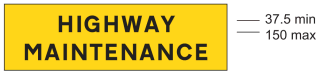 | 1. “HIGHWAY” may be varied to “MOTORWAY” or “ROAD”; 2. The legend may be on one line | 9, 10 | 4, 6(3) |
| 13 | Diagram 7202.1 Temporary lane availability (Alternative types) | 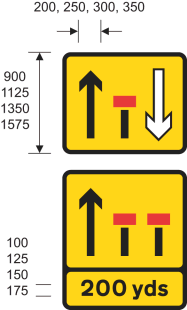 | 1. The number of arrows and symbols indicating the number of lanes and those which are open or closed to traffic may be varied; 2. Where the sign has a bottom panel, the legend may be varied to another distance or to “On slip road”, provided the legend appears on no more than three lines | 9 | 4 |
| 14 | Diagram 7243 Temporary road layout with lane restrictions | 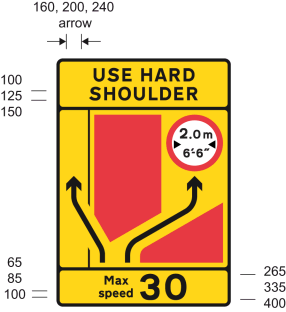 | 1. In the top panel the legend may be— (a) varied to “REJOIN MAIN CARRIAGEWAY” or “NARROW LANES”; (b) on one line; 2. The top panel may be omitted; 3. In the middle panel— (a) the arrows and symbols may be varied to indicate the layout of the traffic lanes provided that the shape of an arrow head is not varied; (b) an individual arrow may include more than one arrow head; (c) the numerals on the width limit symbol may be varied; (d) the width limit symbol may be omitted or varied to a symbol shown in column 3 of the sign table in Part 20 of Schedule 12 at items 24, 25, 28, 30, 33, and 35; (e) the size of a symbol referred to in paragraph (d) may be varied from that shown for the symbol in Part 20 of Schedule 12; (f) route numbers may be added with the x-height being 100, 125 or 150 mm; (g) the route numbers referred to in paragraph (f) may be followed by “only” at the same x-height; (h) a motorway junction number in white characters on a black patch may be added in a manner similar to the patch shown in the diagram at item 15, the x-height being 80, 100 or 120 mm; (i) a horizontal bar may be added in the manner shown in the diagram at item 15 where two or more lanes are associated with the same route number; (j) a white downward pointing arrow, as shown in the upper diagram at item 13, may be added to indicate a contraflow traffic lane 4. In the bottom panel— (a) the numerals indicating the maximum speed advised may be varied; (b) the legend may be varied to a distance with an x-height of 100 mm, 125 mm or 150 mm; (c) the distance referred to in paragraph (b) may be preceded by “For”; 5. The bottom panel may be omitted | 9 | 4, 5 |
| 15 | Diagram 7244 Temporary road layout, with an indication of destinations and route numbers, where the sign is placed on a motorway | 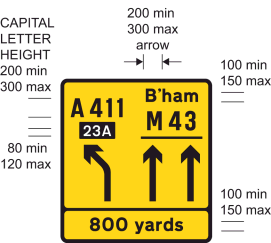 | 1. A panel with the legend “USE HARD SHOULDER”, “REJOIN MAIN CARRIAGEWAY”, “NARROW LANES”, “EVENT TRAFFIC” or other appropriate legend, may be added above the top panel in a manner similar to the top panel shown in the diagram at item 14 with an x-height of not less than 100 mm, nor more than 150 mm; 2. In the top panel— (a) the arrows may be varied to indicate the layout of the traffic lanes provided the shape of an arrow head is not varied; (b) a white downward pointing arrow, as shown in the upper diagram at item 13, may be added to indicate a contraflow traffic lane; (c) the symbol indicating a closed lane, as shown in the diagrams at item 13, may be added; (d) where the sign is placed other than on a motorway, any route number must have characters of the form shown in Part 2 of Schedule 17 with an x- height of not less than 100 mm, nor more than 150 mm; (e) a symbol shown in a diagram in Part 11 or 20 of Schedule 12 may be added and the size of the symbol may be varied from that shown; (f) a destination or route number may be varied or omitted, and additional destinations and route numbers added; (g) the junction number may be varied or omitted; F803. In the bottom panel the distance may be— (a) varied; (b) preceded by “For”; 4. The bottom panel may be omitted | 9 | 4, 5 |
| 16 | Diagram 7245 Temporary road layout | 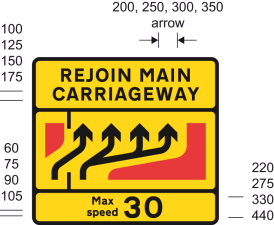 | 1. In the top panel the legend may be- (a) varied to “USE HARD SHOULDER” or “NARROW LANES”; (b) on one line; 2. The top panel may be omitted; 3. In the middle panel— (a) the arrows and symbols may be varied to indicate the layout of the traffic lanes provided the shape of an arrow head is not be varied; (b) an individual arrow may include more than one arrow head; (c) black symbols representing the division of traffic lanes may be added in a manner similar to that shown at item 14 of the sign table in Part 2 of Schedule 11 or at item 1 of the sign table in Part 28 of Schedule 12; (d) a white downward pointing arrow as shown in the upper diagram at item 13 may be added to indicate a contraflow traffic lane; (e) destinations and route numbers may be added with an x-height of 100, 125, 150 or 175 mm; (f) a junction number panel may be added in a manner similar to that shown in the diagram at item 15, the x-height being 80, 100, 120 or 140 mm; (g) symbols provided for in Parts 11, 12, 14, 15, 17 and 18 of Schedule 12 may be added; 4. In the bottom panel— (a) the numerals indicating the maximum speed advised may be varied; (b) the legend may be varied to a distance with an x-height of 100, 125, 150 or 175 mm; (c) the distance may be preceded by “For”; 5. The bottom panel may be omitted | 9 | 4, 5 |
| 17 | Diagram 633 Vehicular traffic must not proceed beyond the sign where displayed by a constable in uniform or by a traffic warden |  | A red or transparent protective strip, with a visible width not exceeding 6 mm, may be applied to the perimeter of the sign | 10 | |
| 18 | Diagram 633.1 Vehicular traffic must not proceed beyond the sign | 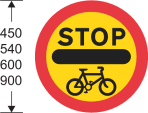 | A red or transparent protective strip, with a visible width not exceeding 6 mm, may be applied to the perimeter of the sign | 1, 9 | 9 |
| 19 | Diagram 636 Temporary prohibition of waiting except for loading and unloading |  | 1. The name of the police force or traffic authority, or the word “Police” or “POLICE” may be added above or below the roundel; 2. An arrow pointing to the left or to the right may be added | 10 | 5, 10 |
| 20 | Diagram 636.1 Temporary prohibition of loading and unloading |  | The legend may be on one line | 10 | 5 |
| 21 | Diagram 636.2 Temporary prohibition on stopping during the periods indicated | 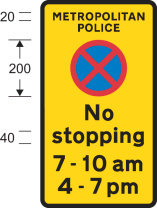 | 1. The name of the police force may be varied to the appropriate force, “POLICE” or “Police”, the name of a traffic authority, or omitted; 2. “No stopping” may be on one line; 3. Time periods shown may be varied or omitted | 10 | 5, 10 |
| 22 | Diagram 640.1 Waiting, loading and unloading prohibited at a parking place where parking is temporarily suspended | 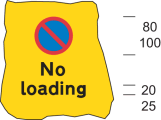 | 1. “during meter control” may be added; 2. “No loading” may be omitted; 3. The sign may have more than one side and may be placed on a parking meter or ticket machine cover; 4. The symbol and legend may be repeated | 10 | 5 |
| 23 | Diagram 829.1 Potential danger temporarily ahead and consequent need to proceed with caution | 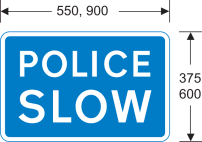 | ` | 7, 10 | |
| 24 | Diagram 829.2 Accident ahead and consequent need to proceed with caution | 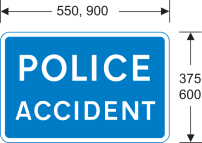 | 7, 10 | ||
| 25 | Diagram 829.3 Traffic should use the hard shoulder in an emergency | 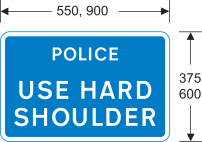 | 7, 10 | ||
| 26 | Diagram 829.4 End of temporary permission for traffic to use the hard shoulder | 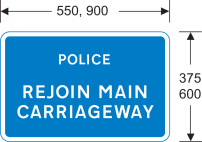 | 7, 10 | ||
| 27 | Diagram 832.7 Goods vehicles or public service vehicles (PSV) should get into the left hand lane of a carriageway on the approach to a goods vehicle or PSV check point ahead | 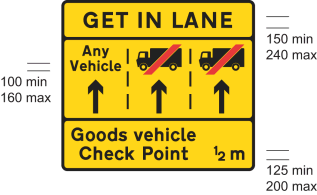 | 1. “GET IN LANE” may be varied to “STAY IN LANE”; 2. The number and position of lanes may be varied; 3. The bus symbol shown in the sign table at item 4 of Part 3 of Schedule 5, with a red diagonal bar through it, may be added below, or substituted for, the lorry symbol (ignoring the requirements as to size at item 4); 4. The legend “Any vehicle” may be varied to “Other vehicles” with the lorry and bus symbols shown without the red bar; 5. “Goods vehicle” may be varied to “Goods vehicle and PSV” or “PSV”; 6. The distance may be varied to “1 m”, “2/3 m” or “1/3 m” | ||
| 28 | Diagrams 2701 and 2701.1 Direction and junction ahead to a new housing development | 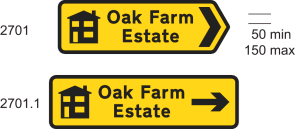 | 1. The sign shown by diagram 2701 may point to the left with the symbol placed to the right of the legend; 2. The direction in which the arrow points in diagram 2701.1 may be varied; 3. When the arrow in diagram 2701.1 points to the left it must be placed on the left hand side of the sign with the symbol placed to the right of the legend; 4. When the arrow in diagram 2701.1 points ahead it may be placed on the left or right hand side of the sign with the symbol placed at the opposite end of the sign; 5. The arrow in diagram 2701.1 may be omitted and the U-turn arrow shown in column 3 of the sign table in Part 5 of Schedule 12 at item 2, placed to the right of the legend; 6. The name of the housing development may be varied or omitted; 7. A distance to the destination may be shown (and the sign treated for the purposes of Part 3 of Schedule 18 as if it were in Schedule 12); 8. The lorry symbol shown at item 5 of the sign table in Part 1 of Schedule 5 may be added (ignoring the requirements as to size at item 5) and reversed where appropriate | 10 | 11 |
| 29 | Temporary obstruction in road caused by stationary vehicle (road vehicle sign) | 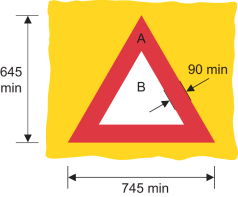 | 3, 12 | 6(5) | |
| 30 | Warning of a temporary hazard (traffic pyramid (type 1)) | 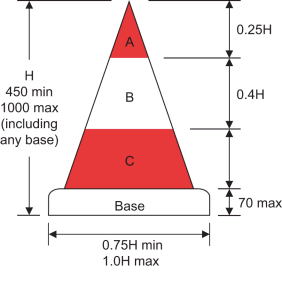 | 4, 12 | ||
| 31 | Warning of a temporary hazard (traffic pyramid (type 2)) | 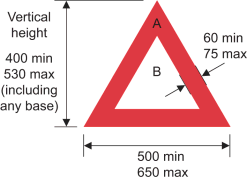 | 5, 12 | ||
| 32 | Warning of a temporary hazard (traffic triangle (type 1)) | 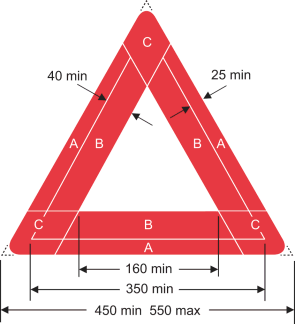 | 6, 12 | ||
| 33 | Warning of a temporary hazard (traffic triangle (type 2)) | 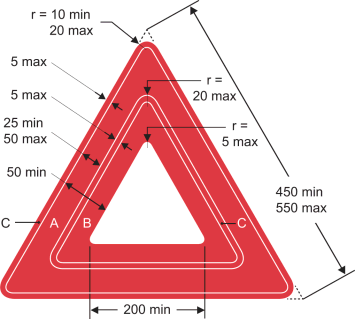 | 7, 12 | ||
| 34 | Diagram 7025 Vehicles to be escorted in through road works ahead | 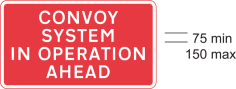 | 4 | ||
| 35 | Diagram 7026 Explanation of reason for escorting vehicles in convoys through road works |  | 4 | ||
| 36 | Diagram 7029 Vehicular traffic must not overtake the vehicle used to escort other vehicles through road works | 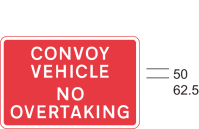 | 1. “NO OVERTAKING” may be omitted; 2. “CONVOY VEHICLE” may be on one line | 1 (except if varied in accordance with entry 1 in column 4) | 4, 6(4) |
| 37 | Diagram 7014 Permanent change in road layout ahead | 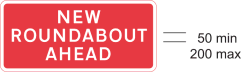 | 1. “NEW ROUNDABOUT” may be varied to— (a) “CHANGED PRIORITIES”; (b) “GAP CLOSED”; (c) “NEW ONE WAY SYSTEM”; (d) “NEW ROAD LAYOUT”; (e) “NEW TRAFFIC ISLANDS”; (f) “NEW TRAFFIC SIGNALS”; (g) “NEW ZEBRA CROSSING”; (h) “SIGNAL PRIORITIES CHANGED”; or (i) “SIGNAL F81TIMINGS CHANGED”; 2. A distance in yards to the nearest 10 yards may be substituted for, or added before, the word “AHEAD”, on a separate line where necessary, and must be expressed as “yards” or “yds” | 8 | 12 |
| 38 | Diagram 7032 In relation to England, commencement point of a newly imposed 30 mph speed limit which is contiguous to an existing 30 mph speed limit | 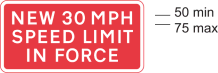 | 8 | 13 | |
| 38A | Diagram 7032.1 In relation to Wales, commencement point or warning of the commencement point of a newly imposed 20 mph speed limit |  | 1. “O’CH BLAEN” may be inserted after “MYA” in the Welsh text. 2. “AHEAD” may be inserted after “LIMIT” in the English text. | 8 | 13A |
| 39 | Diagram 7014.1 Temporary or permanent reduction in bridge headroom ahead | 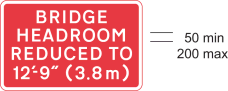 | The numerals may be varied. | 8 | 14 |
| 40 | Diagram 7291 Information on breakdown recovery services during road works | 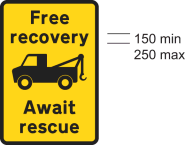 | “Await rescue” may be varied to “End”. | 9 | 4 |
| 41 | Diagram 7294 Temporary maximum speed in mph advised | 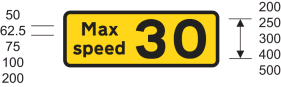 | The numerals may be varied to the appropriate advised maximum speed | 9 | 4 |
| 42 | Diagram 7003.1 Starting date and duration of road works | 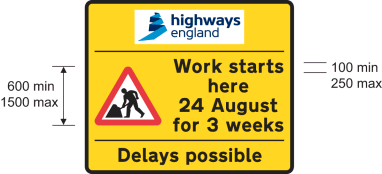 | 1. The Highways England logo may be varied to another logo used by Highways England or replaced by “Highways England”; 2. The Highways England logo may be varied to the name or logo of another traffic authority; 3. The date and duration of the work may be varied; 4. “until” and a date may be substituted for “ for 3 weeks”; 5. The top or bottom panel, or both, may be omitted; 6. The triangular road works symbol may be omitted | 4 | |
| 43 | Diagram 7005 Information for drivers in respect of road works | 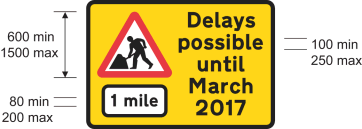 | 1. The date may be varied; 2. “until” and the date may be omitted; 3. “Delays possible until” and the date may be varied to a short description of the work in progress or explanation of why work is suspended; 4. The distance may be varied, may be preceded by “For” and may be on two lines; 5. The triangular road works symbol and distance plate may be omitted | 4 | |
| 44 | Diagram 7006 End of road works and any associated temporary statutory restrictions | 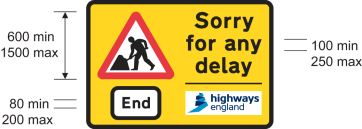 | 1. The Highways England logo may be varied to another logo used by Highways England or replaced by “Highways England”; 2. The Highways England logo may be varied to the name or logo of another traffic authority; 3. The Highways England panel and the horizontal line below “delay” may be omitted | 4 | |
| 45 | Diagram 2708 Junction ahead leading to route for emergency vehicles to a temporary incident control point | 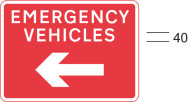 | 1. “EMERGENCY VEHICLES” may be varied to “INCIDENT CONTROL”; 2. The direction in which the arrow or arrows point may be varied | ||
| 46 | Diagram 830.1 Signs indicating that a traffic survey is being undertaken | 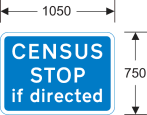 | 1. “CENSUS” may be varied to “CYCLISTS”, “WEIGHT CHECK” or “VEHICLE CHECK; 2. The entire legend may be varied to “STOP AT CENSUS POINT”, ”SLOW CENSUS POINT” or “CENSUS POINT”; 3. For the purposes of entry 2, “CENSUS POINT” may be varied to “WEIGHT CHECK” or “CHECK POINT” | 15 | |
| 47 | Diagram 830.2 Goods vehicles may be directed to stop ahead by a constable in uniform for the purposes of sections 67,68, or 78 of the Road Traffic Act 1988104 | 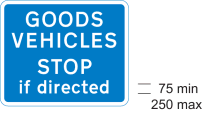 | |||
| 48 | Diagram 830.3 Vehicles should stay in lane for the purposes of a traffic survey, or a weight or vehicle check ahead | 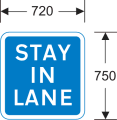 | “STAY” may be varied to “GET” | 15 | |
| 49 | Diagram 831.2 Checks being made in relation to vehicle excise licences (or emissions) ahead | 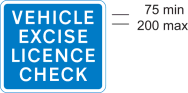 | “EXCISE LICENCE” may be varied to “EMISSIONS” | ||
| 50 | Diagram 832.1B Check point ahead | 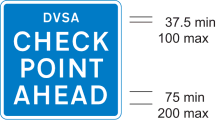 | 1. “DVSA” may be varied to “GOODS VEHICLE” or the name of a successor organisation to the Driver and Vehicle Standards Agency (in respect of its function of carrying out examinations in relation to goods vehicles or public service vehicles at check points) or an acronym for that successor organisation; 2. “CHECK POINT AHEAD” may be varied to “VEHICLE CONDITION INSPECTION” | ||
| 51 | Diagram 832.4 Instructions in relation to goods vehicles for a check point ahead | 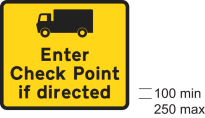 | 1. The legend may be varied to “Enter Check Point”, “Keep to left lane” or “Leave m’way if directed”; 2. The bus symbol shown at item 4 of the sign table in Part 3 of Schedule 5 may be added below or substituted for the symbol (ignoring the requirements as to size at item 4) | ||
| 52 | Diagram 7020 Variable message sign ahead not in use or being tested | 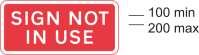 | 1. “SIGN” may be varied to “SIGNAL”; 2. “NOT IN USE” may be varied to “UNDER TEST”; 3. The legend may be on three lines |
PART 7 Provisions applying to signs in Part 6
PART 8 Requirements applying to cones, cylinders and delineators
(1) Item | (2) Aspect of performance | (3) Requirement or test specification and class |
|---|---|---|
| 1 | Daylight chromaticity co-ordinates and luminance factors | Retroreflective material: Class LB in Table 2 |
| Non-retroreflective exterior surfaces: Table 3.A | ||
| Non-retroreflective interior surfaces : Table 3.B | ||
| 2 | Coefficient of retroreflection | Dry conditioned : Class R1B or R2B in Table 4.B |
| Wet conditions: Class WT1 in Table 6 | ||
| 3 | Height and minimum weight (cones) | Class W3 in Table 1 |
PART 9 Other temporary signs
PART 10 Amber and blue light beacons
PART 11 Warning lights
(1) Item | (2) Aspect of performance | (3) Requirement or test specification and class |
|---|---|---|
| 1 | Area, angle and luminous intensity | Class L1 or L3 in Table 1 |
| 2 | Light emitting surface | For class L1 lights: paragraph 4.1.2.1 For class L3 lights: class P1 |
| 3 | Colorimetric performance of light emitted | Class C yellow 1 in Table 2 |
| 4 | Retro-reflective device | Class R2 |
| 5 | Automatic photosensitive switching | Class A1 |
| 6 | Continuity of emitted light | Class F1 (steady) or class F2 (but see NOTE) |
| 7 | On-time (flashing lights) | Class O2 |
| 8 | Mechanical strength | Class M4 |
PART 12 The Schedule 13 General Directions
SCHEDULE 14 
Signs for traffic control by light signals, signs for crossings, and signs for lane control
Regulation 3, Direction 3
PART 1 Provisions applying to signs in Parts 2 and 3
I4951 General provision about signs provided for in this Schedule
I4962 Application of the Part 3 table to certain traffic light signs provided for in the Part 2 table
I4973 Light signals to be ES compliant
(1) Item | (2) Aspect of performance | (3) Requirement or test specification and class |
|---|---|---|
| 1 | Protection rating | Class IV: IP 55 |
| 2 | Operating temperature range | Class A |
| 3 | Luminous intensity | Performance level 3, class 2 |
| 4 | Distribution of luminous intensity | Type M |
| 5 | Maximum signal phantom | Class 5 |
| 6 | Signal lights incorporating symbols | Class S1 |
| 7 | Background screen | the requirement in paragraph 6.9 of the British Standard |
| 8 | Impact resistance | Class IR2 |
(1) Item | (2) Aspect of performance | (3) Requirement or test specification and class |
|---|---|---|
| 1 | Protection rating | Class IV: IP 55 |
| 2 | Operating temperature range | Class A |
| 3 | Luminous intensity | Performance level 1, class 1 |
| 4 | Distribution of luminous intensity | Type W |
| 5 | Maximum signal phantom | Class 1 |
| 6 | Signal lights incorporating symbols | Class S1 |
| 7 | Impact resistance | Class IR2 or IR3 |
I4984 Traffic light signals
Tramcars
I278 Light signals at level crossings, swing or lifting bridges, airfields and premises used by emergency vehicles
I369 Red and green pedestrian, equestrian and cyclist symbols
I3710 Illumination of “WAIT”
I50111 School crossing places
Each light signal forming part of the sign to warn of a school crossing place provided for at item 23 of the Part 2 sign table must, when in operation, show an intermittent amber light at a rate of flashing of not less than 60 nor more than 90 flashes per minute with the sign operating such that one light is always shown when the other light is not shown.I50212 Cattle crossings
Each light signal forming part of the sign for warning of cattle crossing provided for at item 25 of the Part 2 sign table and shown in the upper part of the diagram at that item must, when in operation, show an intermittent amber light at a rate of flashing of not less than 60 nor more than 90 flashes per minute with the sign operating such that one light is always shown when the other light is not shown.I50313 Pedestrians crossing at level crossings
The red figure in the sign provided for at item 26 of the Part 2 sign table (light signals for pedestrians at level crossings) must when the sign is in operation—I3814 Zig-zag lines in a signal-controlled crossing facility controlled area
I50516 Light signals above the carriageway
I50617 Beacons displayed with upright signs relating to the operation of light signals
I50718 Stripes at Zebra and Parallel crossings
I50819 Significance of give-way markings at Zebra crossings
The give-way line marking provided for at item 54 of the Part 2 sign table (and shown in the diagram at item 52) conveys to vehicular traffic proceeding towards a Zebra crossing the position at or before which a vehicle must be stopped for the purpose of complying with paragraph 7 of Part 5.I50920 Significance of zig-zag lines at Zebra crossings
The zig-zag lines provided for at item 52 of the Part 2 sign table convey to vehicular traffic, for the purpose of complying with paragraphs 3 and 6 of Part 5 (movement of traffic at section 25 crossings), the limits of a Zebra controlled area.I4021 Significance of stripes and other road markings at Parallel crossings and in Parallel controlled areas
I4625 General provision about crossings placed across cycle tracks
25A Zebra crossings placed across a minor road in the vicinity of a junction with a major road
I51126 School crossing patrol signs
I4227 Mirror at traffic signals warning of the presence of cyclists and electric scooters being used in a trial
I51228 Automatic bollards
I51329 Refuge indicator lamps
I4330 Meaning of “stop line”
I51431 Primary and secondary signals
I638PART 2 Light signals, signs and road markings for the control of traffic
(1) Item | (2) Description | (3) Diagram | (4) Variants | (5) Applicable requirement in Part 4 | (6) Schedule 14 General Directions |
|---|---|---|---|---|---|
| 1 | Diagram 3000 Traffic light signals for the control of vehicular traffic at road junctions, places where the headroom or the width of the road is permanently restricted, signal controlled crossing facilities, tunnels, or in conjunction with the road marking provided for at item 15 of the table in part 6 of schedule 9 | 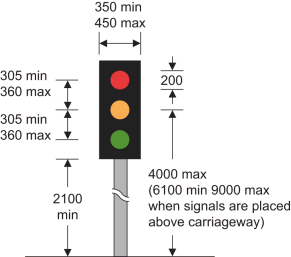 | Where the layout or character of the road restricts the visibility of the signals shown in the diagram, the maximum height of 4000 mm may be increased as appropriate to a maximum of 6100 mm | 1, 2, 3 | 2, 3, 4, 5, 43, 46 |
| 2 | Diagram 3000.1 Portable traffic light signals for the control of vehicular traffic | 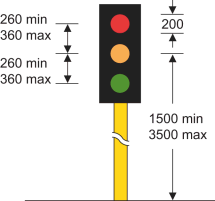 | 1, 2, 3 | 5, 6, 42, 43 | |
| 3 | Diagram 3000.2 Traffic light signals for the control of vehicular traffic consisting solely of pedal cycles and electric scooters being used in a trial (Alternative types) | 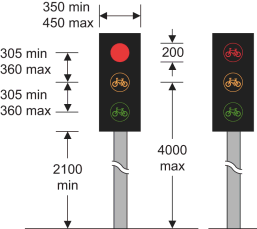 | 1, 2, 3 | 2, 3, 5, 43, 46 | |
| 4 | Diagram 3000.2A Traffic light signals for the control of vehicular traffic consisting solely of pedal cycles and electric scooters being used in a trial (Alternative types) | 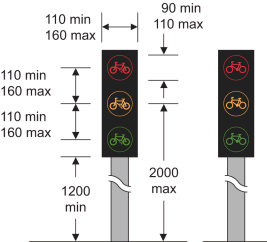 | 1, 2 | 2, 3, 5, 43, 46 | |
| 5 | Diagram 3014 Light signals for the control of road traffic at level crossings, swing or lifting bridges, airfields or in the vicinity of premises used regularly by fire and rescue authority, Scottish Fire and Rescue Service, police or ambulance vehicles | 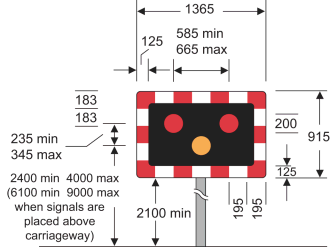 | 1, 2, 3 | 2, 4, 5, 46 | |
| 6 | Diagram 773 The light signals provided for at item 5 are ahead (where those light signals are at level crossing, swing or lifting bridge, or airfields) | 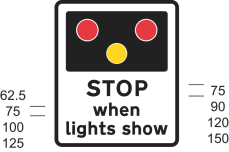 | 1. A distance may be added 2. An arrow pointing horizontally to the left or to the right may be added | 7 | |
| 7 | Diagram 563.1 The light signals provided for at item 5 are ahead (where those light signals are in the vicinity of premises used regularly by fire and rescue authority, Scottish Fire and Rescue Service, police or ambulance vehicles) | 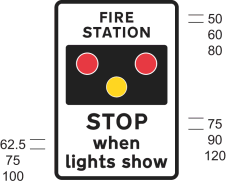 | 1. “FIRE” may be varied to: (a) “AMBULANCE”; (b) “POLICE”; (c) “FIRE AND AMBULANCE”; (d) “FIRE AND POLICE”; (e) “POLICE AND AMBULANCE”; or (f) “FIRE, POLICE AND AMBULANCE” 2. A distance may be added 3. An arrow pointing horizontally to the left or to the right may be added | 8 | |
| 8 | Diagrams 776 and 777 Another train or tramcar may be about to pass over the crossing. Level crossing ahead is crossed by more than one railway or tramway track, and more than one train or tramcar may pass over it in quick succession | 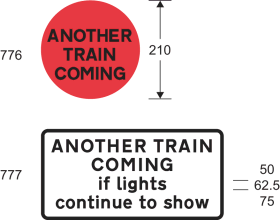 | “TRAIN” may be varied to “TRAM” | 14 (in respect of the sign shown by the diagram numbered 776 only) | 9 |
| 9 | Diagram 4002.1 Farside light signals for pedestrians | 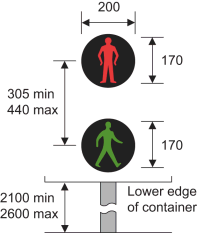 | 3 | 3, 5, 10, 41, 42, 43, 46 | |
| 10 | Diagram 4002.1A Pedestrian countdown unit indicating to pedestrians the time remaining to cross the road (shown in combination with the signal provided for at item 19) | 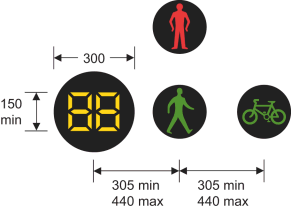 | 1. Numerals may be varied 2. The positions of the countdown unit and green cycle aspect may be reversed 3. The cycle aspect may be omitted | 3, 5, 10, 42, 43 | |
| 11 | Diagram 4003 Instructions to pedestrians above the push button control for calling up pedestrian phases at traffic light signals | 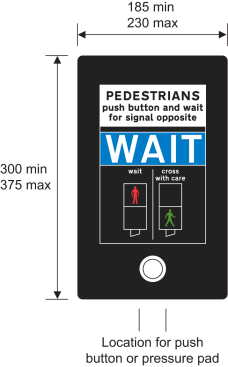 | The legend ‘WAIT’ may be illuminated in white or yellow | 3, 5, 11 ,42, 43, 46 | |
| 12 | Diagram 4003.8 Instructions to road users for calling up pedestrian, equestrian, electric scooter or cyclist phases at traffic light signals | 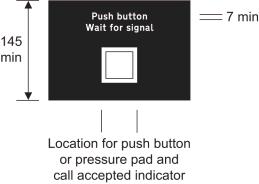 | 3, 12, 42, 43, 46 | ||
| 13 | Diagram 4003.1 Nearside light signals and instructions for pedestrians at a pedestrian facility controlled by traffic light signals | 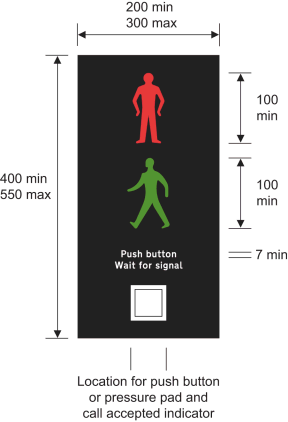 | 1. The symbols may be reversed 2. The legend ‘stand on mat’ may be added between the legends ‘push button’ and ‘wait for signal’ 3. The horizontal positions of the red and green symbols may be varied independently of each other 4. Multiple red and green symbols may be provided 5. The face containing the signal and instructions may be curved and may comprise more than one unit | 3, 5, 13, 42, 43, 46 | |
| 14 | Diagram 4003.1A Supplementary nearside light signals for pedestrians a pedestrian facility controlled by traffic light signals | 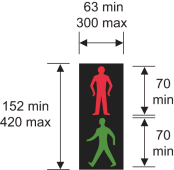 | 1. The symbols may be reversed 2. The horizontal positions of the red and green symbols may be varied independently of each other 3. The face containing the signal may be curved | 3, 5, 14, 43, 46 | |
| 15 | Diagram 4003.2 Farside light signals for equestrian traffic | 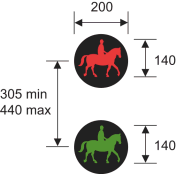 | The symbols may be reversed | 3 | 3, 5, 15, 41, 43, 46 |
| 16 | Diagram 4003.3 Instructions to horse riders above the push button control for calling up equestrian traffic phases at traffic light signals | 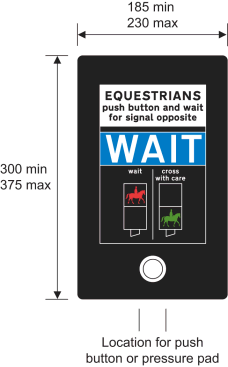 | The legend ‘WAIT’ may be illuminated in white or yellow | 3, 5, 16, 43, 46 | |
| 17 | Diagram 4003.4 Nearside light signals and instructions for horse riders at an equestrian traffic crossing facility controlled by traffic light signals | 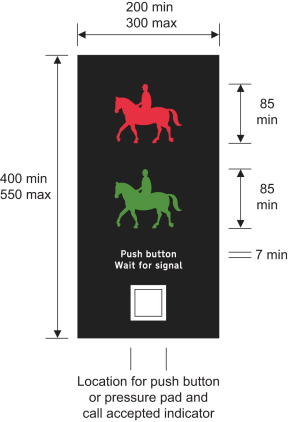 | 1. The symbols may be reversed 2. The horizontal positions of the red and green ridden horse symbols may be varied independently of each other 3. Multiple red and green ridden horse symbols may be provided. 4. The face containing the signal and instructions may be curved and may comprise more than one unit | 3, 5, 17, 41, 43, 46 | |
| 18 | Diagram 4003.4A Supplementary nearside light signals for horse riders at an equestrian traffic crossing facility controlled by traffic light signals | 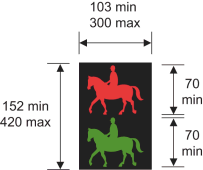 | 1. The symbols may be reversed where appropriate 2. The horizontal positions of the red and green ridden horse symbols may be varied independently of each other 3. The face containing the signal may be curved | 3, 5, 18, 43, 46 | |
| 19 | Diagram 4003.5 Farside light signals for pedestrians , drivers of electric scooters being used in a trial and cyclists at a Toucan crossing | 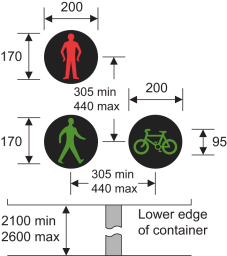 | The cycle aspect may be positioned to the left of the green pedestrian aspect | 3 | 3, 5, 19, 41, 43, 46 |
| 20 | Diagram 4003.6 (a) instructions to pedestrians , drivers of electric scooters being used in a trial and cyclists above the push button control for calling up pedestrian and cycle phases at a Toucan crossing; or (b) instructions to cyclists above the push button control for calling up cycle phases at a crossing controlled by the traffic light signals provided for at item 3 or 4 | 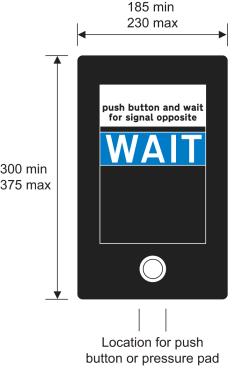 | The legend ‘WAIT’ may be illuminated in white or yellow | 3, 5, 20, 43, 46 | |
| 21 | Diagram 4003.7 Nearside light signals and instructions for pedestrians , drivers of electric scooters being used in a trial and cyclists at a Toucan crossing | 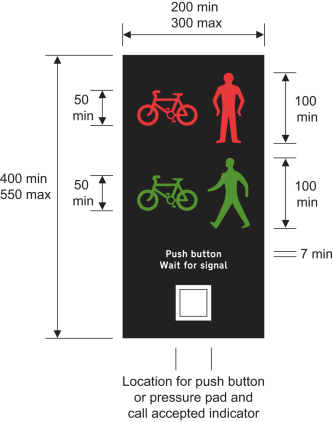 | 1. The combined cycle and pedestrian symbols may be reversed in a mirror image 2. The face containing the signal and instructions may be curved and may comprise more than one unit | 3, 5, 21, 41, 43, 46 | |
| 22 | Diagram 4003.7A Supplementary nearside signals for pedestrians , drivers of electric scooters being used in a trial and cyclists at a Toucan crossing | 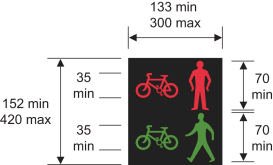 | 1. The combined cycle and pedestrian symbols may be reversed in a mirror image 2. The face containing the signal may be curved | 3, 5, 22, 43, 46 | |
| 23 | Diagram 4004 Signals placed at or near a school crossing place where children likely to be crossing the road on their way to or from school ahead (Alternative types) | 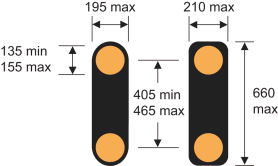 | The container may be coloured grey | 5, 23 | |
| 24 | Diagram 605.3 School crossing patrol sign | 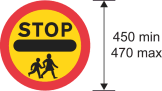 | 1, 2, 12 | ||
| 25 | Diagram 4005 A cattle crossing lies ahead and may be in use | 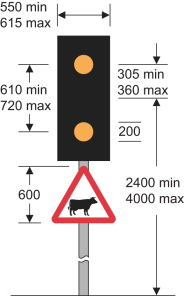 | 3 | 5, 24 | |
| 26 | Diagram 4006 Light signal at level crossing for pedestrians conveying the prohibition that pedestrians must not proceed beyond the marking provided for at item 68 | 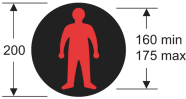 | 3 | 5, 25, 46 | |
| 27 | Diagram 4007 Yellow or fluorescent yellow globe to indicate presence of a Parallel, or Zebra crossing | 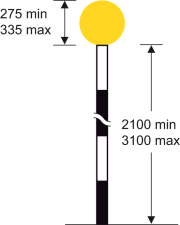 | 13 | ||
| 28 | Diagram 543 Traffic signals ahead | 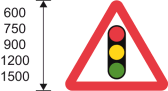 | |||
| 29 | Diagram 543.1 Traffic signals in the direction indicated which only operate at certain times (Supplementary plate) | 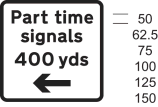 | 1. “Part time signals” may be varied to “Peak hour signals” or “Traffic control” or omitted 2. The sign may show a different distance or the distance may be omitted 3. The arrow may be reversed to point horizontally to the right or omitted 4. When “Part time signals” is omitted, the x-height of the legend may be varied to 200 mm | 26 | |
| 30 | Diagram 544 Zebra crossing or Parallel crossing ahead | 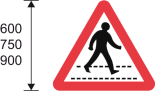 | |||
| 31 | Diagram 547.8 Zebra crossing, Parallel crossing, or signal‑controlled crossing on a road hump, in the direction indicated (Supplementary plate) | 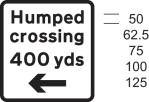 | 1. “Humped crossing” may be varied to “Zebra crossing” or “Parallel crossing” or omitted 2. The sign may show a different distance or the distance may be omitted 3. The arrow may be reversed to point horizontally to the right or omitted 4. When “Humped crossing” is omitted, the x-height of the legend may be varied to 150 mm or 200 mm | 27 | |
| 32 | Diagrams 5001.1 and 5001.2 Lane open to vehicular traffic (Alternative types) | 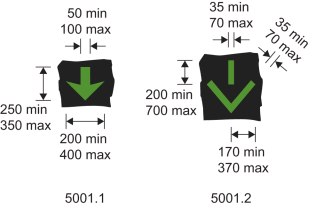 | 5, 28, 46 | ||
| 33 | Diagrams 5003 and 5003.1 Lane closed to vehicular traffic (Alternative types) | 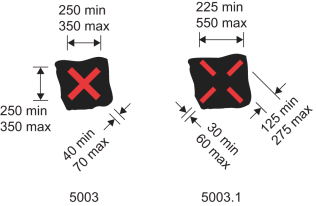 | 5, 28, 46 | ||
| 34 | Diagrams 5005 and 5005.1 Lane closed ahead and vehicular traffic should move to the next lane on the left (Alternative types) | 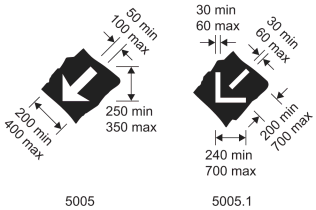 | 5, 28, 46 | ||
| 35 | Diagram 5010 The lane control light signals provided for at items 32, 33 and 34 ahead | 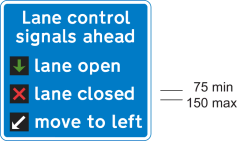 | The diagonal white arrow symbol and the words ‘move to left’ may be omitted where the signals provided for at item 34 are not used in the lane control system | 8 | |
| 36 | Diagram 5011 The lane control light signals provided for at items 32, 33 and 34 ahead on a road extending from a junction | 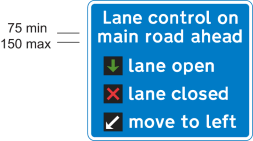 | The diagonal white arrow symbol and the words ‘move to left’ may be omitted where the signals provided for at item 34 are not used in the lane control system | 8 | |
| 37 | Diagram 5012 System of lane control light signals ahead | 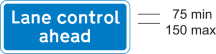 | |||
| 38 | Diagram 5013 Direction of a system of lane control light signals | 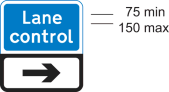 | The direction of the arrow may be varied with the arrow or chevron pointing horizontally to the left | ||
| 39 | Diagram 5014 Distance to and direction of a system of lane control light signals (alternative types) | 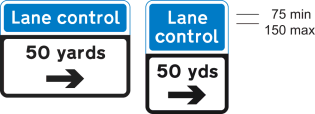 | 1. The sign may show a different distance 2. The arrow may point horizontally to the left or may be omitted | ||
| 40 | Diagram 5015 End of a system of lane control light signals | 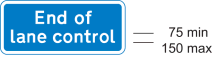 | |||
| 41 | Diagram 548.1A Supervised cattle crossing ahead | 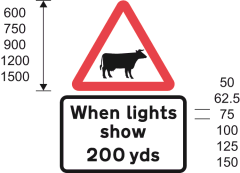 | 1. The sign shown in the lower part of the diagram may show a different distance 2. An arrow pointing to the left or to the right may be added to the sign shown in the lower part of the diagram | ||
| 42 | Diagram 606 Vehicular traffic may proceed only in the direction indicated by the arrow (Alternative types) |  | The diameter may be not less than 95 mm and not more than 110 mm if the sign is placed in conjunction with the sign provided for at item 4 | 10 | 28, 29 |
| 43 | Diagrams 612, 613 and 614 No right, left, or u-turn for vehicular traffic (Alternative types) | 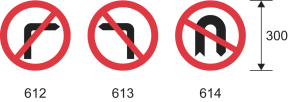 | The diameter may be not less than 95 mm and not more than 110 mm if the sign is placed in conjunction with the sign provided for at item 4 | 10 | 28, 29 |
| 44 | Diagram 616 No entry for vehicular traffic |  | F821, 2, 10 | 28, 30 | |
| 45 | Diagrams 954.5, 954.6 and 954.7 Classes of vehicle excluded from restriction or prohibition conveyed by associated sign . Where the word ‘cycles’ is used on the sign, this also represents, where relevant, electric scooters being used in a trial (Alternative types) | 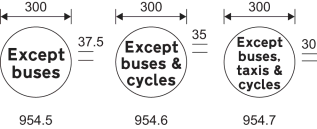 | The legend may be varied to “Except” and “cycles”, “local buses”, “buses & taxis”, local buses & cycles” or “local buses & taxis” | 10 | 28 |
| 46 | Diagram 1001 Vehicular traffic must not proceed beyond the line when required to stop by light signals, by a constable in uniform or by a traffic warden | 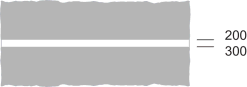 | 4, 5 | 31, 42, 43 | |
| 47 | Diagram 1001.1 Tramcars must not proceed beyond the line when required to stop by light signals | 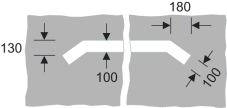 | 4 | 32 | |
| 48 | Diagram 1001.2 Alternatives to the stop line provided for at item 46 showing separate stop lines for pedal cycles and electric scooters being used in a trial proceeding in the cycle lane | 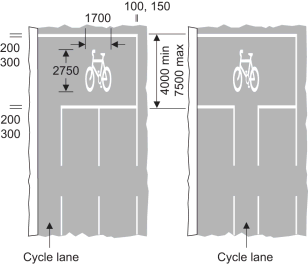 | 1. The number of traffic lanes may be varied 2. The nearside cycle lane may be bounded by the continuous white line provided for at item 7 of the sign table in Part 6 of Schedule 9 3. The right hand longitudinal line may be omitted where that part of the carriageway is delineated by a raised kerb | 4, 5 | 33 |
| 49 | Diagram 1001.2B Alternative to the stop line provided for at item 46 showing separate stop lines for pedal cycles and electric scooters being used in a trial. | 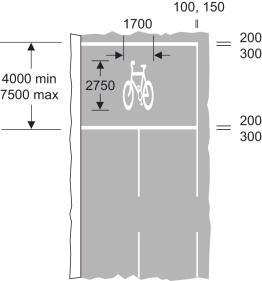 | 1. The number of traffic lanes may be varied 2. The right hand longitudinal line may be omitted where that part of the carriageway is delineated by a raised kerb | 4, 5 | 33 |
| 50 | Diagram 1001.2A Alternatives to the stop line provided for at item 46 showing a separate stop line at a junction for pedal cycles and electric scooters being used in a trial proceeding through the cycle entry | 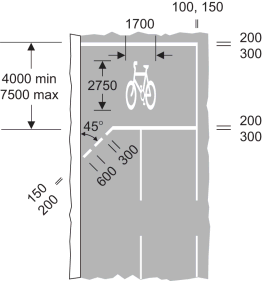 | 1. The number of traffic lanes may be varied 2. The right hand longitudinal line may be omitted where that part of the carriageway is delineated by a raised kerb 3. The number of marks in the diagonal line may be varied | 4, 5 | 33 |
| 51 | Diagram 1001.3 Zig-zag lines to indicate requirements or prohibitions relating to stopping or overtaking at a Puffin crossing, signal-controlled crossing facility or portable signal-controlled pedestrian facility (shown in combination with the markings provided for at items 46 and 55) | 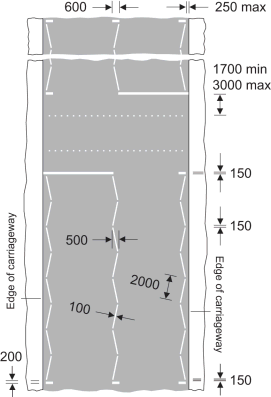 | 1. Subject to entry 4, each zig-zag line may contain more than 8 marks but not more than 18 marks 2. The central zig-zag line may be reversed, or where the road is not more than 6 metres wide, may be omitted 3. Each zig-zag line need not contain the same number of marks as any other line, provided each mark is of the same length as the others 4. Where the traffic authority is satisfied that the layout or character of the road means it is not practical to lay 8 marks, the number of marks can be reduced to not less than 2 5. Where there is a F83refuge for pedestrians or a central reservation in the carriageway the zig-zag lines may be marked on each side of the refuge or reservation provided that the markings on each side are indicated as separate crossings F846. Where a refuge for pedestrians or a central reservation is provided, the following markings may be placed between the zig-zag lines on the approaches to the refuge or reservation— (a) on a one-way road, the markings provided for at item 27 of the sign table in Part 4 of Schedule 11 (and shown in the second diagram of that item); or (b) otherwise, the markings provided for at item 23 of that sign table (and shown in the second diagram of that item) 7.The zig-zag lines may to be placed up to 2 metres from the edge of the carriageway to allow cyclists and drivers of electric scooters being used in a trial to ride on the nearside of the lines | 1, 2, 5 | 34, 42, 43 |
| 52 | Diagram 1001.4: Zig-zag lines to indicate the requirements or prohibitions relating to stopping or overtaking at a Zebra crossing (shown in combination with the marking provided for at item 54, the stripes provided for at paragraph 18 of Part 1 and the marking provided for at item 55) | 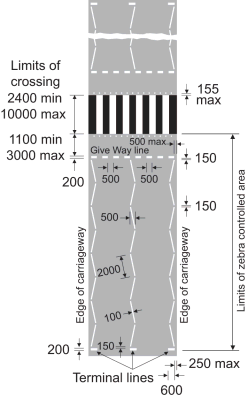 | 1. Subject to entry 4, each zig-zag line may contain more than 8 marks but not more than 18 marks 2. The central zig-zag line may be reversed, or where the road is not more than 6 metres wide, may be omitted 3. Each zig-zag line need not contain the same number of marks as any other line, provided each mark is of the same length as the others 4. Where the traffic authority is satisfied that the layout or character of the road means it is not practical to lay 8 marks, the number of marks can be reduced to not less than 2 5. Where there is a refuge for pedestrians or a central reservation in the carriageway the zig-zag lines may be marked on each side of the refuge or reservation, as the case may be, provided that the marking on each side are indicated as separate crossings 6. Where a refuge for pedestrians or a central reservation is provided, the following markings may be placed between the zig-zag lines on the approaches to the refuge or reservation— (a) on a one-way road, the markings provided for at item 27 of the sign table in Part 4 of Schedule 11 (and shown in the second diagram of that item); or (b) otherwise, the markings provided for at item 23 of that sign table (and shown in the second diagram of that item) 7.The zig-zag lines may to be placed up to 2 metres from the edge of the carriageway to allow cyclists and drivers of electric scooters being used in a trial to ride on the nearside of the lines 8. The marking provided for at item 55 may be omitted 9. The maximum distance of 3 metres between the give-way line and the limits of the crossing may, if the traffic authority thinks fit, be increased to not more than 10 metres 10. In the circumstances described in paragraph 25A(2) of Part 1 of this Schedule, the minimum distance of 1100 millimetres between the give way line and the limits of the crossing may, if the traffic authority thinks fit, be reduced to 300 millimetres. | 1, 2 | |
| 53 | F85 Diagram 1003.5 Zig-zag lines to indicate the requirements or prohibitions relating to stopping or overtaking at a Parallel pedestrian , electric scooter and cyclist crossing (shown in combination with markings provided for at items 54 and 57 and the stripes provided for at paragraph 18 of Part 1) | 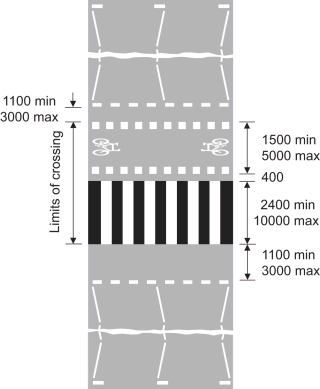 | 1. Subject to entry 4, each zig-zag line may contain more than 8 marks but not more than 18 marks. 2. The central zig-zag line may be reversed, or where the road is not more than 6 metres wide, may be omitted 3. Each zig-zag line need not contain the same number of marks as any other line, provided each mark is of the same length as the others 4. Where the traffic authority is satisfied that the layout or character of the road means it is not practical to lay 8 marks, the number of marks can be reduced to not less than 2 5. Where there is a F86refuge for pedestrians , drivers of electric scooters being used in a trial and cyclists or a central reservation in the carriageway the zig-zag lines may be marked on each side of the refuge or reservation, as the case may be, provided that the marking on each side are indicated as separate crossings F876. Where a refuge for pedestrians , drivers of electric scooters being used in a trial and cyclists or a central reservation is provided, the following markings may be placed between the zig-zag lines on the approaches to the refuge or reservation— (a) on a one-way road, the markings provided for at item 27 of the sign table in Part 4 of Schedule 11 (and shown in the second diagram of that item); or (b) otherwise, the markings provided for at item 23 of that sign table (and shown in the second diagram of that item) 7. The zig-zag lines may to be placed up to 2 metres from the edge of the carriageway to allow cyclists and drivers of electric scooters being used in a trial to ride on the nearside of the lines 8. The cycle symbols may be omitted or reversed as appropriate | 1, 2 | |
| 54 | Diagram 1001.5 Give-way marking for use at Zebra crossings, and Parallel pedestrian , electric scooter and cyclist crossings | 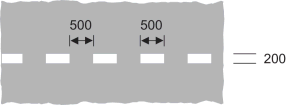 | |||
| 55 | Diagram 1055.1 (a) a place suitable for pedestrians to cross a road at which traffic is subject to control by a constable in uniform or by a traffic warden, being control which is normally in operation during periods amounting in aggregate to not less than 20 hours in any week; (b) the most suitable place for pedestrians to cross a carriageway within 10 metres of the traffic signals provided for at item 1; (c) place suitable for cyclists and drivers of electric scooters being used in a trial to cross a road at which cyclists and drivers of electric scooters being used in a trial are controlled by traffic light signals of the kind provided for at item 3 or 4, and other vehicular traffic is controlled by traffic signals of the kind provided for at item 1; (d) place suitable for pedestrians to cross at a signal (including portable) controlled pedestrian facility; (e) place suitable for pedestrians , drivers of electric scooters being used in a trial and cyclists to cross at a Toucan crossing; (f) place suitable for crossing at an equestrian only crossing; or (h) place suitable for pedestrians to cross forming part of a Zebra crossing | 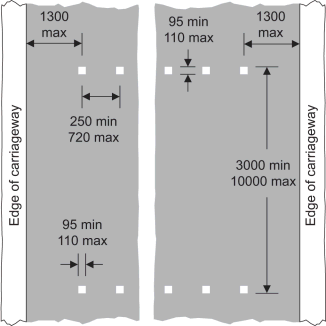 | 1. The square marks may be varied to circular marks with a diameter between 95 mm and 110 mm 2. The square marks, or the circular marks referred to at 1, may be varied to square or circular non-depressible studs of the same size and shape which are coloured white, silver or light grey provided the studs are not fitted with reflectors, retroreflecting material or a light source 3. The number of marks may be varied according to the width of the road 4. The minimum width of the crossing, other than a Toucan crossing, may be reduced from 3000 mm to 2400 mm | 42, 43 | |
| 56 | Diagram 1055.2 As for the description in this column of item 55, paragraph (c) (d) or (e), with an additional crossing point for equestrians | 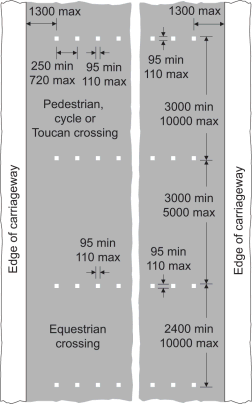 | 1. The square marks may be varied to circular marks with a diameter between 95 mm and 110 mm 2. The square marks, or the circular marks referred to at 1, may be varied to square or circular non-depressible studs of the same size and shape which are coloured white, silver or light grey provided the studs are not fitted with reflectors, retroreflecting material or a light source 3. The number of marks may be varied according to the width of the road 4. The minimum width of the crossing, not being a Toucan crossing, may be reduced from 3000 mm to 2400 mm | 43 | |
| 57 | Diagram 1055.3 (a) route for vehicular traffic consisting solely of pedal cyclists and drivers of electric scooters being used in a trial across a signal controlled junction (b) route for vehicular traffic consisting solely of pedal cyclists and drivers of electric scooters being used in a trial across a Parallel crossing | 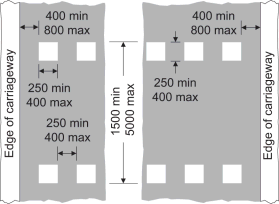 | The marking may be varied to include the symbol shown in the diagram at item 28 of the sign table in Part 4 Schedule 11 (cycle symbol) | 35 | |
| 58 | Diagram 7011 Point beyond which vehicular traffic must not proceed when required to stop (in accordance with the provisions of Part 1) at portable light signals provided for at item 2 when the road marking provided for at item 46 is not placed on the carriageway | 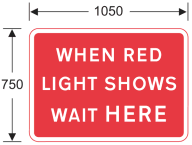 | The legend may be varied as follows— (a) “WHEN STOP SIGN SHOWS WAIT HERE”; (b) “WHEN RED LIGHT SHOWS WAIT HERE FOR CONVOY VEHICLE”; (c) “WHEN STOP SIGN SHOWS WAIT HERE FOR CONVOY VEHICLE”; (d) “WHEN GREEN LIGHT SHOWS FOLLOW CONVOY VEHICLE”; or (e) “AT TRAFFIC CONTROL FOLLOW CONVOY VEHICLE” | F29F88... | |
| 59 | Diagram 7011.1 As for item 58 where there is a road junction | 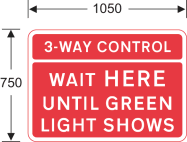 | ‘3-WAY’ may be varied to ‘4-WAY’ | F29F88... | |
| 60 | Diagram 7011.2 Instruction to vehicular traffic at a portable signal-controlled pedestrian facility | 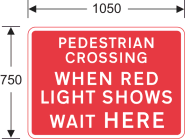 | F29F88... | 42, 43 | |
| 61 | Diagram 7019 Traffic light signals not in use | 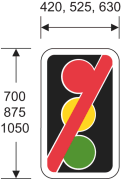 | |||
| 62 | Diagram 7021 Traffic on road ahead is being controlled by portable light signals (indication to traffic joining that road) | 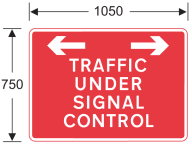 | F29F88... | ||
| 63 | Diagram 7022 Traffic joining a length of road being controlled by portable light signals is not controlled by such signals | 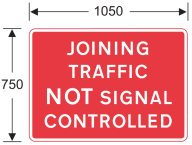 | |||
| 64 | Diagram 7023 Vehicular traffic must not proceed into a length of road where one-way working is temporarily necessary (manually operated sign) |  | 1, 6, 9 | 36 | |
| 65 | Diagram 7024 Vehicular traffic may proceed into a length of road where one-way working is temporarily necessary (manually operated sign) |  | 6, 9 | 36 | |
| 66 | Diagram 7031 Vehicular traffic must not proceed beyond the sign when displayed for a short period during works on or near an all‑purpose road (Double sided sign) | 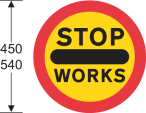 | A red or transparent protective strip, with a visible width not exceeding 6 mm, may be applied to the perimeter of the sign | 1, 7, 11 | 37, 38 |
| 67 | Diagram 790 New method of controlling traffic at a railway or tramway level crossing ahead – temporary sign | 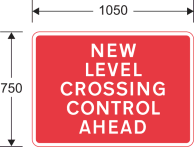 | “CONTROL” may be omitted | 39 | |
| 68 | Diagram 1003.2 Pedestrians approaching a level crossing must wait behind the line when the barriers are closed or when the red figure in the sign provided for at item 26 or the light signals provided for at item 5 are showing or, if there are neither barriers nor light signals, until satisfied that it is safe to proceed | 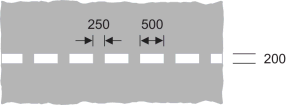 | |||
| 69 | Diagram 545.1 Part-time advisory 20 mph speed limit at or near a school | 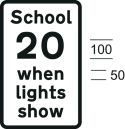 | 40 |
I669PART 3 Green arrow, tram and cycle signals

(1) Item | (2) Description | (3) Diagram | (4) Permitted location and variations |
|---|---|---|---|
| 1 | Diagrams 3001.2 and 3001.3 Green arrow to show the direction for vehicular traffic to take for inclusion in traffic light signals as described in Part 1 |  | 1. Diagram A: can be placed in positions 1, 2, 3, 4 2. Diagram B: can be placed in positions 2, 3 3. Diagram C: can be placed in positions 1, 2, 3, 4, 5 4. Diagram D: can be placed in positions 2, 3 |
| 2 | Diagram 3013 Light signal for control of tramcars (diagram shows the light signal fully illuminated- see items 3 to 7 for the illumination of the signal to convey particular descriptions) | 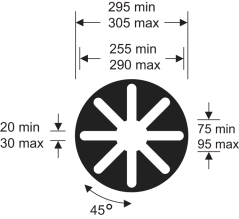 | 1. Diagram A: can be placed in positions 1, 2, 3, 4 2. Diagram B: can be placed in positions 1, 2, 3 3. Diagram C: can be placed in positions 1, 2, 4, 5 4. Diagram D: can be placed in positions 1, 3 |
| 3 | Diagram 3013.1 Tramcar must not proceed beyond the stop line |  | |
| 4 | Diagram 3013.2 Tramcar may proceed beyond the stopline and proceed straight ahead | 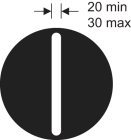 | |
| 5 | Diagram 3013.3 Tramcar may proceed beyond the stopline and proceed to the left |  | |
| 6 | Diagram 3013.4 Tramcar may proceed beyond the stopline and proceed to the right |  | |
| 7 | Diagram 3013.5 Tramcar must not proceed beyond the stop line except that, as respects a tramcar which is so close to the stop line that it cannot safely be stopped without proceeding beyond the stop line, it conveys the same indication as the aspect which was shown immediately before it | 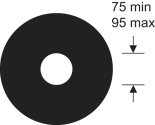 | |
| 8 | Diagram 3001.4 Green cycle signal for inclusion in traffic light signals as described in Part 1 |  | 1. Diagram A: can be placed in position 2 2. Diagram B: can be placed in position 2 3. Diagram C: can be placed in position 2 4. Diagram D: can be placed in position 3 |
PART 4 Requirements applying to signs in Parts 2 and 3
PART 5 Movement at section 25 crossings
PART 6 The Schedule 14 General Directions
(1) Item | (2) State | (3) Class |
|---|---|---|
| 1 | Green-green conflict | AA1 |
| 2 | Green-yellow conflict | AB1 |
| 3 | Yellow-yellow conflict | AC0 |
| 4 | Green-red/yellow conflict | AD1 |
| 5 | Green-green/yellow conflict | AE0 |
| 6 | Absence of any conflicting red signal | AF0 |
| 7 | Absence for conflicting red on specified signal heads | AG0 |
| 8 | Absence of the last conflicting red signal | AH0 |
| 9 | Absent red/absent red | AJ0 |
| 10 | National signal regulations (infringement) | BA0 |
| 11 | Absence of a red signal on a specified signal group | CA1 |
| 12 | Absence of the last red signal | CB1 |
| 13 | Absence of a number of red signals | CC1 |
| 14 | Absence of specified red signals | CD0 |
| 15 | Absent signal groups, yellow or green signals | CE0 |
| 16 | Compliance checking | DA1 |
| 17 | Stored values of timings | FA1 |
| 18 | Time base frequency | FB0 |
| 19 | Minimum values of time settings | FC0 |
| 20 | Maximum values of time settings | FD0 |
| 21 | Duration of timings | FE0 |
| 22 | National signal sequences (infringement) | GA0 |
| 23 | Specified signal group green to signal group green movements | GB0 |
| 24 | Specified signal start-up sequence signal group movements | GC0 |
| 25 | Failure of external inputs | HA1 |
(1) Item | (2) Subject area | (3) Aspect of performance | (4) Class |
|---|---|---|---|
| 1 | Electrical supply | Overvoltage | D0 |
| 2 | Safety | Leakage current | T2 |
| 3 | Enclosure | V2 | |
| 4 | Terminations | H0 | |
| 5 | Requirements of signalling intensity for safety | AF5 | |
| 6 | Requirements for signal states (i) | AG5 | |
| 7 | Requirements for signal states (ii) | X1 | |
| 8 | Location of monitoring elements for signals | N0 | |
| 9 | Test of impedance | Fault loop impedance test | AA1 |
| 10 | Maintenance | Maintenance testing procedures | Y1 |
| 11 | Environmental | Dry heat | AB3 |
| 12 | Cold | AE2 | |
| 13 | Damp heat, cyclic | AK2 | |
| 14 | Solar radiation | AH0 | |
| 15 | Random vibration (operational) | AL2 | |
| 16 | Random vibration (transportation) | AM2 |
SCHEDULE 15 
Matrix signs and light signals for the control of moving traffic on motorways and dual carriageway roads
Regulation 3, Direction 3
PART 1 Provisions applying to signs in Part 2
I670PART 2 Matrix signs and light signals for motorways and all‑purpose dual carriageway roads
(1) Item | (2 Description | (3) Diagram | (4) Permitted variants in Part 3 | (5) Applicable provisions in Part 4 | (6) Schedule 15 General Directions |
|---|---|---|---|---|---|
| 1 | Diagram 6001 Temporary maximum speed advised | 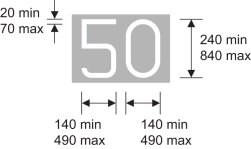 | 1 | 1, 2, 3, 4 | 1 |
| 2 | Diagram 6002 Vehicular traffic must move to the next lane on the right |  | 2 | 1, 2, 3, 4 | 1 |
| 3 | Diagram 6002.1 Vehicular traffic must move to the next lane on the right (may be combined with items 6 and 15) (Alternative types) |  | 4, 9, 11 | 1, 3, 4 | 1 |
| 4 | Diagram 6003 Vehicular traffic must leave at next junction |  | 3 | 1, 2, 3, 4 | 1 |
| 5 | Diagram 6008 Closure of one lane of a two lane carriageway ahead |  | 4 | 1, 2, 3, 4 | 1 |
| 6 | Diagram 6008.2 Closure of one lane of a two lane carriageway ahead (may be combined with items 3 and 15) (Alternative types) |  | 4, 11 | 1, 3, 4 | 1 |
| 7 | Diagram 6008.1 Closure of both lanes of a two lane carriageway ahead |  | 4, 10 | 1, 4 | 1 |
| 8 | Diagram 6011 Risk of fog ahead |  | 1, 2, 3, 4 | 1 | |
| 9 | Diagram 6011.1 Risk of ice ahead |  | 1, 2, 3, 4 | 1 | |
| 10 | Diagram 6012 End of temporary restrictions |  | 1 | 1 | |
| 11 | Diagram 6021 Hazard ahead (flashing amber lamps used with the sign provided for at item 1, 2, 4, 8 or 9 when that sign is mounted on a gantry, or over a traffic lane or hard shoulder) |  | 5 | 1, 2 | 1 |
| 12 | Diagram 6022 Hazard ahead (flashing amber lamps used with the sign provided for at item 1, 3, 4, 5, 6, 8 or 9 when that sign is mounted on a post) |  | 6 | 1, 3 | 1 |
| 13 | Diagram 6023 Light signal conveying the warning described at paragraph 2 of Part 1 |  | 5 | 1 | |
| 14 | Diagram 6031.1 Gantry-mounted light signals conveying the prohibition described at paragraph 3 of Part 1 | 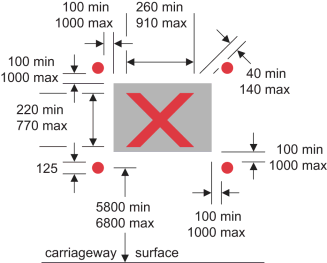 | 6, 7 | 1, 2 | |
| 15 | Diagram 6031.2 Carriageway side mounted light signals conveying the prohibition described at paragraph 3 of Part 1 (left hand symbol may be combined with items 3 and 6) (Alternative types) |  | 4, 8, 11 | 6, 7 | 1 |
| 16 | Diagram 6032.1 Post-mounted light signals conveying the prohibition described at paragraph 4 of Part 1 |  | 7 | 6, 7 | 1 |
PART 3 Permitted variants in respect of the signs shown in Part 2
PART 4 Provisions applying to signs in Part 2
PART 5 The Schedule 15 General Directions
SCHEDULE 16 
Variable message signs
Regulation 3, Schedule 1
PART 1 Preliminary
PART 2 Signs automatically activated by vehicular traffic
PART 3 Legends giving warnings of adverse weather or other temporary hazards or incidents
PART 4 Legends indicating location of temporary hazard or incident
PART 5 Additional information
PART 6 Other legends
I671PART 7 Performance classes
(1) Item | (2) Aspect of performance | (3) Requirements or classes for colour | (4) Requirements or classes for colour | (5) Requirements or classes for colour | (6) Requirements or classes for colour | (7) Requirements or classes for colour | |
|---|---|---|---|---|---|---|---|
| 1 | White | Yellow | Green | Red | Blue | ||
| 2 | Colour Chromaticity Area | Area 10 | Area 9 (Yellow C2) | Area 11 (Green C2) | Area 7 (Red C2) | Area 12 (Blue C2) | |
| 3 | Luminance | L1 | L1 | L1 | L1 | L1 | |
| L3 | L3 | L3 | L3 | L3 | |||
| 4 | Luminance Ratio (On Axis) | R3 | R3 | R3 | R3 | R3 | |
| R1 | R1 | R1 | R1 | R1 | |||
| 5 | Beam Width | Narrow | B1 | B1 | B1 | B1 | B1 |
| Wide | B3 | B3 | B3 | B3 | B3 | ||
(1) Item | (2) Aspect of Performance | (3) Requirement or Class |
|---|---|---|
| 1 | Temperature | T1 |
| 2 | Pollution | D1 |
| 3 | Protection | P2 |
(1) Item | (2) Visual performance parameter | (3) Class designation - Level 1 | (4) Class designation - Level 2 |
|---|---|---|---|
| 1. | Colour | C2 | C2 |
| 2. | Luminance | L3 | L1 |
| 3. | Luminance ratio | R3 | R1 |
| 4. | Beam Width | B1 or B3 | B1 or B3 |
(1) Item | (2) 85percentile approach speed (mph) | (3) Class designation |
|---|---|---|
| 1. | Up to and including 50 | 1 or 2 |
| 2. | Over 50 | 1 |
SCHEDULE 17 
Letters, F89numerals and other characters
Regulation 5
I672PART 1 Letters, numerals and other characters for use with a black, blue, brown, dark green, green or red background
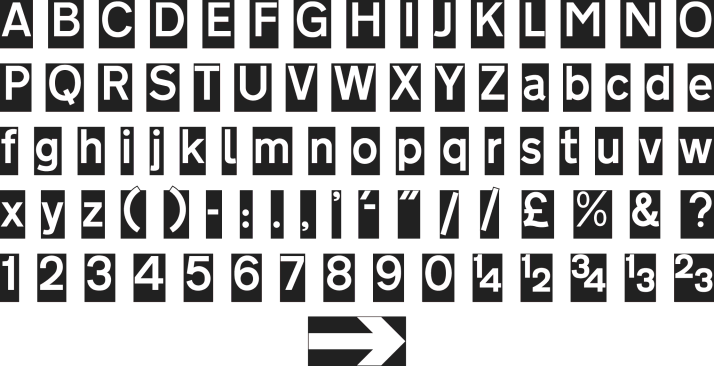
I673PART 2 Letters, numerals and other characters for use with an orange, white or yellow background

I674PART 3 Letters, numerals and other characters for motorway route numbers on blue backgrounds

I675PART 4 Letters, numerals and other characters for route numbers on temporary motorway signs with yellow backgrounds)

I676PART 5 Letters, numerals and other characters for use on variable message signs where the characters shown in parts 1, 2, 3 and 4 cannot be used because of the method of construction or operation of the sign

I677PART 6 Proportions and forms of letters, numerals and other characters for use in road markings where the character height is between 280 mm and 700 mm (inclusive)

I678PART 7 Letters, numerals and other characters for use in road markings where the character height is 1600 mm (or 705 mm or 1035 mm in accordance with regulation 5(15))

I679PART 8 Letters, numerals and other characters for use in road markings where the character height is 2800 mm

Letters, numerals and other characters for use in road markings where the character height is 2800 mm

I680PART 9 Scottish Gaelic letters, numerals and other characters for use on a brown or dark green background

I681PART 10 Scottish Gaelic letters, numerals and other characters for use on a white background

SCHEDULE 18 
Permitted Expressions Of Time, Distance and Parking Restrictions
Regulation 6
PART 1 Permitted expressions of time periods, days and dates
PART 2 Permitted expressions for parking restriction signs
PART 3 Permitted expressions of distance
SCHEDULE 19 
Revocations
Regulation 13, Direction 12
I628PART 1 Regulations Revoked
(1) Regulations revoked | (2) References |
|---|---|
| The Zebra, Pelican and Puffin Pedestrian Crossings Regulations 1997 | Part 1 of S.I. 1997/2400 |
| The Traffic Signs (Temporary Obstructions) Regulations 1997 | S. I. 1997/3053 |
| The Traffic Signs Regulations 2002 | Part 1 of S.I. 2002/3113 |
| The Traffic Signs (Amendment) Regulations 2005 | Part 1 of S.I. 2005/1670 |
| The Traffic Signs (Amendment) Regulations 2006 | S.I. 2006/2083 |
| The School Crossing Patrol Sign (England and Wales) Regulations 2006 | S.I. 2006/2215 |
| The Traffic Signs (Amendment) Regulations 2008 | Part 1 of S.I. 2008/2177 |
| The Traffic Signs (Amendment) Regulations 2011 | Part 1 of S.I. 2011/1040 |
| The Traffic Signs (Amendment) (No. 2) Regulations 2011 | Part 1 of S.I. 2011/3041 |
I629PART 2 General Directions Revoked
(1) General Directions revoked | (2) References |
|---|---|
| The Pelican and Puffin Pedestrian Crossings General Directions 1997 | Part 2 of S.I. 1997/2400 |
| The Pelican and Puffin Pedestrian Crossings General (Amendment) Directions 1998 | S.I. 1998/901 |
| The Traffic Signs General Directions 2002 | Part 2 of S.I. 2002/3113 |
| The Traffic Signs (Amendment) General Directions 2003 | S.I. 2003/393 |
| The Traffic Signs (Amendment) General Directions 2004 | Part 2 of S.I. 2004/1275 |
| The Traffic Signs (Amendment) General Directions 2005 | Part 2 of S.I. 2005/1670 |
| The Traffic Signs (Amendment) General Directions 2008 | Part 2 of S.I. 2008/2177 |
| The Traffic Signs (Amendment) General Directions 2011 | Part 2 of S.I. 2011/1040 |
| The Traffic Signs (Amendment) (No. 2) General Directions 2011 | Part 2 of S.I. 2011/3041 |
Footnotes
- I1Reg. 4 in force at 22.4.2016, see reg. 1(b)
- I2Reg. 14 in force at 22.4.2016, see reg. 1(b)
- I3Reg. 1 in force at 22.4.2016, see reg. 1(b)
- I4Reg. 3 in force at 22.4.2016, see reg. 1(b)
- I5Sch. 3 para. 9 in force at 22.4.2016, see reg. 1(b)
- I6Sch. 11 para. 49 in force at 22.4.2016, see reg. 1(b)
- I7Sch. 12 para. 10 in force at 22.4.2016, see reg. 1(b)
- I8Sch. 2 Pt. 7 para. 1 in force at 22.4.2016, see reg. 1(b)
- I9Sch. 2 Pt. 7 para. 2 in force at 22.4.2016, see reg. 1(b)
- I10Sch. 3 Pt. 4 para. 1 in force at 22.4.2016, see reg. 1(b)
- I11Sch. 7 Pt. 6 para. 2 in force at 22.4.2016, see reg. 1(b)
- I12Sch. 7 Pt. 3 para. 3 in force at 22.4.2016, see reg. 1(b)
- I13Sch. 7 Pt. 6 para. 3 in force at 22.4.2016, see reg. 1(b)
- I14Sch. 9 Pt. 8 para. 1 in force at 22.4.2016, see reg. 1(b)
- I15Sch. 9 Pt. 8 para. 2 in force at 22.4.2016, see reg. 1(b)
- I16Sch. 9 Pt. 9 para. 7 in force at 22.4.2016, see reg. 1(b)
- I17Sch. 9 Pt. 7 para. 9 in force at 22.4.2016, see reg. 1(b)
- I18Sch. 10 Pt. 4 para. 1 in force at 22.4.2016, see reg. 1(b)
- I19Sch. 11 Pt. 6 para. 14 in force at 22.4.2016, see reg. 1(b)
- I20Sch. 12 Pt. 1 para. 8 in force at 22.4.2016, see reg. 1(b)
- I21Sch. 13 Pt. 7 para. 1 in force at 22.4.2016, see reg. 1(b)
- I22Sch. 13 Pt. 8 para. 3 in force at 22.4.2016, see reg. 1(b)
- I23Sch. 13 Pt. 12 para. 9 in force at 22.4.2016, see reg. 1(b)
- I24Sch. 13 Pt. 12 para. 10 in force at 22.4.2016, see reg. 1(b)
- I25Sch. 14 Pt. 4 para. 1 in force at 22.4.2016, see reg. 1(b)
- I26Sch. 14 Pt. 4 para. 2 in force at 22.4.2016, see reg. 1(b)
- I27Sch. 14 Pt. 1 para. 8 in force at 22.4.2016, see reg. 1(b)
- I28Sch. 15 Pt. 4 para. 7 in force at 22.4.2016, see reg. 1(b)
- I29Sch. 9 Pt. 7 para. 7 in force at 22.4.2016, see reg. 1(b)
- I30Sch. 9 Pt. 7 para. 8 in force at 22.4.2016, see reg. 1(b)
- I31Sch. 9 Pt. 7 para. 12 in force at 22.4.2016, see reg. 1(b)
- I32Sch. 13 Pt. 9 para. 8 in force at 22.4.2016, see reg. 1(b)
- I33Sch. 13 Pt. 9 para. 9 in force at 22.4.2016, see reg. 1(b)
- I34Sch. 13 Pt. 9 para. 13 in force at 22.4.2016, see reg. 1(b)
- I35Sch. 14 Pt. 1 para. 5 in force at 22.4.2016, see reg. 1(b)
- I36Sch. 14 Pt. 1 para. 9 in force at 22.4.2016, see reg. 1(b)
- I37Sch. 14 Pt. 1 para. 10 in force at 22.4.2016, see reg. 1(b)
- I38Sch. 14 Pt. 1 para. 14 in force at 22.4.2016, see reg. 1(b)
- I39Sch. 14 Pt. 1 para. 23 in force at 22.4.2016, see reg. 1(b)
- I40Sch. 14 Pt. 1 para. 21 in force at 22.4.2016, see reg. 1(b)
- I41Sch. 14 Pt. 1 para. 22 in force at 22.4.2016, see reg. 1(b)
- I42Sch. 14 Pt. 1 para. 27 in force at 22.4.2016, see reg. 1(b)
- I43Sch. 14 Pt. 1 para. 30 in force at 22.4.2016, see reg. 1(b)
- I44Sch. 14 Pt. 5 para. 4 in force at 22.4.2016, see reg. 1(b)
- I45Sch. 3 Pt. 3 para. 3 in force at 22.4.2016, see reg. 1(b)
- I46Sch. 14 Pt. 1 para. 25 in force at 22.4.2016, see reg. 1(b)
- I47Reg. 5 in force at 22.4.2016, see reg. 1(b)
- I48Reg. 6 in force at 22.4.2016, see reg. 1(b)
- I49Reg. 7 in force at 22.4.2016, see reg. 1(b)
- I50Reg. 8 in force at 22.4.2016, see reg. 1(b)
- I51Reg. 9 in force at 22.4.2016, see reg. 1(b)
- I52Reg. 10 in force at 22.4.2016, see reg. 1(b)
- I53Reg. 11 in force at 22.4.2016, see reg. 1(b)
- I54Reg. 12 in force at 22.4.2016, see reg. 1(b)
- I55Reg. 13 in force at 22.4.2016, see reg. 1(b)
- I56Reg. 15 in force at 22.4.2016, see reg. 1(b)
- I57Dir. 1 in force at 22.4.2016, see dir. 1(b)
- I58Dir. 2 in force at 22.4.2016, see dir. 1(b)
- I59Dir. 3 in force at 22.4.2016, see dir. 1(b)
- I60Dir. 4 in force at 22.4.2016, see dir. 1(b)
- I61Dir. 5 in force at 22.4.2016, see dir. 1(b)
- I62Dir. 6 in force at 22.4.2016, see dir. 1(b)
- I63Dir. 7 in force at 22.4.2016, see dir. 1(b)
- I64Dir. 8 in force at 22.4.2016, see dir. 1(b)
- I65Dir. 9 in force at 22.4.2016, see dir. 1(b)
- I66Dir. 10 in force at 22.4.2016, see dir. 1(b)
- I67Dir. 11 in force at 22.4.2016, see dir. 1(b)
- I68Dir. 12 in force at 22.4.2016, see dir. 1(b)
- I69Dir. 13 in force at 22.4.2016, see dir. 1(b)
- I70Dir. 14 in force at 22.4.2016, see dir. 1(b)
- I71Sch. 2 Pt. 1 para. 1 in force at 22.4.2016, see reg. 1(b)
- I72Sch. 2 Pt. 1 para. 2 in force at 22.4.2016, see reg. 1(b)
- I73Sch. 2 Pt. 1 para. 3 in force at 22.4.2016, see reg. 1(b)
- I74Sch. 2 Pt. 1 para. 4 in force at 22.4.2016, see reg. 1(b)
- I75Sch. 2 Pt. 1 para. 5 in force at 22.4.2016, see reg. 1(b)
- I76Sch. 2 Pt. 3 para. 1 in force at 22.4.2016, see reg. 1(b)
- I77Sch. 2 Pt. 4 para. 1 in force at 22.4.2016, see reg. 1(b)
- I78Sch. 2 Pt. 4 para. 2 in force at 22.4.2016, see reg. 1(b)
- I79Sch. 2 Pt. 4 para. 3 in force at 22.4.2016, see reg. 1(b)
- I80Sch. 2 Pt. 4 para. 4 in force at 22.4.2016, see reg. 1(b)
- I81Sch. 2 Pt. 4 para. 5 in force at 22.4.2016, see reg. 1(b)
- I82Sch. 2 Pt. 5 para. 1 in force at 22.4.2016, see reg. 1(b)
- I83Sch. 2 Pt. 5 para. 2 in force at 22.4.2016, see reg. 1(b)
- I84Sch. 2 Pt. 6 para. 1 in force at 22.4.2016, see reg. 1(b)
- I85Sch. 2 Pt. 6 para. 2 in force at 22.4.2016, see reg. 1(b)
- I86Sch. 2 Pt. 6 para. 3 in force at 22.4.2016, see reg. 1(b)
- I87Sch. 2 Pt. 6 para. 4 in force at 22.4.2016, see reg. 1(b)
- I88Sch. 2 Pt. 7 para. 3 in force at 22.4.2016, see reg. 1(b)
- I89Sch. 2 Pt. 7 para. 4 in force at 22.4.2016, see reg. 1(b)
- I90Sch. 2 Pt. 7 para. 5 in force at 22.4.2016, see reg. 1(b)
- I91Sch. 2 para. 6 in force at 22.4.2016, see reg. 1(b)
- I92Sch. 2 para. 7 in force at 22.4.2016, see reg. 1(b)
- I93Sch. 2 para. 8 in force at 22.4.2016, see reg. 1(b)
- I94Sch. 2 para. 9 in force at 22.4.2016, see reg. 1(b)
- I95Sch. 2 para. 10 in force at 22.4.2016, see reg. 1(b)
- I96Sch. 2 para. 11 in force at 22.4.2016, see reg. 1(b)
- I97Sch. 2 para. 12 in force at 22.4.2016, see reg. 1(b)
- I98Sch. 2 para. 13 in force at 22.4.2016, see reg. 1(b)
- I99Sch. 2 Pt. 8 para. 1 in force at 22.4.2016, see reg. 1(b)
- I100Sch. 2 Pt. 8 para. 2 in force at 22.4.2016, see reg. 1(b)
- I101Sch. 2 Pt. 8 para. 3 in force at 22.4.2016, see reg. 1(b)
- I102Sch. 2 Pt. 8 para. 4 in force at 22.4.2016, see reg. 1(b)
- I103Sch. 2 Pt. 8 para. 5 in force at 22.4.2016, see reg. 1(b)
- I104Sch. 3 Pt. 1 para. 1 in force at 22.4.2016, see reg. 1(b)
- I105Sch. 3 Pt. 1 para. 2 in force at 22.4.2016, see reg. 1(b)
- I106Sch. 3 Pt. 1 para. 3 in force at 22.4.2016, see reg. 1(b)
- I107Sch. 3 Pt. 1 para. 4 in force at 22.4.2016, see reg. 1(b)
- I108Sch. 3 Pt. 1 para. 5 in force at 22.4.2016, see reg. 1(b)
- I109Sch. 3 Pt. 1 para. 6 in force at 22.4.2016, see reg. 1(b)
- I110Sch. 3 Pt. 3 para. 1 in force at 22.4.2016, see reg. 1(b)
- I111Sch. 3 Pt. 3 para. 2 in force at 22.4.2016, see reg. 1(b)
- I112Sch. 3 Pt. 3 para. 4 in force at 22.4.2016, see reg. 1(b)
- I113Sch. 3 Pt. 3 para. 5 in force at 22.4.2016, see reg. 1(b)
- I114Sch. 3 Pt. 3 para. 6 in force at 22.4.2016, see reg. 1(b)
- I115Sch. 3 Pt. 3 para. 7 in force at 22.4.2016, see reg. 1(b)
- I116Sch. 3 Pt. 3 para. 8 in force at 22.4.2016, see reg. 1(b)
- I117Sch. 3 para. 10 in force at 22.4.2016, see reg. 1(b)
- I118Sch. 3 para. 11 in force at 22.4.2016, see reg. 1(b)
- I119Sch. 3 para. 12 in force at 22.4.2016, see reg. 1(b)
- I120Sch. 3 para. 13 in force at 22.4.2016, see reg. 1(b)
- I121Sch. 3 para. 14 in force at 22.4.2016, see reg. 1(b)
- I122Sch. 3 para. 15 in force at 22.4.2016, see reg. 1(b)
- I123Sch. 3 para. 16 in force at 22.4.2016, see reg. 1(b)
- I124Sch. 3 para. 17 in force at 22.4.2016, see reg. 1(b)
- I125Sch. 3 Pt. 4 para. 2 in force at 22.4.2016, see reg. 1(b)
- I126Sch. 3 Pt. 4 para. 3 in force at 22.4.2016, see reg. 1(b)
- I127Sch. 3 Pt. 4 para. 4 in force at 22.4.2016, see reg. 1(b)
- I128Sch. 3 Pt. 4 para. 5 in force at 22.4.2016, see reg. 1(b)
- I129Sch. 3 Pt. 4 para. 6 in force at 22.4.2016, see reg. 1(b)
- I130Sch. 3 Pt. 4 para. 7 in force at 22.4.2016, see reg. 1(b)
- I131Sch. 3 Pt. 4 para. 8 in force at 22.4.2016, see reg. 1(b)
- I132Sch. 3 Pt. 5 para. 1 in force at 22.4.2016, see reg. 1(b)
- I133Sch. 3 Pt. 5 para. 2 in force at 22.4.2016, see reg. 1(b)
- I134Sch. 3 Pt. 5 para. 3 in force at 22.4.2016, see reg. 1(b)
- I135Sch. 3 Pt. 5 para. 4 in force at 22.4.2016, see reg. 1(b)
- I136Sch. 4 Pt. 2 para. 1 in force at 22.4.2016, see reg. 1(b)
- I137Sch. 4 para. 2 in force at 22.4.2016, see reg. 1(b)
- I138Sch. 4 para. 3 in force at 22.4.2016, see reg. 1(b)
- I139Sch. 4 para. 4 in force at 22.4.2016, see reg. 1(b)
- I140Sch. 4 para. 5 in force at 22.4.2016, see reg. 1(b)
- I141Sch. 4 para. 6 in force at 22.4.2016, see reg. 1(b)
- I142Sch. 4 para. 7 in force at 22.4.2016, see reg. 1(b)
- I143Sch. 4 para. 8 in force at 22.4.2016, see reg. 1(b)
- I144Sch. 4 para. 9 in force at 22.4.2016, see reg. 1(b)
- I145Sch. 4 para. 10 in force at 22.4.2016, see reg. 1(b)
- I146Sch. 4 para. 11 in force at 22.4.2016, see reg. 1(b)
- I147Sch. 4 para. 12 in force at 22.4.2016, see reg. 1(b)
- I148Sch. 4 para. 13 in force at 22.4.2016, see reg. 1(b)
- I149Sch. 4 para. 14 in force at 22.4.2016, see reg. 1(b)
- I150Sch. 4 para. 15 in force at 22.4.2016, see reg. 1(b)
- I151Sch. 4 para. 16 in force at 22.4.2016, see reg. 1(b)
- I152Sch. 4 para. 17 in force at 22.4.2016, see reg. 1(b)
- I153Sch. 4 para. 18 in force at 22.4.2016, see reg. 1(b)
- I154Sch. 4 para. 19 in force at 22.4.2016, see reg. 1(b)
- I155Sch. 4 para. 20 in force at 22.4.2016, see reg. 1(b)
- I156Sch. 4 para. 21 in force at 22.4.2016, see reg. 1(b)
- I157Sch. 4 para. 22 in force at 22.4.2016, see reg. 1(b)
- I158Sch. 4 para. 23 in force at 22.4.2016, see reg. 1(b)
- I159Sch. 4 para. 24 in force at 22.4.2016, see reg. 1(b)
- I160Sch. 4 para. 25 in force at 22.4.2016, see reg. 1(b)
- I161Sch. 4 Pt. 6 para. 1 in force at 22.4.2016, see reg. 1(b)
- I162Sch. 5 Pt. 1 para. 1 in force at 22.4.2016, see reg. 1(b)
- I163Sch. 5 para. 2 in force at 22.4.2016, see reg. 1(b)
- I164Sch. 5 para. 3 in force at 22.4.2016, see reg. 1(b)
- I165Sch. 5 para. 4 in force at 22.4.2016, see reg. 1(b)
- I166Sch. 5 para. 5 in force at 22.4.2016, see reg. 1(b)
- I167Sch. 5 para. 6 in force at 22.4.2016, see reg. 1(b)
- I168Sch. 5 para. 7 in force at 22.4.2016, see reg. 1(b)
- I169Sch. 5 para. 8 in force at 22.4.2016, see reg. 1(b)
- I170Sch. 5 Pt. 5 para. 1 in force at 22.4.2016, see reg. 1(b)
- I171Sch. 6 Pt. 1 para. 1 in force at 22.4.2016, see reg. 1(b)
- I172Sch. 6 para. 2 in force at 22.4.2016, see reg. 1(b)
- I173Sch. 6 para. 3 in force at 22.4.2016, see reg. 1(b)
- I174Sch. 6 para. 4 in force at 22.4.2016, see reg. 1(b)
- I175Sch. 6 para. 5 in force at 22.4.2016, see reg. 1(b)
- I176Sch. 6 para. 6 in force at 22.4.2016, see reg. 1(b)
- I177Sch. 6 para. 7 in force at 22.4.2016, see reg. 1(b)
- I178Sch. 6 para. 8 in force at 22.4.2016, see reg. 1(b)
- I179Sch. 6 para. 9 in force at 22.4.2016, see reg. 1(b)
- I180Sch. 6 para. 10 in force at 22.4.2016, see reg. 1(b)
- I181Sch. 6 Pt. 3 para. 1 in force at 22.4.2016, see reg. 1(b)
- I182Sch. 7 Pt. 1 para. 1 in force at 22.4.2016, see reg. 1(b)
- I183Sch. 7 Pt. 1 para. 2 in force at 22.4.2016, see reg. 1(b)
- I184Sch. 7 Pt. 3 para. 1 in force at 22.4.2016, see reg. 1(b)
- I185Sch. 7 Pt. 3 para. 2 in force at 22.4.2016, see reg. 1(b)
- I186Sch. 7 Pt. 5 para. 1 in force at 22.4.2016, see reg. 1(b)
- I187Sch. 7 Pt. 5 para. 2 in force at 22.4.2016, see reg. 1(b)
- I188Sch. 7 Pt. 5 para. 3 in force at 22.4.2016, see reg. 1(b)
- I189Sch. 7 Pt. 5 para. 4 in force at 22.4.2016, see reg. 1(b)
- I190Sch. 7 para. 5 in force at 22.4.2016, see reg. 1(b)
- I191Sch. 7 para. 6 in force at 22.4.2016, see reg. 1(b)
- I192Sch. 7 para. 7 in force at 22.4.2016, see reg. 1(b)
- I193Sch. 7 para. 8 in force at 22.4.2016, see reg. 1(b)
- I194Sch. 7 para. 9 in force at 22.4.2016, see reg. 1(b)
- I195Sch. 7 para. 10 in force at 22.4.2016, see reg. 1(b)
- I196Sch. 7 para. 11 in force at 22.4.2016, see reg. 1(b)
- I197Sch. 7 para. 12 in force at 22.4.2016, see reg. 1(b)
- I198Sch. 7 para. 13 in force at 22.4.2016, see reg. 1(b)
- I199Sch. 7 para. 14 in force at 22.4.2016, see reg. 1(b)
- I200Sch. 7 para. 15 in force at 22.4.2016, see reg. 1(b)
- I201Sch. 7 para. 16 in force at 22.4.2016, see reg. 1(b)
- I202Sch. 7 Pt. 6 para. 1 in force at 22.4.2016, see reg. 1(b)
- I203Sch. 7 Pt. 6 para. 4 in force at 22.4.2016, see reg. 1(b)
- I204Sch. 7 Pt. 7 para. 1 in force at 22.4.2016, see reg. 1(b)
- I205Sch. 7 Pt. 7 para. 2 in force at 22.4.2016, see reg. 1(b)
- I206Sch. 7 Pt. 7 para. 3 in force at 22.4.2016, see reg. 1(b)
- I207Sch. 8 Pt. 1 para. 1 in force at 22.4.2016, see reg. 1(b)
- I208Sch. 8 Pt. 1 para. 2 in force at 22.4.2016, see reg. 1(b)
- I209Sch. 8 Pt. 3 para. 1 in force at 22.4.2016, see reg. 1(b)
- I210Sch. 8 Pt. 5 para. 1 in force at 22.4.2016, see reg. 1(b)
- I211Sch. 8 Pt. 5 para. 2 in force at 22.4.2016, see reg. 1(b)
- I212Sch. 9 Pt. 1 para. 1 in force at 22.4.2016, see reg. 1(b)
- I213Sch. 9 Pt. 1 para. 2 in force at 22.4.2016, see reg. 1(b)
- I214Sch. 9 Pt. 1 para. 3 in force at 22.4.2016, see reg. 1(b)
- I215Sch. 9 Pt. 3 para. 1 in force at 22.4.2016, see reg. 1(b)
- I216Sch. 9 Pt. 3 para. 2 in force at 22.4.2016, see reg. 1(b)
- I217Sch. 9 Pt. 3 para. 3 in force at 22.4.2016, see reg. 1(b)
- I218Sch. 9 Pt. 5 para. 1 in force at 22.4.2016, see reg. 1(b)
- I219Sch. 9 Pt. 5 para. 2 in force at 22.4.2016, see reg. 1(b)
- I220Sch. 9 Pt. 5 para. 3 in force at 22.4.2016, see reg. 1(b)
- I221Sch. 9 Pt. 5 para. 4 in force at 22.4.2016, see reg. 1(b)
- I222Sch. 9 Pt. 7 para. 1 in force at 22.4.2016, see reg. 1(b)
- I223Sch. 9 Pt. 7 para. 2 in force at 22.4.2016, see reg. 1(b)
- I224Sch. 9 Pt. 7 para. 3 in force at 22.4.2016, see reg. 1(b)
- I225Sch. 9 Pt. 7 para. 4 in force at 22.4.2016, see reg. 1(b)
- I226Sch. 9 Pt. 7 para. 5 in force at 22.4.2016, see reg. 1(b)
- I227Sch. 9 Pt. 7 para. 6 in force at 22.4.2016, see reg. 1(b)
- I228Sch. 9 Pt. 7 para. 10 in force at 22.4.2016, see reg. 1(b)
- I229Sch. 9 Pt. 7 para. 11 in force at 22.4.2016, see reg. 1(b)
- I230Sch. 9 Pt. 8 para. 3 in force at 22.4.2016, see reg. 1(b)
- I231Sch. 9 Pt. 8 para. 4 in force at 22.4.2016, see reg. 1(b)
- I232Sch. 9 Pt. 8 para. 5 in force at 22.4.2016, see reg. 1(b)
- I233Sch. 9 Pt. 8 para. 6 in force at 22.4.2016, see reg. 1(b)
- I234Sch. 9 Pt. 8 para. 7 in force at 22.4.2016, see reg. 1(b)
- I235Sch. 9 Pt. 8 para. 8 in force at 22.4.2016, see reg. 1(b)
- I236Sch. 9 Pt. 8 para. 9 in force at 22.4.2016, see reg. 1(b)
- I237Sch. 9 Pt. 8 para. 10 in force at 22.4.2016, see reg. 1(b)
- I238Sch. 9 Pt. 8 para. 11 in force at 22.4.2016, see reg. 1(b)
- I239Sch. 9 Pt. 8 para. 12 in force at 22.4.2016, see reg. 1(b)
- I240Sch. 9 Pt. 8 para. 13 in force at 22.4.2016, see reg. 1(b)
- I241Sch. 9 Pt. 8 para. 14 in force at 22.4.2016, see reg. 1(b)
- I242Sch. 9 para. 15 in force at 22.4.2016, see reg. 1(b)
- I243Sch. 9 para. 16 in force at 22.4.2016, see reg. 1(b)
- I244Sch. 9 Pt. 9 para. 1 in force at 22.4.2016, see reg. 1(b)
- I245Sch. 9 Pt. 9 para. 2 in force at 22.4.2016, see reg. 1(b)
- I246Sch. 9 Pt. 9 para. 3 in force at 22.4.2016, see reg. 1(b)
- I247Sch. 9 Pt. 9 para. 4 in force at 22.4.2016, see reg. 1(b)
- I248Sch. 9 Pt. 9 para. 5 in force at 22.4.2016, see reg. 1(b)
- I249Sch. 9 Pt. 9 para. 6 in force at 22.4.2016, see reg. 1(b)
- I250Sch. 9 Pt. 9 para. 8 in force at 22.4.2016, see reg. 1(b)
- I251Sch. 9 Pt. 9 para. 9 in force at 22.4.2016, see reg. 1(b)
- I252Sch. 9 Pt. 9 para. 10 in force at 22.4.2016, see reg. 1(b)
- I253Sch. 9 Pt. 9 para. 11 in force at 22.4.2016, see reg. 1(b)
- I254Sch. 9 Pt. 9 para. 12 in force at 22.4.2016, see reg. 1(b)
- I255Sch. 9 Pt. 9 para. 13 in force at 22.4.2016, see reg. 1(b)
- I256Sch. 9 Pt. 9 para. 14 in force at 22.4.2016, see reg. 1(b)
- I257Sch. 10 Pt. 1 para. 1 in force at 22.4.2016, see reg. 1(b)
- I258Sch. 10 Pt. 1 para. 2 in force at 22.4.2016, see reg. 1(b)
- I259Sch. 10 Pt. 1 para. 3 in force at 22.4.2016, see reg. 1(b)
- I260Sch. 10 Pt. 3 para. 1 in force at 22.4.2016, see reg. 1(b)
- I261Sch. 10 Pt. 3 para. 2 in force at 22.4.2016, see reg. 1(b)
- I262Sch. 10 Pt. 3 para. 3 in force at 22.4.2016, see reg. 1(b)
- I263Sch. 10 Pt. 3 para. 4 in force at 22.4.2016, see reg. 1(b)
- I264Sch. 10 Pt. 4 para. 3 in force at 22.4.2016, see reg. 1(b)
- I265Sch. 10 Pt. 4 para. 4 in force at 22.4.2016, see reg. 1(b)
- I266Sch. 10 para. 5 in force at 22.4.2016, see reg. 1(b)
- I267Sch. 10 para. 6 in force at 22.4.2016, see reg. 1(b)
- I268Sch. 11 Pt. 1 para. 1 in force at 22.4.2016, see reg. 1(b)
- I269Sch. 11 Pt. 1 para. 2 in force at 22.4.2016, see reg. 1(b)
- I270Sch. 11 Pt. 1 para. 3 in force at 22.4.2016, see reg. 1(b)
- I271Sch. 11 Pt. 1 para. 4 in force at 22.4.2016, see reg. 1(b)
- I272Sch. 11 Pt. 3 para. 1 in force at 22.4.2016, see reg. 1(b)
- I273Sch. 11 Pt. 3 para. 2 in force at 22.4.2016, see reg. 1(b)
- I274Sch. 11 Pt. 3 para. 3 in force at 22.4.2016, see reg. 1(b)
- I275Sch. 11 Pt. 5 para. 1 in force at 22.4.2016, see reg. 1(b)
- I276Sch. 11 Pt. 5 para. 2 in force at 22.4.2016, see reg. 1(b)
- I277Sch. 11 Pt. 5 para. 3 in force at 22.4.2016, see reg. 1(b)
- I278Sch. 11 Pt. 5 para. 4 in force at 22.4.2016, see reg. 1(b)
- I279Sch. 11 Pt. 5 para. 5 in force at 22.4.2016, see reg. 1(b)
- I280Sch. 11 Pt. 5 para. 6 in force at 22.4.2016, see reg. 1(b)
- I281Sch. 11 Pt. 5 para. 7 in force at 22.4.2016, see reg. 1(b)
- I282Sch. 11 Pt. 5 para. 8 in force at 22.4.2016, see reg. 1(b)
- I283Sch. 11 Pt. 5 para. 9 in force at 22.4.2016, see reg. 1(b)
- I284Sch. 11 Pt. 5 para. 10 in force at 22.4.2016, see reg. 1(b)
- I285Sch. 11 Pt. 5 para. 11 in force at 22.4.2016, see reg. 1(b)
- I286Sch. 11 Pt. 5 para. 12 in force at 22.4.2016, see reg. 1(b)
- I287Sch. 11 Pt. 5 para. 13 in force at 22.4.2016, see reg. 1(b)
- I288Sch. 11 Pt. 5 para. 14 in force at 22.4.2016, see reg. 1(b)
- I289Sch. 11 Pt. 5 para. 15 in force at 22.4.2016, see reg. 1(b)
- I290Sch. 11 para. 16 in force at 22.4.2016, see reg. 1(b)
- I291Sch. 11 para. 17 in force at 22.4.2016, see reg. 1(b)
- I292Sch. 11 para. 18 in force at 22.4.2016, see reg. 1(b)
- I293Sch. 11 para. 19 in force at 22.4.2016, see reg. 1(b)
- I294Sch. 11 para. 20 in force at 22.4.2016, see reg. 1(b)
- I295Sch. 11 para. 21 in force at 22.4.2016, see reg. 1(b)
- I296Sch. 11 para. 22 in force at 22.4.2016, see reg. 1(b)
- I297Sch. 11 para. 23 in force at 22.4.2016, see reg. 1(b)
- I298Sch. 11 para. 24 in force at 22.4.2016, see reg. 1(b)
- I299Sch. 11 para. 25 in force at 22.4.2016, see reg. 1(b)
- I300Sch. 11 para. 26 in force at 22.4.2016, see reg. 1(b)
- I301Sch. 11 para. 27 in force at 22.4.2016, see reg. 1(b)
- I302Sch. 11 para. 28 in force at 22.4.2016, see reg. 1(b)
- I303Sch. 11 para. 29 in force at 22.4.2016, see reg. 1(b)
- I304Sch. 11 para. 30 in force at 22.4.2016, see reg. 1(b)
- I305Sch. 11 para. 31 in force at 22.4.2016, see reg. 1(b)
- I306Sch. 11 para. 32 in force at 22.4.2016, see reg. 1(b)
- I307Sch. 11 para. 33 in force at 22.4.2016, see reg. 1(b)
- I308Sch. 11 para. 34 in force at 22.4.2016, see reg. 1(b)
- I309Sch. 11 para. 35 in force at 22.4.2016, see reg. 1(b)
- I310Sch. 11 para. 36 in force at 22.4.2016, see reg. 1(b)
- I311Sch. 11 para. 37 in force at 22.4.2016, see reg. 1(b)
- I312Sch. 11 para. 38 in force at 22.4.2016, see reg. 1(b)
- I313Sch. 11 para. 39 in force at 22.4.2016, see reg. 1(b)
- I314Sch. 11 para. 40 in force at 22.4.2016, see reg. 1(b)
- I315Sch. 11 para. 41 in force at 22.4.2016, see reg. 1(b)
- I316Sch. 11 para. 42 in force at 22.4.2016, see reg. 1(b)
- I317Sch. 11 para. 43 in force at 22.4.2016, see reg. 1(b)
- I318Sch. 11 para. 44 in force at 22.4.2016, see reg. 1(b)
- I319Sch. 11 para. 45 in force at 22.4.2016, see reg. 1(b)
- I320Sch. 11 para. 46 in force at 22.4.2016, see reg. 1(b)
- I321Sch. 11 para. 47 in force at 22.4.2016, see reg. 1(b)
- I322Sch. 11 para. 48 in force at 22.4.2016, see reg. 1(b)
- I323Sch. 11 para. 50 in force at 22.4.2016, see reg. 1(b)
- I324Sch. 11 para. 51 in force at 22.4.2016, see reg. 1(b)
- I325Sch. 11 para. 52 in force at 22.4.2016, see reg. 1(b)
- I326Sch. 11 para. 53 in force at 22.4.2016, see reg. 1(b)
- I327Sch. 11 para. 54 in force at 22.4.2016, see reg. 1(b)
- I328Sch. 11 para. 55 in force at 22.4.2016, see reg. 1(b)
- I329Sch. 11 para. 56 in force at 22.4.2016, see reg. 1(b)
- I330Sch. 11 para. 57 in force at 22.4.2016, see reg. 1(b)
- I331Sch. 11 para. 58 in force at 22.4.2016, see reg. 1(b)
- I332Sch. 11 Pt. 6 para. 1 in force at 22.4.2016, see reg. 1(b)
- I333Sch. 11 Pt. 6 para. 2 in force at 22.4.2016, see reg. 1(b)
- I334Sch. 11 Pt. 6 para. 3 in force at 22.4.2016, see reg. 1(b)
- I335Sch. 11 Pt. 6 para. 4 in force at 22.4.2016, see reg. 1(b)
- I336Sch. 11 Pt. 6 para. 5 in force at 22.4.2016, see reg. 1(b)
- I337Sch. 11 Pt. 6 para. 6 in force at 22.4.2016, see reg. 1(b)
- I338Sch. 11 Pt. 6 para. 7 in force at 22.4.2016, see reg. 1(b)
- I339Sch. 11 Pt. 6 para. 8 in force at 22.4.2016, see reg. 1(b)
- I340Sch. 11 Pt. 6 para. 9 in force at 22.4.2016, see reg. 1(b)
- I341Sch. 11 Pt. 6 para. 10 in force at 22.4.2016, see reg. 1(b)
- I342Sch. 11 Pt. 6 para. 11 in force at 22.4.2016, see reg. 1(b)
- I343Sch. 11 Pt. 6 para. 12 in force at 22.4.2016, see reg. 1(b)
- I344Sch. 11 Pt. 6 para. 13 in force at 22.4.2016, see reg. 1(b)
- I345Sch. 11 Pt. 6 para. 15 in force at 22.4.2016, see reg. 1(b)
- I346Sch. 11 Pt. 7 para. 1 in force at 22.4.2016, see reg. 1(b)
- I347Sch. 11 Pt. 7 para. 2 in force at 22.4.2016, see reg. 1(b)
- I348Sch. 11 Pt. 7 para. 3 in force at 22.4.2016, see reg. 1(b)
- I349Sch. 11 Pt. 7 para. 4 in force at 22.4.2016, see reg. 1(b)
- I350Sch. 12 Pt. 1 para. 1 in force at 22.4.2016, see reg. 1(b)
- I351Sch. 12 Pt. 1 para. 2 in force at 22.4.2016, see reg. 1(b)
- I352Sch. 12 Pt. 1 para. 3 in force at 22.4.2016, see reg. 1(b)
- I353Sch. 12 Pt. 1 para. 4 in force at 22.4.2016, see reg. 1(b)
- I354Sch. 12 Pt. 1 para. 5 in force at 22.4.2016, see reg. 1(b)
- I355Sch. 12 Pt. 1 para. 6 in force at 22.4.2016, see reg. 1(b)
- I356Sch. 12 Pt. 1 para. 7 in force at 22.4.2016, see reg. 1(b)
- I357Sch. 12 Pt. 3 para. 1 in force at 22.4.2016, see reg. 1(b)
- I358Sch. 12 Pt. 3 para. 2 in force at 22.4.2016, see reg. 1(b)
- I359Sch. 12 Pt. 3 para. 3 in force at 22.4.2016, see reg. 1(b)
- I360Sch. 12 Pt. 3 para. 4 in force at 22.4.2016, see reg. 1(b)
- I361Sch. 12 Pt. 4 para. 1 in force at 22.4.2016, see reg. 1(b)
- I362Sch. 12 Pt. 4 para. 2 in force at 22.4.2016, see reg. 1(b)
- I363Sch. 12 Pt. 4 para. 3 in force at 22.4.2016, see reg. 1(b)
- I364Sch. 12 Pt. 6 para. 1 in force at 22.4.2016, see reg. 1(b)
- I365Sch. 12 Pt. 6 para. 2 in force at 22.4.2016, see reg. 1(b)
- I366Sch. 12 Pt. 6 para. 3 in force at 22.4.2016, see reg. 1(b)
- I367Sch. 12 Pt. 8 para. 1 in force at 22.4.2016, see reg. 1(b)
- I368Sch. 12 Pt. 8 para. 2 in force at 22.4.2016, see reg. 1(b)
- I369Sch. 12 Pt. 8 para. 3 in force at 22.4.2016, see reg. 1(b)
- I370Sch. 12 Pt. 8 para. 4 in force at 22.4.2016, see reg. 1(b)
- I371Sch. 12 Pt. 8 para. 5 in force at 22.4.2016, see reg. 1(b)
- I372Sch. 12 Pt. 8 para. 6 in force at 22.4.2016, see reg. 1(b)
- I373Sch. 12 Pt. 10 para. 1 in force at 22.4.2016, see reg. 1(b)
- I374Sch. 12 Pt. 10 para. 2 in force at 22.4.2016, see reg. 1(b)
- I375Sch. 12 Pt. 10 para. 3 in force at 22.4.2016, see reg. 1(b)
- I376Sch. 12 Pt. 10 para. 4 in force at 22.4.2016, see reg. 1(b)
- I377Sch. 12 Pt. 10 para. 5 in force at 22.4.2016, see reg. 1(b)
- I378Sch. 12 Pt. 10 para. 6 in force at 22.4.2016, see reg. 1(b)
- I379Sch. 12 Pt. 10 para. 7 in force at 22.4.2016, see reg. 1(b)
- I380Sch. 12 Pt. 10 para. 8 in force at 22.4.2016, see reg. 1(b)
- I381Sch. 12 Pt. 10 para. 9 in force at 22.4.2016, see reg. 1(b)
- I382Sch. 12 Pt. 13 para. 1 in force at 22.4.2016, see reg. 1(b)
- I383Sch. 12 Pt. 13 para. 2 in force at 22.4.2016, see reg. 1(b)
- I384Sch. 12 Pt. 13 para. 3 in force at 22.4.2016, see reg. 1(b)
- I385Sch. 12 Pt. 13 para. 4 in force at 22.4.2016, see reg. 1(b)
- I386Sch. 12 Pt. 13 para. 5 in force at 22.4.2016, see reg. 1(b)
- I387Sch. 12 Pt. 13 para. 6 in force at 22.4.2016, see reg. 1(b)
- I388Sch. 12 Pt. 13 para. 7 in force at 22.4.2016, see reg. 1(b)
- I389Sch. 12 Pt. 13 para. 8 in force at 22.4.2016, see reg. 1(b)
- I390Sch. 12 Pt. 13 para. 9 in force at 22.4.2016, see reg. 1(b)
- I391Sch. 12 Pt. 19 para. 1 in force at 22.4.2016, see reg. 1(b)
- I392Sch. 12 Pt. 19 para. 2 in force at 22.4.2016, see reg. 1(b)
- I393Sch. 12 Pt. 19 para. 3 in force at 22.4.2016, see reg. 1(b)
- I394Sch. 12 Pt. 19 para. 4 in force at 22.4.2016, see reg. 1(b)
- I395Sch. 12 Pt. 19 para. 5 in force at 22.4.2016, see reg. 1(b)
- I396Sch. 12 Pt. 19 para. 6 in force at 22.4.2016, see reg. 1(b)
- I397Sch. 12 Pt. 19 para. 7 in force at 22.4.2016, see reg. 1(b)
- I398Sch. 12 Pt. 19 para. 8 in force at 22.4.2016, see reg. 1(b)
- I399Sch. 12 Pt. 19 para. 9 in force at 22.4.2016, see reg. 1(b)
- I400Sch. 12 Pt. 21 para. 1 in force at 22.4.2016, see reg. 1(b)
- I401Sch. 12 Pt. 21 para. 2 in force at 22.4.2016, see reg. 1(b)
- I402Sch. 12 Pt. 23 para. 1 in force at 22.4.2016, see reg. 1(b)
- I403Sch. 12 Pt. 23 para. 2 in force at 22.4.2016, see reg. 1(b)
- I404Sch. 12 Pt. 23 para. 3 in force at 22.4.2016, see reg. 1(b)
- I405Sch. 12 Pt. 23 para. 4 in force at 22.4.2016, see reg. 1(b)
- I406Sch. 12 Pt. 23 para. 5 in force at 22.4.2016, see reg. 1(b)
- I407Sch. 12 Pt. 23 para. 6 in force at 22.4.2016, see reg. 1(b)
- I408Sch. 12 Pt. 23 para. 7 in force at 22.4.2016, see reg. 1(b)
- I409Sch. 12 Pt. 25 para. 1 in force at 22.4.2016, see reg. 1(b)
- I410Sch. 12 Pt. 25 para. 2 in force at 22.4.2016, see reg. 1(b)
- I411Sch. 12 Pt. 27 para. 1 in force at 22.4.2016, see reg. 1(b)
- I412Sch. 12 Pt. 27 para. 2 in force at 22.4.2016, see reg. 1(b)
- I413Sch. 12 Pt. 27 para. 3 in force at 22.4.2016, see reg. 1(b)
- I414Sch. 12 Pt. 27 para. 4 in force at 22.4.2016, see reg. 1(b)
- I415Sch. 12 Pt. 27 para. 5 in force at 22.4.2016, see reg. 1(b)
- I416Sch. 12 Pt. 29 para. 1 in force at 22.4.2016, see reg. 1(b)
- I417Sch. 12 Pt. 29 para. 2 in force at 22.4.2016, see reg. 1(b)
- I418Sch. 12 Pt. 29 para. 3 in force at 22.4.2016, see reg. 1(b)
- I419Sch. 12 Pt. 29 para. 4 in force at 22.4.2016, see reg. 1(b)
- I420Sch. 13 Pt. 1 para. 1 in force at 22.4.2016, see reg. 1(b)
- I421Sch. 13 Pt. 1 para. 2 in force at 22.4.2016, see reg. 1(b)
- I422Sch. 13 Pt. 1 para. 3 in force at 22.4.2016, see reg. 1(b)
- I423Sch. 13 Pt. 1 para. 4 in force at 22.4.2016, see reg. 1(b)
- I424Sch. 13 Pt. 3 para. 1 in force at 22.4.2016, see reg. 1(b)
- I425Sch. 13 Pt. 3 para. 2 in force at 22.4.2016, see reg. 1(b)
- I426Sch. 13 Pt. 3 para. 3 in force at 22.4.2016, see reg. 1(b)
- I427Sch. 13 Pt. 5 para. 1 in force at 22.4.2016, see reg. 1(b)
- I428Sch. 13 Pt. 5 para. 2 in force at 22.4.2016, see reg. 1(b)
- I429Sch. 13 Pt. 5 para. 3 in force at 22.4.2016, see reg. 1(b)
- I430Sch. 13 Pt. 5 para. 4 in force at 22.4.2016, see reg. 1(b)
- I431Sch. 13 Pt. 5 para. 5 in force at 22.4.2016, see reg. 1(b)
- I432Sch. 13 Pt. 5 para. 6 in force at 22.4.2016, see reg. 1(b)
- I433Sch. 13 Pt. 5 para. 7 in force at 22.4.2016, see reg. 1(b)
- I434Sch. 13 Pt. 7 para. 2 in force at 22.4.2016, see reg. 1(b)
- I435Sch. 13 Pt. 7 para. 3 in force at 22.4.2016, see reg. 1(b)
- I436Sch. 13 Pt. 7 para. 4 in force at 22.4.2016, see reg. 1(b)
- I437Sch. 13 Pt. 7 para. 5 in force at 22.4.2016, see reg. 1(b)
- I438Sch. 13 Pt. 7 para. 6 in force at 22.4.2016, see reg. 1(b)
- I439Sch. 13 Pt. 7 para. 7 in force at 22.4.2016, see reg. 1(b)
- I440Sch. 13 Pt. 7 para. 8 in force at 22.4.2016, see reg. 1(b)
- I441Sch. 13 Pt. 7 para. 9 in force at 22.4.2016, see reg. 1(b)
- I442Sch. 13 Pt. 7 para. 10 in force at 22.4.2016, see reg. 1(b)
- I443Sch. 13 Pt. 7 para. 11 in force at 22.4.2016, see reg. 1(b)
- I444Sch. 13 Pt. 7 para. 12 in force at 22.4.2016, see reg. 1(b)
- I445Sch. 13 Pt. 8 para. 1 in force at 22.4.2016, see reg. 1(b)
- I446Sch. 13 Pt. 8 para. 2 in force at 22.4.2016, see reg. 1(b)
- I447Sch. 13 Pt. 8 para. 4 in force at 22.4.2016, see reg. 1(b)
- I448Sch. 13 Pt. 8 para. 5 in force at 22.4.2016, see reg. 1(b)
- I449Sch. 13 Pt. 8 para. 6 in force at 22.4.2016, see reg. 1(b)
- I450Sch. 13 Pt. 8 para. 7 in force at 22.4.2016, see reg. 1(b)
- I451Sch. 13 Pt. 8 para. 8 in force at 22.4.2016, see reg. 1(b)
- I452Sch. 13 Pt. 9 para. 1 in force at 22.4.2016, see reg. 1(b)
- I453Sch. 13 Pt. 9 para. 2 in force at 22.4.2016, see reg. 1(b)
- I454Sch. 13 Pt. 9 para. 3 in force at 22.4.2016, see reg. 1(b)
- I455Sch. 13 Pt. 9 para. 4 in force at 22.4.2016, see reg. 1(b)
- I456Sch. 13 Pt. 9 para. 5 in force at 22.4.2016, see reg. 1(b)
- I457Sch. 13 Pt. 9 para. 6 in force at 22.4.2016, see reg. 1(b)
- I458Sch. 13 Pt. 9 para. 7 in force at 22.4.2016, see reg. 1(b)
- I459Sch. 13 Pt. 9 para. 10 in force at 22.4.2016, see reg. 1(b)
- I460Sch. 13 Pt. 9 para. 11 in force at 22.4.2016, see reg. 1(b)
- I461Sch. 13 Pt. 9 para. 12 in force at 22.4.2016, see reg. 1(b)
- I462Sch. 13 Pt. 9 para. 14 in force at 22.4.2016, see reg. 1(b)
- I463Sch. 13 Pt. 10 para. 1 in force at 22.4.2016, see reg. 1(b)
- I464Sch. 13 Pt. 10 para. 2 in force at 22.4.2016, see reg. 1(b)
- I465Sch. 13 Pt. 10 para. 3 in force at 22.4.2016, see reg. 1(b)
- I466Sch. 13 Pt. 10 para. 4 in force at 22.4.2016, see reg. 1(b)
- I467Sch. 13 Pt. 10 para. 5 in force at 22.4.2016, see reg. 1(b)
- I468Sch. 13 Pt. 10 para. 6 in force at 22.4.2016, see reg. 1(b)
- I469Sch. 13 Pt. 10 para. 7 in force at 22.4.2016, see reg. 1(b)
- I470Sch. 13 Pt. 11 para. 1 in force at 22.4.2016, see reg. 1(b)
- I471Sch. 13 Pt. 11 para. 2 in force at 22.4.2016, see reg. 1(b)
- I472Sch. 13 Pt. 11 para. 3 in force at 22.4.2016, see reg. 1(b)
- I473Sch. 13 Pt. 11 para. 4 in force at 22.4.2016, see reg. 1(b)
- I474Sch. 13 Pt. 11 para. 5 in force at 22.4.2016, see reg. 1(b)
- I475Sch. 13 Pt. 11 para. 6 in force at 22.4.2016, see reg. 1(b)
- I476Sch. 13 Pt. 11 para. 7 in force at 22.4.2016, see reg. 1(b)
- I477Sch. 13 Pt. 11 para. 8 in force at 22.4.2016, see reg. 1(b)
- I478Sch. 13 Pt. 12 para. 1 in force at 22.4.2016, see reg. 1(b)
- I479Sch. 13 Pt. 12 para. 2 in force at 22.4.2016, see reg. 1(b)
- I480Sch. 13 Pt. 12 para. 3 in force at 22.4.2016, see reg. 1(b)
- I481Sch. 13 Pt. 12 para. 4 in force at 22.4.2016, see reg. 1(b)
- I482Sch. 13 Pt. 12 para. 5 in force at 22.4.2016, see reg. 1(b)
- I483Sch. 13 Pt. 12 para. 6 in force at 22.4.2016, see reg. 1(b)
- I484Sch. 13 Pt. 12 para. 7 in force at 22.4.2016, see reg. 1(b)
- I485Sch. 13 Pt. 12 para. 8 in force at 22.4.2016, see reg. 1(b)
- I486Sch. 13 Pt. 12 para. 11 in force at 22.4.2016, see reg. 1(b)
- I487Sch. 13 Pt. 12 para. 12 in force at 22.4.2016, see reg. 1(b)
- I488Sch. 13 Pt. 12 para. 13 in force at 22.4.2016, see reg. 1(b)
- I489Sch. 13 Pt. 12 para. 14 in force at 22.4.2016, see reg. 1(b)
- I490Sch. 13 para. 15 in force at 22.4.2016, see reg. 1(b)
- I491Sch. 13 para. 16 in force at 22.4.2016, see reg. 1(b)
- I492Sch. 13 para. 17 in force at 22.4.2016, see reg. 1(b)
- I493Sch. 13 para. 18 in force at 22.4.2016, see reg. 1(b)
- I494Sch. 13 para. 19 in force at 22.4.2016, see reg. 1(b)
- I495Sch. 14 Pt. 1 para. 1 in force at 22.4.2016, see reg. 1(b)
- I496Sch. 14 Pt. 1 para. 2 in force at 22.4.2016, see reg. 1(b)
- I497Sch. 14 Pt. 1 para. 3 in force at 22.4.2016, see reg. 1(b)
- I498Sch. 14 Pt. 1 para. 4 in force at 22.4.2016, see reg. 1(b)
- I499Sch. 14 Pt. 1 para. 6 in force at 22.4.2016, see reg. 1(b)
- I500Sch. 14 Pt. 1 para. 7 in force at 22.4.2016, see reg. 1(b)
- I501Sch. 14 Pt. 1 para. 11 in force at 22.4.2016, see reg. 1(b)
- I502Sch. 14 Pt. 1 para. 12 in force at 22.4.2016, see reg. 1(b)
- I503Sch. 14 Pt. 1 para. 13 in force at 22.4.2016, see reg. 1(b)
- I504Sch. 14 Pt. 1 para. 15 in force at 22.4.2016, see reg. 1(b)
- I505Sch. 14 Pt. 1 para. 16 in force at 22.4.2016, see reg. 1(b)
- I506Sch. 14 Pt. 1 para. 17 in force at 22.4.2016, see reg. 1(b)
- I507Sch. 14 Pt. 1 para. 18 in force at 22.4.2016, see reg. 1(b)
- I508Sch. 14 Pt. 1 para. 19 in force at 22.4.2016, see reg. 1(b)
- I509Sch. 14 Pt. 1 para. 20 in force at 22.4.2016, see reg. 1(b)
- I510Sch. 14 Pt. 1 para. 24 in force at 22.4.2016, see reg. 1(b)
- I511Sch. 14 Pt. 1 para. 26 in force at 22.4.2016, see reg. 1(b)
- I512Sch. 14 Pt. 1 para. 28 in force at 22.4.2016, see reg. 1(b)
- I513Sch. 14 Pt. 1 para. 29 in force at 22.4.2016, see reg. 1(b)
- I514Sch. 14 Pt. 1 para. 31 in force at 22.4.2016, see reg. 1(b)
- I515Sch. 14 Pt. 4 para. 3 in force at 22.4.2016, see reg. 1(b)
- I516Sch. 14 Pt. 4 para. 4 in force at 22.4.2016, see reg. 1(b)
- I517Sch. 14 Pt. 4 para. 5 in force at 22.4.2016, see reg. 1(b)
- I518Sch. 14 Pt. 4 para. 6 in force at 22.4.2016, see reg. 1(b)
- I519Sch. 14 Pt. 4 para. 7 in force at 22.4.2016, see reg. 1(b)
- I520Sch. 14 Pt. 4 para. 8 in force at 22.4.2016, see reg. 1(b)
- I521Sch. 14 Pt. 4 para. 9 in force at 22.4.2016, see reg. 1(b)
- I522Sch. 14 Pt. 4 para. 10 in force at 22.4.2016, see reg. 1(b)
- I523Sch. 14 Pt. 4 para. 11 in force at 22.4.2016, see reg. 1(b)
- I524Sch. 14 Pt. 4 para. 12 in force at 22.4.2016, see reg. 1(b)
- I525Sch. 14 Pt. 4 para. 13 in force at 22.4.2016, see reg. 1(b)
- I526Sch. 14 Pt. 4 para. 14 in force at 22.4.2016, see reg. 1(b)
- I527Sch. 14 Pt. 5 para. 1 in force at 22.4.2016, see reg. 1(b)
- I528Sch. 14 Pt. 5 para. 2 in force at 22.4.2016, see reg. 1(b)
- I529Sch. 14 Pt. 5 para. 3 in force at 22.4.2016, see reg. 1(b)
- I530Sch. 14 Pt. 5 para. 5 in force at 22.4.2016, see reg. 1(b)
- I531Sch. 14 Pt. 5 para. 6 in force at 22.4.2016, see reg. 1(b)
- I532Sch. 14 Pt. 5 para. 7 in force at 22.4.2016, see reg. 1(b)
- I533Sch. 14 Pt. 6 para. 1 in force at 22.4.2016, see reg. 1(b)
- I534Sch. 14 Pt. 6 para. 2 in force at 22.4.2016, see reg. 1(b)
- I535Sch. 14 Pt. 6 para. 3 in force at 22.4.2016, see reg. 1(b)
- I536Sch. 14 Pt. 6 para. 4 in force at 22.4.2016, see reg. 1(b)
- I537Sch. 14 Pt. 6 para. 5 in force at 22.4.2016, see reg. 1(b)
- I538Sch. 14 Pt. 6 para. 6 in force at 22.4.2016, see reg. 1(b)
- I539Sch. 14 Pt. 6 para. 7 in force at 22.4.2016, see reg. 1(b)
- I540Sch. 14 Pt. 6 para. 8 in force at 22.4.2016, see reg. 1(b)
- I541Sch. 14 Pt. 6 para. 9 in force at 22.4.2016, see reg. 1(b)
- I542Sch. 14 Pt. 6 para. 10 in force at 22.4.2016, see reg. 1(b)
- I543Sch. 14 Pt. 6 para. 11 in force at 22.4.2016, see reg. 1(b)
- I544Sch. 14 Pt. 6 para. 12 in force at 22.4.2016, see reg. 1(b)
- I545Sch. 14 Pt. 6 para. 13 in force at 22.4.2016, see reg. 1(b)
- I546Sch. 14 Pt. 6 para. 14 in force at 22.4.2016, see reg. 1(b)
- I547Sch. 14 Pt. 6 para. 15 in force at 22.4.2016, see reg. 1(b)
- I548Sch. 14 Pt. 6 para. 16 in force at 22.4.2016, see reg. 1(b)
- I549Sch. 14 Pt. 6 para. 17 in force at 22.4.2016, see reg. 1(b)
- I550Sch. 14 Pt. 6 para. 18 in force at 22.4.2016, see reg. 1(b)
- I551Sch. 14 Pt. 6 para. 19 in force at 22.4.2016, see reg. 1(b)
- I552Sch. 14 Pt. 6 para. 20 in force at 22.4.2016, see reg. 1(b)
- I553Sch. 14 Pt. 6 para. 21 in force at 22.4.2016, see reg. 1(b)
- I554Sch. 14 Pt. 6 para. 22 in force at 22.4.2016, see reg. 1(b)
- I555Sch. 14 Pt. 6 para. 23 in force at 22.4.2016, see reg. 1(b)
- I556Sch. 14 Pt. 6 para. 24 in force at 22.4.2016, see reg. 1(b)
- I557Sch. 14 Pt. 6 para. 25 in force at 22.4.2016, see reg. 1(b)
- I558Sch. 14 Pt. 6 para. 26 in force at 22.4.2016, see reg. 1(b)
- I559Sch. 14 Pt. 6 para. 27 in force at 22.4.2016, see reg. 1(b)
- I560Sch. 14 Pt. 6 para. 28 in force at 22.4.2016, see reg. 1(b)
- I561Sch. 14 Pt. 6 para. 29 in force at 22.4.2016, see reg. 1(b)
- I562Sch. 14 Pt. 6 para. 30 in force at 22.4.2016, see reg. 1(b)
- I563Sch. 14 Pt. 6 para. 31 in force at 22.4.2016, see reg. 1(b)
- I564Sch. 14 para. 32 in force at 22.4.2016, see reg. 1(b)
- I565Sch. 14 para. 33 in force at 22.4.2016, see reg. 1(b)
- I566Sch. 14 para. 34 in force at 22.4.2016, see reg. 1(b)
- I567Sch. 14 para. 35 in force at 22.4.2016, see reg. 1(b)
- I568Sch. 14 para. 36 in force at 22.4.2016, see reg. 1(b)
- I569Sch. 14 para. 37 in force at 22.4.2016, see reg. 1(b)
- I570Sch. 14 para. 38 in force at 22.4.2016, see reg. 1(b)
- I571Sch. 14 para. 39 in force at 22.4.2016, see reg. 1(b)
- I572Sch. 14 para. 40 in force at 22.4.2016, see reg. 1(b)
- I573Sch. 14 para. 41 in force at 22.4.2016, see reg. 1(b)
- I574Sch. 14 para. 42 in force at 22.4.2016, see reg. 1(b)
- I575Sch. 14 para. 43 in force at 22.4.2016, see reg. 1(b)
- I576Sch. 14 para. 44 in force at 22.4.2016, see reg. 1(b)
- I577Sch. 14 para. 45 in force at 22.4.2016, see reg. 1(b)
- I578Sch. 14 para. 46 in force at 22.4.2016, see reg. 1(b)
- I579Sch. 15 Pt. 1 para. 1 in force at 22.4.2016, see reg. 1(b)
- I580Sch. 15 Pt. 1 para. 2 in force at 22.4.2016, see reg. 1(b)
- I581Sch. 15 Pt. 1 para. 3 in force at 22.4.2016, see reg. 1(b)
- I582Sch. 15 Pt. 1 para. 4 in force at 22.4.2016, see reg. 1(b)
- I583Sch. 15 Pt. 1 para. 5 in force at 22.4.2016, see reg. 1(b)
- I584Sch. 15 Pt. 1 para. 6 in force at 22.4.2016, see reg. 1(b)
- I585Sch. 15 Pt. 1 para. 7 in force at 22.4.2016, see reg. 1(b)
- I586Sch. 15 Pt. 1 para. 8 in force at 22.4.2016, see reg. 1(b)
- I587Sch. 15 Pt. 3 para. 1 in force at 22.4.2016, see reg. 1(b)
- I588Sch. 15 Pt. 3 para. 2 in force at 22.4.2016, see reg. 1(b)
- I589Sch. 15 Pt. 3 para. 3 in force at 22.4.2016, see reg. 1(b)
- I590Sch. 15 Pt. 3 para. 4 in force at 22.4.2016, see reg. 1(b)
- I591Sch. 15 Pt. 3 para. 5 in force at 22.4.2016, see reg. 1(b)
- I592Sch. 15 Pt. 3 para. 6 in force at 22.4.2016, see reg. 1(b)
- I593Sch. 15 Pt. 3 para. 7 in force at 22.4.2016, see reg. 1(b)
- I594Sch. 15 Pt. 3 para. 8 in force at 22.4.2016, see reg. 1(b)
- I595Sch. 15 para. 9 in force at 22.4.2016, see reg. 1(b)
- I596Sch. 15 para. 10 in force at 22.4.2016, see reg. 1(b)
- I597Sch. 15 para. 11 in force at 22.4.2016, see reg. 1(b)
- I598Sch. 15 Pt. 4 para. 1 in force at 22.4.2016, see reg. 1(b)
- I599Sch. 15 Pt. 4 para. 2 in force at 22.4.2016, see reg. 1(b)
- I600Sch. 15 Pt. 4 para. 3 in force at 22.4.2016, see reg. 1(b)
- I601Sch. 15 Pt. 4 para. 4 in force at 22.4.2016, see reg. 1(b)
- I602Sch. 15 Pt. 4 para. 5 in force at 22.4.2016, see reg. 1(b)
- I603Sch. 15 Pt. 4 para. 6 in force at 22.4.2016, see reg. 1(b)
- I604Sch. 15 Pt. 5 para. 1 in force at 22.4.2016, see reg. 1(b)
- I605Sch. 15 Pt. 5 para. 2 in force at 22.4.2016, see reg. 1(b)
- I606Sch. 16 para. 1 in force at 22.4.2016, see reg. 1(b)
- I607Sch. 16 para. 2 in force at 22.4.2016, see reg. 1(b)
- I608Sch. 16 para. 3 in force at 22.4.2016, see reg. 1(b)
- I609Sch. 16 para. 4 in force at 22.4.2016, see reg. 1(b)
- I610Sch. 16 para. 5 in force at 22.4.2016, see reg. 1(b)
- I611Sch. 16 para. 6 in force at 22.4.2016, see reg. 1(b)
- I612Sch. 16 para. 7 in force at 22.4.2016, see reg. 1(b)
- I613Sch. 18 Pt. 1 para. 1 in force at 22.4.2016, see reg. 1(b)
- I614Sch. 18 Pt. 1 para. 2 in force at 22.4.2016, see reg. 1(b)
- I615Sch. 18 Pt. 1 para. 3 in force at 22.4.2016, see reg. 1(b)
- I616Sch. 18 Pt. 1 para. 4 in force at 22.4.2016, see reg. 1(b)
- I617Sch. 18 Pt. 1 para. 5 in force at 22.4.2016, see reg. 1(b)
- I618Sch. 18 Pt. 1 para. 6 in force at 22.4.2016, see reg. 1(b)
- I619Sch. 18 Pt. 1 para. 7 in force at 22.4.2016, see reg. 1(b)
- I620Sch. 18 Pt. 2 para. 1 in force at 22.4.2016, see reg. 1(b)
- I621Sch. 18 Pt. 3 para. 1 in force at 22.4.2016, see reg. 1(b)
- I622Sch. 18 Pt. 3 para. 2 in force at 22.4.2016, see reg. 1(b)
- I623Sch. 18 Pt. 3 para. 3 in force at 22.4.2016, see reg. 1(b)
- I624Sch. 18 Pt. 3 para. 4 in force at 22.4.2016, see reg. 1(b)
- I625Sch. 18 Pt. 3 para. 5 in force at 22.4.2016, see reg. 1(b)
- I626Sch. 18 Pt. 3 para. 6 in force at 22.4.2016, see reg. 1(b)
- I627Sch. 18 Pt. 3 para. 7 in force at 22.4.2016, see reg. 1(b)
- I628Sch. 19 Pt. 1 in force at 22.4.2016, see reg. 1(b)
- I629Sch. 19 Pt. 2 in force at 22.4.2016, see reg. 1(b)
- I630Sch. 3 Pt. 2 in force at 22.4.2016, see reg. 1(b)
- I631Sch. 5 Pt. 3 in force at 22.4.2016, see reg. 1(b)
- I632Sch. 9 Pt. 6 in force at 22.4.2016, see reg. 1(b)
- I633Sch. 11 Pt. 2 in force at 22.4.2016, see reg. 1(b)
- I634Sch. 11 Pt. 4 in force at 22.4.2016, see reg. 1(b)
- I635Sch. 12 Pt. 20 in force at 22.4.2016, see reg. 1(b)
- I636Sch. 13 Pt. 2 in force at 22.4.2016, see reg. 1(b)
- I637Sch. 13 Pt. 6 in force at 22.4.2016, see reg. 1(b)
- I638Sch. 14 Pt. 2 in force at 22.4.2016, see reg. 1(b)
- I639Sch. 9 Pt. 4 in force at 22.4.2016, see reg. 1(b)
- I640Sch. 12 Pt. 2 in force at 22.4.2016, see reg. 1(b)
- I641Sch. 12 Pt. 9 in force at 22.4.2016, see reg. 1(b)
- I642Sch. 12 Pt. 11 in force at 22.4.2016, see reg. 1(b)
- I643Sch. 12 Pt. 28 in force at 22.4.2016, see reg. 1(b)
- I644Sch. 4 Pt. 5 in force at 22.4.2016, see reg. 1(b)
- I645Sch. 6 Pt. 2 in force at 22.4.2016, see reg. 1(b)
- I646Sch. 8 Pt. 2 in force at 22.4.2016, see reg. 1(b)
- I647Sch. 2 Pt. 2 in force at 22.4.2016, see reg. 1(b)
- I648Sch. 12 Pt. 17 in force at 22.4.2016, see reg. 1(b)
- I649Sch. 12 Pt. 24 in force at 22.4.2016, see reg. 1(b)
- I650Sch. 12 Pt. 26 in force at 22.4.2016, see reg. 1(b)
- I651Sch. 4 Pt. 1 in force at 22.4.2016, see reg. 1(b)
- I652Sch. 4 Pt. 3 in force at 22.4.2016, see reg. 1(b)
- I653Sch. 4 Pt. 4 in force at 22.4.2016, see reg. 1(b)
- I654Sch. 5 Pt. 4 in force at 22.4.2016, see reg. 1(b)
- I655Sch. 7 Pt. 2 in force at 22.4.2016, see reg. 1(b)
- I656Sch. 7 Pt. 4 in force at 22.4.2016, see reg. 1(b)
- I657Sch. 8 Pt. 4 in force at 22.4.2016, see reg. 1(b)
- I658Sch. 9 Pt. 2 in force at 22.4.2016, see reg. 1(b)
- I659Sch. 10 Pt. 2 in force at 22.4.2016, see reg. 1(b)
- I660Sch. 12 Pt. 5 in force at 22.4.2016, see reg. 1(b)
- I661Sch. 12 Pt. 7 in force at 22.4.2016, see reg. 1(b)
- I662Sch. 12 Pt. 12 in force at 22.4.2016, see reg. 1(b)
- I663Sch. 12 Pt. 14 in force at 22.4.2016, see reg. 1(b)
- I664Sch. 12 Pt. 15 in force at 22.4.2016, see reg. 1(b)
- I665Sch. 12 Pt. 16 in force at 22.4.2016, see reg. 1(b)
- I666Sch. 12 Pt. 18 in force at 22.4.2016, see reg. 1(b)
- I667Sch. 12 Pt. 22 in force at 22.4.2016, see reg. 1(b)
- I668Sch. 13 Pt. 4 in force at 22.4.2016, see reg. 1(b)
- I669Sch. 14 Pt. 3 in force at 22.4.2016, see reg. 1(b)
- I670Sch. 15 Pt. 2 in force at 22.4.2016, see reg. 1(b)
- I671Sch. 16 Pt. 7 in force at 22.4.2016, see reg. 1(b)
- I672Sch. 17 Pt. 1 in force at 22.4.2016, see reg. 1(b)
- I673Sch. 17 Pt. 2 in force at 22.4.2016, see reg. 1(b)
- I674Sch. 17 Pt. 3 in force at 22.4.2016, see reg. 1(b)
- I675Sch. 17 Pt. 4 in force at 22.4.2016, see reg. 1(b)
- I676Sch. 17 Pt. 5 in force at 22.4.2016, see reg. 1(b)
- I677Sch. 17 Pt. 6 in force at 22.4.2016, see reg. 1(b)
- I678Sch. 17 Pt. 7 in force at 22.4.2016, see reg. 1(b)
- I679Sch. 17 Pt. 8 in force at 22.4.2016, see reg. 1(b)
- I680Sch. 17 Pt. 9 in force at 22.4.2016, see reg. 1(b)
- I681Sch. 17 Pt. 10 in force at 22.4.2016, see reg. 1(b)
- I682Sch. 1 in force at 22.4.2016, see reg. 1
- F1Word in Sch. 1 substituted (E.W.) (13.12.2017) by The Traffic Signs (Amendment) (England and Wales) Regulations and General Directions 2017 (S.I. 2017/1086), regs. 1(2), 4(2)
- F2Words in Sch. 1 inserted (E.W.) (13.12.2017) by The Traffic Signs (Amendment) (England and Wales) Regulations and General Directions 2017 (S.I. 2017/1086), regs. 1(2), 4(3)
- F3Words in Sch. 2 Pt. 4 Table item 5 substituted (E.W.) (13.12.2017) by The Traffic Signs (Amendment) (England and Wales) Regulations and General Directions 2017 (S.I. 2017/1086), regs. 1(2), 5(2)
- F4Words in Sch. 3 Pt. 2 Table heading substituted (E.W.) (13.12.2017) by The Traffic Signs (Amendment) (England and Wales) Regulations and General Directions 2017 (S.I. 2017/1086), reg. 1(2), 6(2)(a)
- F5Words in Sch. 3 Pt. 2 Table item 10 substituted (E.W.) (13.12.2017) by The Traffic Signs (Amendment) (England and Wales) Regulations and General Directions 2017 (S.I. 2017/1086), regs. 1(2), 6(2)(b)
- F6Words in Sch. 3 Pt. 2 Table item 27 substituted (E.W.) (13.12.2017) by The Traffic Signs (Amendment) (England and Wales) Regulations and General Directions 2017 (S.I. 2017/1086), regs. 1(2), 6(2)(c)
- F7Sch. 3 Pt. 4 para. 9 inserted (E.W.) (13.12.2017) by The Traffic Signs (Amendment) (England and Wales) Regulations and General Directions 2017 (S.I. 2017/1086), regs. 1(2), 6(3)(b)
- F8Words and semicolon in Sch. 5 Pt. 3 Table item 5 omitted (E.W.) (13.12.2017) by virtue of The Traffic Signs (Amendment) (England and Wales) Regulations and General Directions 2017 (S.I. 2017/1086), regs. 1(2), 7
- F9Sch. 9 Pt. 6 Table item 8 image: "50" substituted for each reference to "150" (E.W.) (13.12.2017) by The Traffic Signs (Amendment) (England and Wales) Regulations and General Directions 2017 (S.I. 2017/1086), regs. 1(2), 9(2)
- F10Word in Sch. 11 Pt. 2 heading substituted (E.W.) (13.12.2017) by The Traffic Signs (Amendment) (England and Wales) Regulations and General Directions 2017 (S.I. 2017/1086), regs. 1(2), 11(2)
- F11Words in Sch. 11 Pt. 4 heading substituted (E.W.) (13.12.2017) by The Traffic Signs (Amendment) (England and Wales) Regulations and General Directions 2017 (S.I. 2017/1086), regs. 1(2), 11(3)
- F12Words in Sch. 12 Pt. 20 Table item 45 substituted (E.W.) (13.12.2017) by The Traffic Signs (Amendment) (England and Wales) Regulations and General Directions 2017 (S.I. 2017/1086), regs. 1(2), 12(4)(a)
- F13Words in Sch. 12 Pt. 20 Table item 45 substituted (E.W.) (13.12.2017) by The Traffic Signs (Amendment) (England and Wales) Regulations and General Directions 2017 (S.I. 2017/1086), regs. 1(2), 12(4)(b)(i)
- F14Words in Sch. 12 Pt. 20 Table item 45 substituted (E.W.) (13.12.2017) by The Traffic Signs (Amendment) (England and Wales) Regulations and General Directions 2017 (S.I. 2017/1086), regs. 1(2), 12(4)(b)(ii)
- F15Words in Sch. 12 Pt. 20 Table item 45 substituted (E.W.) (13.12.2017) by The Traffic Signs (Amendment) (England and Wales) Regulations and General Directions 2017 (S.I. 2017/1086), regs. 1(2), 12(4)(b)(iii)
- F16Words in Sch. 13 Pt. 6 Table item 4 substituted (E.W.) (13.12.2017) by The Traffic Signs (Amendment) (England and Wales) Regulations and General Directions 2017 (S.I. 2017/1086), regs. 1(2), 13(3)(a)
- F17Word in Sch. 13 Pt. 6 Table item 5 inserted (E.W.) (13.12.2017) by The Traffic Signs (Amendment) (England and Wales) Regulations and General Directions 2017 (S.I. 2017/1086), regs. 1(2), 13(3)(b)(i)
- F18Words in Sch. 13 Pt. 6 Table item 5 substituted (E.W.) (13.12.2017) by The Traffic Signs (Amendment) (England and Wales) Regulations and General Directions 2017 (S.I. 2017/1086), regs. 1(2), 13(3)(b)(ii)
- F19Words in Sch. 13 Pt. 6 Table item 5 inserted (E.W.) (13.12.2017) by The Traffic Signs (Amendment) (England and Wales) Regulations and General Directions 2017 (S.I. 2017/1086), regs. 1(2), 13(3)(b)(iii)
- F20Words in Sch. 13 Pt. 6 Table item 15 substituted (E.W.) (13.12.2017) by The Traffic Signs (Amendment) (England and Wales) Regulations and General Directions 2017 (S.I. 2017/1086), regs. 1(2), 13(3)(c)
- F21Word in Sch. 13 Pt. 6 Table item 37 substituted (E.W.) (13.12.2017) by The Traffic Signs (Amendment) (England and Wales) Regulations and General Directions 2017 (S.I. 2017/1086), regs. 1(2), 13(3)(d)
- F22Word in Sch. 13 Pt. 2 Table item 3 substituted (E.W.) (13.12.2017) by The Traffic Signs (Amendment) (England and Wales) Regulations and General Directions 2017 (S.I. 2017/1086), regs. 1(2), 13(2)
- F23Words in Sch. 14 Pt. 2 Table item 44 substituted (E.W.) (13.12.2017) by The Traffic Signs (Amendment) (England and Wales) Regulations and General Directions 2017 (S.I. 2017/1086), regs. 1(2), 14(3)(a)
- F24Words in Sch. 14 Pt. 2 Table items 51, 52 substituted (E.W.) (13.12.2017) by The Traffic Signs (Amendment) (England and Wales) Regulations and General Directions 2017 (S.I. 2017/1086), regs. 1(2), 14(3)(b)(i)
- F25Words in Sch. 14 Pt. 2 Table items 51, 52 substituted (E.W.) (13.12.2017) by The Traffic Signs (Amendment) (England and Wales) Regulations and General Directions 2017 (S.I. 2017/1086), regs. 1(2), 14(3)(b)(ii)
- F26Words in Sch. 14 Pt. 2 Table item 53 substituted (E.W.) (13.12.2017) by The Traffic Signs (Amendment) (England and Wales) Regulations and General Directions 2017 (S.I. 2017/1086), regs. 1(2), 14(3)(c)(i)
- F27Words in Sch. 14 Pt. 2 Table item 53 substituted (E.W.) (13.12.2017) by The Traffic Signs (Amendment) (England and Wales) Regulations and General Directions 2017 (S.I. 2017/1086), regs. 1(2), 14(3)(c)(ii)
- F28Words in Sch. 14 Pt. 2 Table item 53 substituted (E.W.) (13.12.2017) by The Traffic Signs (Amendment) (England and Wales) Regulations and General Directions 2017 (S.I. 2017/1086), regs. 1(2), 14(3)(c)(iii)
- F29Word in Sch. 14 Pt. 2 Table items 58, 59, 60, 62 omitted (E.W.) (13.12.2017) by virtue of The Traffic Signs (Amendment) (England and Wales) Regulations and General Directions 2017 (S.I. 2017/1086), regs. 1(2), 14(3)(d)
- F30Word in Sch. 17 heading substituted (E.W.) (13.12.2017) by The Traffic Signs (Amendment) (England and Wales) Regulations and General Directions 2017 (S.I. 2017/1086), regs. 1(2), 16
- F31Words in Sch. 2 Pt. 7 para. 1 substituted (E.W.) (13.12.2017) by The Traffic Signs (Amendment) (England and Wales) Regulations and General Directions 2017 (S.I. 2017/1086), regs. 1(2), 5(3)
- F32Words in Sch. 2 Pt. 7 para. 2 substituted (E.W.) (13.12.2017) by The Traffic Signs (Amendment) (England and Wales) Regulations and General Directions 2017 (S.I. 2017/1086), regs. 1(2), 5(3)
- F33Words in Sch. 3 Pt. 4 para. 1 substituted (E.W.) (13.12.2017) by The Traffic Signs (Amendment) (England and Wales) Regulations and General Directions 2017 (S.I. 2017/1086), regs. 1(2), 6(3)(a)
- F34Words in Sch. 7 Pt. 3 para. 3 substituted (E.W.) (13.12.2017) by The Traffic Signs (Amendment) (England and Wales) Regulations and General Directions 2017 (S.I. 2017/1086), regs. 1(2), 8(2)
- F35Words in Sch. 7 Pt. 6 para. 2 substituted (E.W.) (13.12.2017) by The Traffic Signs (Amendment) (England and Wales) Regulations and General Directions 2017 (S.I. 2017/1086), regs. 1(2), 8(3)(a)
- F36Words in Sch. 7 Pt. 6 para. 3 substituted (E.W.) (13.12.2017) by The Traffic Signs (Amendment) (England and Wales) Regulations and General Directions 2017 (S.I. 2017/1086), regs. 1(2), 8(3)(b)(i)
- F37Words in Sch. 7 Pt. 6 para. 3 omitted (E.W.) (13.12.2017) by virtue of The Traffic Signs (Amendment) (England and Wales) Regulations and General Directions 2017 (S.I. 2017/1086), regs. 1(2), 8(3)(b)(ii)
- F38Words in Sch. 9 Pt. 7 para. 9(5)(e) substituted (E.W.) (13.12.2017) by The Traffic Signs (Amendment) (England and Wales) Regulations and General Directions 2017 (S.I. 2017/1086), regs. 1(2), 9(3)
- F39Words in Sch. 9 Pt. 8 para. 1(1) substituted (E.W.) (13.12.2017) by The Traffic Signs (Amendment) (England and Wales) Regulations and General Directions 2017 (S.I. 2017/1086), regs. 1(2), 9(4)
- F40Words in Sch. 9 Pt. 8 para. 2 substituted (E.W.) (13.12.2017) by The Traffic Signs (Amendment) (England and Wales) Regulations and General Directions 2017 (S.I. 2017/1086), regs. 1(2), 9(4)
- F41Words in Sch. 9 Pt. 9 para. 7 substituted (E.W.) (13.12.2017) by The Traffic Signs (Amendment) (England and Wales) Regulations and General Directions 2017 (S.I. 2017/1086), dirs. 1(2), 2(2)
- F42Words in Sch. 10 Pt. 4 para. 1(4) substituted (E.W.) (13.12.2017) by The Traffic Signs (Amendment) (England and Wales) Regulations and General Directions 2017 (S.I. 2017/1086), regs. 1(2), 10(2), dirs. 1(2), 2(3)
- F43Sch. 11 Pt. 5 para. 49(2) substituted (E.W.) (13.12.2017) by The Traffic Signs (Amendment) (England and Wales) Regulations and General Directions 2017 (S.I. 2017/1086), regs. 1(2), 11(4)
- F44Word in Sch. 11 Pt. 6 para. 14 Table substituted (E.W.) (13.12.2017) by The Traffic Signs (Amendment) (England and Wales) Regulations and General Directions 2017 (S.I. 2017/1086), regs. 1(2), 11(5)
- F45Word in Sch. 12 Pt. 1 para. 8(b)(i) omitted (E.W.) (13.12.2017) by virtue of The Traffic Signs (Amendment) (England and Wales) Regulations and General Directions 2017 (S.I. 2017/1086), regs. 1(2), 12(2)
- F46Words in Sch. 12 Pt. 19 para. 10 substituted (E.W.) (13.12.2017) by The Traffic Signs (Amendment) (England and Wales) Regulations and General Directions 2017 (S.I. 2017/1086), regs. 1(2), 12(3)
- F47Words in Sch. 13 Pt. 7 para. 1 substituted (E.W.) (13.12.2017) by The Traffic Signs (Amendment) (England and Wales) Regulations and General Directions 2017 (S.I. 2017/1086), regs. 1(2), 13(4)
- F48Word in Sch. 13 Pt. 8 para. 3(a) substituted (E.W.) (13.12.2017) by The Traffic Signs (Amendment) (England and Wales) Regulations and General Directions 2017 (S.I. 2017/1086), regs. 1(2), 13(5)
- F49Words in Sch. 13 Pt. 12 para. 9(1)(a) substituted (E.W.) (13.12.2017) by The Traffic Signs (Amendment) (England and Wales) Regulations and General Directions 2017 (S.I. 2017/1086), dirs. 1(2), 2(4)(a)
- F50Words in Sch. 13 Pt. 12 para. 10 substituted (E.W.) (13.12.2017) by The Traffic Signs (Amendment) (England and Wales) Regulations and General Directions 2017 (S.I. 2017/1086), dirs. 1(2), 2(4)(b)
- F51Words in Sch. 14 Pt. 4 para. 1 substituted (E.W.) (13.12.2017) by The Traffic Signs (Amendment) (England and Wales) Regulations and General Directions 2017 (S.I. 2017/1086), regs. 1(2), 14(4)
- F52Words in Sch. 14 Pt. 4 para. 2 substituted (E.W.) (13.12.2017) by The Traffic Signs (Amendment) (England and Wales) Regulations and General Directions 2017 (S.I. 2017/1086), regs. 1(2), 14(4)
- F53Words in Sch. 15 Pt. 4 para. 7(2) substituted (E.W.) (13.12.2017) by The Traffic Signs (Amendment) (England and Wales) Regulations and General Directions 2017 (S.I. 2017/1086), regs. 1(2), 15
- F54Words in Sch. 14 Pt. 1 para. 8(3)(a) substituted (E.W.) (13.12.2017) by The Traffic Signs (Amendment) (England and Wales) Regulations and General Directions 2017 (S.I. 2017/1086), regs. 1(2), 14(2)
- F55Word in Sch. 7 Pt. 6 para. 4(3)(e) substituted (28.12.2017) by The Communications Act 2003 and the Digital Economy Act 2017 (Consequential Amendments to Secondary Legislation) Regulations 2017 (S.I. 2017/1011), reg. 1(1), Sch. 4 para. 58(2)
- F56Word in Sch. 9 Pt. 7 para. 9(3)(c)(iv) substituted (28.12.2017) by The Communications Act 2003 and the Digital Economy Act 2017 (Consequential Amendments to Secondary Legislation) Regulations 2017 (S.I. 2017/1011), reg. 1(1), Sch. 4 para. 58(3)
- F57Word in Sch. 14 Pt. 1 para. 14(3)(d)(iv) substituted (28.12.2017) by The Communications Act 2003 and the Digital Economy Act 2017 (Consequential Amendments to Secondary Legislation) Regulations 2017 (S.I. 2017/1011), reg. 1(1), Sch. 4 para. 58(4)(a)
- F58Words in Sch. 14 Pt. 1 para. 23(3)(e)(iv) substituted (28.12.2017) by The Communications Act 2003 and the Digital Economy Act 2017 (Consequential Amendments to Secondary Legislation) Regulations 2017 (S.I. 2017/1011), reg. 1(1), Sch. 4 para. 58(4)(a)
- F59Words in Sch. 14 Pt. 5 para. 4(2)(e)(iv) substituted (28.12.2017) by The Communications Act 2003 and the Digital Economy Act 2017 (Consequential Amendments to Secondary Legislation) Regulations 2017 (S.I. 2017/1011), reg. 1(1), Sch. 4 para. 58(4)(b)
- F60Word in Sch. 1 substituted (S.) (28.6.2018) by The Traffic Signs Amendment (Scotland) Regulations and General Directions 2018 (S.S.I. 2018/161), regs. 1(2), 4(2)
- F61Words in Sch. 1 inserted (S.) (28.6.2018) by The Traffic Signs Amendment (Scotland) Regulations and General Directions 2018 (S.S.I. 2018/161), regs. 1(2), 4(3)
- F62Words in Sch. 2 Pt. 4 Table item 5 substituted (S.) (28.6.2018) by The Traffic Signs Amendment (Scotland) Regulations and General Directions 2018 (S.S.I. 2018/161), regs. 1(2), 5(2)
- F63Words in Sch. 3 Pt. 2 Table heading substituted (S.) (28.6.2018) by The Traffic Signs Amendment (Scotland) Regulations and General Directions 2018 (S.S.I. 2018/161), regs. 1(2), 6(2)(a)
- F64Words in Sch. 3 Pt. 2 Table item 10 substituted (S.) (28.6.2018) by The Traffic Signs Amendment (Scotland) Regulations and General Directions 2018 (S.S.I. 2018/161), regs. 1(2), 6(2)(b)
- F65Words in Sch. 3 Pt. 2 Table item 27 substituted (S.) (28.6.2018) by The Traffic Signs Amendment (Scotland) Regulations and General Directions 2018 (S.S.I. 2018/161), regs. 1(2), 6(2)(c)
- F66Sch. 3 Pt. 4 para. 9 inserted (S.) (28.6.2018) by The Traffic Signs Amendment (Scotland) Regulations and General Directions 2018 (S.S.I. 2018/161), regs. 1(2), 6(3)(b)
- F67Words and semicolon in Sch. 5 Pt. 3 Table item 5 omitted (S.) (28.6.2018) by virtue of The Traffic Signs Amendment (Scotland) Regulations and General Directions 2018 (S.S.I. 2018/161), regs. 1(2), 7
- F68Word in Sch. 9 Pt. 6 Table item 8 image: "50" substituted for each reference to "150" (S.) (28.6.2018) by The Traffic Signs Amendment (Scotland) Regulations and General Directions 2018 (S.S.I. 2018/161), regs. 1(2), 9(2)
- F69Word in Sch. 11 Pt. 2 heading substituted (S.) (28.6.2018) by The Traffic Signs Amendment (Scotland) Regulations and General Directions 2018 (S.S.I. 2018/161), regs. 1(2), 11(2)
- F70Words in Sch. 11 Pt. 4 heading substituted (S.) (28.6.2018) by The Traffic Signs Amendment (Scotland) Regulations and General Directions 2018 (S.S.I. 2018/161), regs. 1(2), 11(3)
- F71Words in Sch. 12 Pt. 20 Table item 45 substituted (S.) (28.6.2018) by The Traffic Signs Amendment (Scotland) Regulations and General Directions 2018 (S.S.I. 2018/161), regs. 1(2), 12(4)(a)
- F72Words in Sch. 12 Pt. 20 Table item 45 substituted (S.) (28.6.2018) by The Traffic Signs Amendment (Scotland) Regulations and General Directions 2018 (S.S.I. 2018/161), regs. 1(2), 12(4)(b)(i)
- F73Words in Sch. 12 Pt. 20 Table item 45 substituted (S.) (28.6.2018) by The Traffic Signs Amendment (Scotland) Regulations and General Directions 2018 (S.S.I. 2018/161), regs. 1(2), 12(4)(b)(ii)
- F74Words in Sch. 12 Pt. 20 Table item 45 substituted (S.) (28.6.2018) by The Traffic Signs Amendment (Scotland) Regulations and General Directions 2018 (S.S.I. 2018/161), regs. 1(2), 12(4)(b)(iii)
- F75Word in Sch. 13 Pt. 2 Table item 3 substituted (S.) (28.6.2018) by The Traffic Signs Amendment (Scotland) Regulations and General Directions 2018 (S.S.I. 2018/161), regs. 1(2), 13(2)
- F76Words in Sch. 13 Pt. 6 Table item 4 substituted (S.) (28.6.2018) by The Traffic Signs Amendment (Scotland) Regulations and General Directions 2018 (S.S.I. 2018/161), regs. 1(2), 13(3)(a)
- F77Word in Sch. 13 Pt. 6 Table item 5 inserted (S.) (28.6.2018) by The Traffic Signs Amendment (Scotland) Regulations and General Directions 2018 (S.S.I. 2018/161), regs. 1(2), 13(3)(b)(i)
- F78Words in Sch. 13 Pt. 6 Table item 5 substituted (S.) (28.6.2018) by The Traffic Signs Amendment (Scotland) Regulations and General Directions 2018 (S.S.I. 2018/161), regs. 1(2), 13(3)(b)(ii)
- F79Words in Sch. 13 Pt. 6 Table item 5 inserted (S.) (28.6.2018) by The Traffic Signs Amendment (Scotland) Regulations and General Directions 2018 (S.S.I. 2018/161), regs. 1(2), 13(3)(b)(iii)
- F80Words in Sch. 13 Pt. 6 Table item 15 substituted (S.) (28.6.2018) by The Traffic Signs Amendment (Scotland) Regulations and General Directions 2018 (S.S.I. 2018/161), regs. 1(2), 13(3)(c)
- F81Word in Sch. 13 Pt. 6 Table item 37 substituted (S.) (28.6.2018) by The Traffic Signs Amendment (Scotland) Regulations and General Directions 2018 (S.S.I. 2018/161), regs. 1(2), 13(3)(d)
- F82Words in Sch. 14 Pt. 2 Table item 44 substituted (S.) (28.6.2018) by The Traffic Signs Amendment (Scotland) Regulations and General Directions 2018 (S.S.I. 2018/161), regs. 1(2), 14(3)(a)
- F83Words in Sch. 14 Pt. 2 Table item 51 substituted (S.) (28.6.2018) by The Traffic Signs Amendment (Scotland) Regulations and General Directions 2018 (S.S.I. 2018/161), regs. 1(2), 14(3)(b)(i)
- F84Words in Sch. 14 Pt. 2 Table item 51 substituted (S.) (28.6.2018) by The Traffic Signs Amendment (Scotland) Regulations and General Directions 2018 (S.S.I. 2018/161), regs. 1(2), 14(3)(b)(ii)
- F85Words in Sch. 14 Pt. 2 Table item 53 substituted (S.) (28.6.2018) by The Traffic Signs Amendment (Scotland) Regulations and General Directions 2018 (S.S.I. 2018/161), regs. 1(2), 14(3)(c)(i)
- F86Words in Sch. 14 Pt. 2 Table item 53 substituted (S.) (28.6.2018) by The Traffic Signs Amendment (Scotland) Regulations and General Directions 2018 (S.S.I. 2018/161), regs. 1(2), 14(3)(c)(ii)
- F87Words in Sch. 14 Pt. 2 Table item 53 substituted (S.) (28.6.2018) by The Traffic Signs Amendment (Scotland) Regulations and General Directions 2018 (S.S.I. 2018/161), regs. 1(2), 14(3)(c)(iii)
- F88Word in Sch. 14 Pt. 2 Table items 58, 59, 60, 62 omitted (S.) (28.6.2018) by virtue of The Traffic Signs Amendment (Scotland) Regulations and General Directions 2018 (S.S.I. 2018/161), regs. 1(2), 14(3)(d) )
- F89Word in Sch. 17 heading substituted (S.) (28.6.2018) by The Traffic Signs Amendment (Scotland) Regulations and General Directions 2018 (S.S.I. 2018/161), regs. 1(2), 16
- F90Reg. 2(1)(b) and word omitted (E.W.) (13.12.2017) by virtue of The Traffic Signs (Amendment) (England and Wales) Regulations and General Directions 2017 (S.I. 2017/1086), regs. 1(2), 3; and corresponding amendment (S.) (28.6.2018) by The Traffic Signs Amendment (Scotland) Regulations and General Directions 2018 (S.S.I. 2018/161), regs. 1(2), 3
- I683Reg. 2 in force at 22.4.2016, see reg. 1(b)
- F91Words in Sch. 2 Pt. 7 para. 1 substituted (S.) (28.6.2018) by The Traffic Signs Amendment (Scotland) Regulations and General Directions 2018 (S.S.I. 2018/161), regs. 1(2), 5(3)
- F92Words in Sch. 2 Pt. 7 para. 2 substituted (S.) (28.6.2018) by The Traffic Signs Amendment (Scotland) Regulations and General Directions 2018 (S.S.I. 2018/161), regs. 1(2), 5(3)
- F93Words in Sch. 3 Pt. 4 para. 1 substituted (S.) (28.6.2018) by The Traffic Signs Amendment (Scotland) Regulations and General Directions 2018 (S.S.I. 2018/161), regs. 1(2), 6(3)(a)
- F94Words in Sch. 7 Pt. 3 para. 3 substituted (S.) (28.6.2018) by The Traffic Signs Amendment (Scotland) Regulations and General Directions 2018 (S.S.I. 2018/161), regs. 1(2), 8(2)
- F95Words in Sch. 7 Pt. 6 para. 2 substituted (S.) (28.6.2018) by The Traffic Signs Amendment (Scotland) Regulations and General Directions 2018 (S.S.I. 2018/161), regs. 1(2), 8(3)(a)
- F96Words in Sch. 7 Pt. 6 para. 3 substituted (S.) (28.6.2018) by The Traffic Signs Amendment (Scotland) Regulations and General Directions 2018 (S.S.I. 2018/161), regs. 1(2), 8(3)(b)(i)
- F97Words in Sch. 7 Pt. 6 para. 3 omitted (S.) (28.6.2018) by virtue of The Traffic Signs Amendment (Scotland) Regulations and General Directions 2018 (S.S.I. 2018/161), regs. 1(2), 8(3)(b)(ii)
- F98Words in Sch. 9 Pt. 7 para. 9(5)(e) substituted (S.) (28.6.2018) by The Traffic Signs Amendment (Scotland) Regulations and General Directions 2018 (S.S.I. 2018/161), regs. 1(2), 9(3)
- F99Words in Sch. 9 Pt. 8 para. 1(1) substituted (S.) (28.6.2018) by The Traffic Signs Amendment (Scotland) Regulations and General Directions 2018 (S.S.I. 2018/161), regs. 1(2), 9(4)
- F100Words in Sch. 9 Pt. 8 para. 2 substituted (S.) (28.6.2018) by The Traffic Signs Amendment (Scotland) Regulations and General Directions 2018 (S.S.I. 2018/161), regs. 1(2), 9(4)
- F101Words in Sch. 9 Pt. 9 para. 7 substituted (S.) (28.6.2018) by The Traffic Signs Amendment (Scotland) Regulations and General Directions 2018 (S.S.I. 2018/161), dirs. 1(2), 2(2)
- F102Words in Sch. 10 Pt. 4 para. 1(4) substituted (S.) (28.6.2018) by The Traffic Signs Amendment (Scotland) Regulations and General Directions 2018 (S.S.I. 2018/161), regs. 1(2), 10(2), dirs. 1(2), 2(3)
- F103Sch. 11 Pt. 5 para. 49(2) substituted (S.) (28.6.2018) by The Traffic Signs Amendment (Scotland) Regulations and General Directions 2018 (S.S.I. 2018/161), regs. 1(2), 11(4)
- F104Word in Sch. 11 Pt. 6 para. 14 Table substituted (S.) (28.6.2018) by The Traffic Signs Amendment (Scotland) Regulations and General Directions 2018 (S.S.I. 2018/161), regs. 1(2), 11(5)
- F105Word in Sch. 12 Pt. 1 para. 8(b)(i) omitted (S.) (28.6.2018) by virtue of The Traffic Signs Amendment (Scotland) Regulations and General Directions 2018 (S.S.I. 2018/161), regs. 1(2), 12(2)
- F106Words in Sch. 12 Pt. 19 para. 10 substituted (S.) (28.6.2018) by The Traffic Signs Amendment (Scotland) Regulations and General Directions 2018 (S.S.I. 2018/161), regs. 1(2), 12(3)
- F107Words in Sch. 13 Pt. 7 para. 1 substituted (S.) (28.6.2018) by The Traffic Signs Amendment (Scotland) Regulations and General Directions 2018 (S.S.I. 2018/161), regs. 1(2), 13(4)
- F108Word in Sch. 13 Pt. 8 para. 3(a) substituted (S.) (28.6.2018) by The Traffic Signs Amendment (Scotland) Regulations and General Directions 2018 (S.S.I. 2018/161), regs. 1(2), 13(5)
- F109Words in Sch. 13 Pt. 12 para. 9(1)(a) substituted (S.) (28.6.2018) by The Traffic Signs Amendment (Scotland) Regulations and General Directions 2018 (S.S.I. 2018/161), dirs. 1(2), 2(4)(a)
- F110Words in Sch. 13 Pt. 12 para. 10 substituted (S.) (28.6.2018) by The Traffic Signs Amendment (Scotland) Regulations and General Directions 2018 (S.S.I. 2018/161), dirs. 1(2), 2(4)(b)
- F111Words in Sch. 14 Pt. 1 para. 8(3)(a) substituted (S.) (28.6.2018) by The Traffic Signs Amendment (Scotland) Regulations and General Directions 2018 (S.S.I. 2018/161), regs. 1(2), 14(2)
- F112Words in Sch. 14 Pt. 4 para. 1 substituted (S.) (28.6.2018) by The Traffic Signs Amendment (Scotland) Regulations and General Directions 2018 (S.S.I. 2018/161), regs. 1(2), 14(4)
- F113Words in Sch. 14 Pt. 4 para. 2 substituted (S.) (28.6.2018) by The Traffic Signs Amendment (Scotland) Regulations and General Directions 2018 (S.S.I. 2018/161), regs. 1(2), 14(4)
- F114Words in Sch. 15 Pt. 4 para. 7(2) substituted (S.) (28.6.2018) by The Traffic Signs Amendment (Scotland) Regulations and General Directions 2018 (S.S.I. 2018/161), regs. 1(2), 15
- F115Words in dir. 8(2) inserted (E.) (4.7.2020) by The Electric Scooter Trials and Traffic Signs (Coronavirus) Regulations and General Directions 2020 (S.I. 2020/663), dirs. 1(2), 2(2)
- F116Words in Sch. 1 inserted (E.) (4.7.2020) by The Electric Scooter Trials and Traffic Signs (Coronavirus) Regulations and General Directions 2020 (S.I. 2020/663), regs. 1(2), 5(2)(a)(i)
- F117Words in Sch. 1 inserted (E.) (4.7.2020) by The Electric Scooter Trials and Traffic Signs (Coronavirus) Regulations and General Directions 2020 (S.I. 2020/663), regs. 1(2), 5(2)(a)(ii)
- F118Words in Sch. 1 inserted (E.) (4.7.2020) by The Electric Scooter Trials and Traffic Signs (Coronavirus) Regulations and General Directions 2020 (S.I. 2020/663), regs. 1(2), 5(2)(a)(iii)
- F119Words in Sch. 1 inserted (E.) (4.7.2020) by The Electric Scooter Trials and Traffic Signs (Coronavirus) Regulations and General Directions 2020 (S.I. 2020/663), regs. 1(2), 5(2)(d)(ii)
- F120Words in Sch. 1 inserted (E.) (4.7.2020) by The Electric Scooter Trials and Traffic Signs (Coronavirus) Regulations and General Directions 2020 (S.I. 2020/663), regs. 1(2), 5(2)(e)(i)
- F121Words in Sch. 1 inserted (E.) (4.7.2020) by The Electric Scooter Trials and Traffic Signs (Coronavirus) Regulations and General Directions 2020 (S.I. 2020/663), regs. 1(2), 5(2)(e)(ii)
- F122Words in Sch. 1 inserted (E.) (4.7.2020) by The Electric Scooter Trials and Traffic Signs (Coronavirus) Regulations and General Directions 2020 (S.I. 2020/663), regs. 1(2), 5(2)(f)(ii)
- F123Words in Sch. 1 inserted (E.) (4.7.2020) by The Electric Scooter Trials and Traffic Signs (Coronavirus) Regulations and General Directions 2020 (S.I. 2020/663), regs. 1(2), 5(2)(g)
- F124Words in Sch. 1 inserted (E.) (4.7.2020) by The Electric Scooter Trials and Traffic Signs (Coronavirus) Regulations and General Directions 2020 (S.I. 2020/663), regs. 1(2), 5(2)(b)(i)
- F125Words in Sch. 1 inserted (E.) (4.7.2020) by The Electric Scooter Trials and Traffic Signs (Coronavirus) Regulations and General Directions 2020 (S.I. 2020/663), regs. 1(2), 5(2)(b)(ii)
- F126Words in Sch. 1 inserted (E.) (4.7.2020) by The Electric Scooter Trials and Traffic Signs (Coronavirus) Regulations and General Directions 2020 (S.I. 2020/663), regs. 1(2), 5(2)(c)(i)
- F127Words in Sch. 1 inserted (E.) (4.7.2020) by The Electric Scooter Trials and Traffic Signs (Coronavirus) Regulations and General Directions 2020 (S.I. 2020/663), regs. 1(2), 5(2)(c)(ii)
- F128Word in Sch. 1 inserted (E.) (4.7.2020) by The Electric Scooter Trials and Traffic Signs (Coronavirus) Regulations and General Directions 2020 (S.I. 2020/663), regs. 1(2), 5(2)(h)(i)
- F129Words in Sch. 1 inserted (E.) (4.7.2020) by The Electric Scooter Trials and Traffic Signs (Coronavirus) Regulations and General Directions 2020 (S.I. 2020/663), regs. 1(2), 5(2)(h)(ii)
- F130Words in Sch. 3 Pt. 2 Table inserted (E.) (4.7.2020) by The Electric Scooter Trials and Traffic Signs (Coronavirus) Regulations and General Directions 2020 (S.I. 2020/663), regs. 1(2), 5(3)(a)
- F131Words in Sch. 3 Pt. 2 Table inserted (E.) (4.7.2020) by The Electric Scooter Trials and Traffic Signs (Coronavirus) Regulations and General Directions 2020 (S.I. 2020/663), regs. 1(2), 5(3)(b)
- F132Words in Sch. 3 Pt. 2 Table inserted (E.) (4.7.2020) by The Electric Scooter Trials and Traffic Signs (Coronavirus) Regulations and General Directions 2020 (S.I. 2020/663), regs. 1(2), 5(3)(c)
- F133Words in Sch. 3 Pt. 2 Table inserted (E.) (4.7.2020) by The Electric Scooter Trials and Traffic Signs (Coronavirus) Regulations and General Directions 2020 (S.I. 2020/663), regs. 1(2), 5(3)(d)
- F134Words in Sch. 9 Pt. 4 Table inserted (E.) (4.7.2020) by The Electric Scooter Trials and Traffic Signs (Coronavirus) Regulations and General Directions 2020 (S.I. 2020/663), regs. 1(2), 5(4)
- F135Words in Sch. 9 Pt. 6 Table inserted (E.) (4.7.2020) by The Electric Scooter Trials and Traffic Signs (Coronavirus) Regulations and General Directions 2020 (S.I. 2020/663), regs. 1(2), 5(5)(a)
- F136Words in Sch. 9 Pt. 6 Table inserted (E.) (4.7.2020) by The Electric Scooter Trials and Traffic Signs (Coronavirus) Regulations and General Directions 2020 (S.I. 2020/663), regs. 1(2), 5(5)(b)
- F137Words in Sch. 11 Pt. 2 Table inserted (E.) (4.7.2020) by The Electric Scooter Trials and Traffic Signs (Coronavirus) Regulations and General Directions 2020 (S.I. 2020/663), regs. 1(2), 5(7)(a)
- F138Words in Sch. 11 Pt. 2 Table inserted (E.) (4.7.2020) by The Electric Scooter Trials and Traffic Signs (Coronavirus) Regulations and General Directions 2020 (S.I. 2020/663), regs. 1(2), 5(7)(b)
- F139Words in Sch. 11 Pt. 2 Table inserted (E.) (4.7.2020) by The Electric Scooter Trials and Traffic Signs (Coronavirus) Regulations and General Directions 2020 (S.I. 2020/663), regs. 1(2), 5(7)(c)
- F140Words in Sch. 11 Pt. 4 Table inserted (E.) (4.7.2020) by The Electric Scooter Trials and Traffic Signs (Coronavirus) Regulations and General Directions 2020 (S.I. 2020/663), regs. 1(2), 5(8)
- F141Words in Sch. 12 Pt. 2 Table inserted (E.) (4.7.2020) by The Electric Scooter Trials and Traffic Signs (Coronavirus) Regulations and General Directions 2020 (S.I. 2020/663), regs. 1(2), 5(9)
- F142Words in Sch. 12 Pt. 9 Table inserted (E.) (4.7.2020) by The Electric Scooter Trials and Traffic Signs (Coronavirus) Regulations and General Directions 2020 (S.I. 2020/663), regs. 1(2), 5(10)
- F143Words in Sch. 12 Pt. 11 Table inserted (E.) (4.7.2020) by The Electric Scooter Trials and Traffic Signs (Coronavirus) Regulations and General Directions 2020 (S.I. 2020/663), regs. 1(2), 5(11)
- F144Words in Sch. 12 Pt. 20 Table substituted (E.) (4.7.2020) by The Electric Scooter Trials and Traffic Signs (Coronavirus) Regulations and General Directions 2020 (S.I. 2020/663), regs. 1(2), 5(12)(a)
- F145Words in Sch. 12 Pt. 20 Table inserted (E.) (4.7.2020) by The Electric Scooter Trials and Traffic Signs (Coronavirus) Regulations and General Directions 2020 (S.I. 2020/663), regs. 1(2), 5(12)(b)
- F146Words in Sch. 12 Pt. 20 Table inserted (E.) (4.7.2020) by The Electric Scooter Trials and Traffic Signs (Coronavirus) Regulations and General Directions 2020 (S.I. 2020/663), regs. 1(2), 5(12)(c)
- F147Words in Sch. 12 Pt. 28 Table inserted (E.) (4.7.2020) by The Electric Scooter Trials and Traffic Signs (Coronavirus) Regulations and General Directions 2020 (S.I. 2020/663), regs. 1(2), 5(13)
- F148Words in Sch. 14 Pt. 2 Table inserted (E.) (4.7.2020) by The Electric Scooter Trials and Traffic Signs (Coronavirus) Regulations and General Directions 2020 (S.I. 2020/663), regs. 1(2), 5(16)(a)
- F149Words in Sch. 14 Pt. 2 Table inserted (E.) (4.7.2020) by The Electric Scooter Trials and Traffic Signs (Coronavirus) Regulations and General Directions 2020 (S.I. 2020/663), regs. 1(2), 5(16)(b)
- F150Words in Sch. 14 Pt. 2 Table inserted (E.) (4.7.2020) by The Electric Scooter Trials and Traffic Signs (Coronavirus) Regulations and General Directions 2020 (S.I. 2020/663), regs. 1(2), 5(16)(c)
- F151Words in Sch. 14 Pt. 2 Table inserted (E.) (4.7.2020) by The Electric Scooter Trials and Traffic Signs (Coronavirus) Regulations and General Directions 2020 (S.I. 2020/663), regs. 1(2), 5(16)(d)
- F152Words in Sch. 14 Pt. 2 Table inserted (E.) (4.7.2020) by The Electric Scooter Trials and Traffic Signs (Coronavirus) Regulations and General Directions 2020 (S.I. 2020/663), regs. 1(2), 5(16)(e)
- F153Words in Sch. 14 Pt. 2 Table inserted (E.) (4.7.2020) by The Electric Scooter Trials and Traffic Signs (Coronavirus) Regulations and General Directions 2020 (S.I. 2020/663), regs. 1(2), 5(16)(f)
- F154Words in Sch. 14 Pt. 2 Table inserted (E.) (4.7.2020) by The Electric Scooter Trials and Traffic Signs (Coronavirus) Regulations and General Directions 2020 (S.I. 2020/663), regs. 1(2), 5(16)(g)
- F155Words in Sch. 14 Pt. 2 Table inserted (E.) (4.7.2020) by The Electric Scooter Trials and Traffic Signs (Coronavirus) Regulations and General Directions 2020 (S.I. 2020/663), regs. 1(2), 5(17)(a)
- F156Words in Sch. 14 Pt. 2 Table inserted (E.) (4.7.2020) by The Electric Scooter Trials and Traffic Signs (Coronavirus) Regulations and General Directions 2020 (S.I. 2020/663), regs. 1(2), 5(17)(b)
- F157Words in Sch. 9 Pt. 7 para. 7(d) inserted (E.) (4.7.2020) by The Electric Scooter Trials and Traffic Signs (Coronavirus) Regulations and General Directions 2020 (S.I. 2020/663), regs. 1(2), 5(6)(a)(i)
- F158Words in Sch. 9 Pt. 7 para. 7(d) inserted (E.) (4.7.2020) by The Electric Scooter Trials and Traffic Signs (Coronavirus) Regulations and General Directions 2020 (S.I. 2020/663), regs. 1(2), 5(6)(a)(ii)
- F159Words in Sch. 9 Pt. 7 para. 8 heading inserted (E.) (4.7.2020) by The Electric Scooter Trials and Traffic Signs (Coronavirus) Regulations and General Directions 2020 (S.I. 2020/663), regs. 1(2), 5(6)(b)
- F160Words in Sch. 9 Pt. 7 para. 8 inserted (E.) (4.7.2020) by The Electric Scooter Trials and Traffic Signs (Coronavirus) Regulations and General Directions 2020 (S.I. 2020/663), regs. 1(2), 5(6)(c)
- F161Sch. 9 Pt. 7 para. 9(4)(ca) inserted (E.) (4.7.2020) by The Electric Scooter Trials and Traffic Signs (Coronavirus) Regulations and General Directions 2020 (S.I. 2020/663), regs. 1(2), 5(6)(d)(i)
- F162Words in Sch. 9 Pt. 7 para. 9(5)(f) inserted (E.) (4.7.2020) by The Electric Scooter Trials and Traffic Signs (Coronavirus) Regulations and General Directions 2020 (S.I. 2020/663), regs. 1(2), 5(6)(d)(ii)
- F163Words in Sch. 9 Pt. 7 para. 12(2) inserted (E.) (4.7.2020) by The Electric Scooter Trials and Traffic Signs (Coronavirus) Regulations and General Directions 2020 (S.I. 2020/663), regs. 1(2), 5(6)(e)(i)
- F164Words in Sch. 9 Pt. 7 para. 12(3) inserted (E.) (4.7.2020) by The Electric Scooter Trials and Traffic Signs (Coronavirus) Regulations and General Directions 2020 (S.I. 2020/663), regs. 1(2), 5(6)(e)(ii)
- F165Words in Sch. 13 Pt. 9 para. 8(1)(b) inserted (E.) (4.7.2020) by The Electric Scooter Trials and Traffic Signs (Coronavirus) Regulations and General Directions 2020 (S.I. 2020/663), regs. 1(2), 5(14)
- F166Words in Sch. 13 Pt. 9 para. 9(1)(a) inserted (E.) (4.7.2020) by The Electric Scooter Trials and Traffic Signs (Coronavirus) Regulations and General Directions 2020 (S.I. 2020/663), regs. 1(2), 5(14)
- F167Words in Sch. 13 Pt. 9 para. 13(2)(a) inserted (E.) (4.7.2020) by The Electric Scooter Trials and Traffic Signs (Coronavirus) Regulations and General Directions 2020 (S.I. 2020/663), regs. 1(2), 5(14)
- F168Words in Sch. 14 Pt. 1 para. 5(8)(c) inserted (E.) (4.7.2020) by The Electric Scooter Trials and Traffic Signs (Coronavirus) Regulations and General Directions 2020 (S.I. 2020/663), regs. 1(2), 5(15)(a)
- F169Words in Sch. 14 Pt. 1 para. 5(13) inserted (E.) (4.7.2020) by The Electric Scooter Trials and Traffic Signs (Coronavirus) Regulations and General Directions 2020 (S.I. 2020/663), regs. 1(2), 5(15)(a)
- F170Words in Sch. 14 Pt. 1 para. 9(3) inserted (E.) (4.7.2020) by The Electric Scooter Trials and Traffic Signs (Coronavirus) Regulations and General Directions 2020 (S.I. 2020/663), regs. 1(2), 5(15)(b)
- F171Words in Sch. 14 Pt. 1 para. 9(4) inserted (E.) (4.7.2020) by The Electric Scooter Trials and Traffic Signs (Coronavirus) Regulations and General Directions 2020 (S.I. 2020/663), regs. 1(2), 5(15)(b)
- F172Words in Sch. 14 Pt. 1 para. 10(1) inserted (E.) (4.7.2020) by The Electric Scooter Trials and Traffic Signs (Coronavirus) Regulations and General Directions 2020 (S.I. 2020/663), regs. 1(2), 5(15)(b)
- F173Word in Sch. 14 Pt. 1 para. 14(2) omitted (E.) (4.7.2020) by virtue of The Electric Scooter Trials and Traffic Signs (Coronavirus) Regulations and General Directions 2020 (S.I. 2020/663), regs. 1(2), 5(15)(c)(i)
- F174Sch. 14 Pt. 1 para. 14(2)(aa) inserted (E.) (4.7.2020) by The Electric Scooter Trials and Traffic Signs (Coronavirus) Regulations and General Directions 2020 (S.I. 2020/663), regs. 1(2), 5(15)(c)(ii)
- F175Words in Sch. 14 Pt. 1 para. 21(1)(b) inserted (E.) (4.7.2020) by The Electric Scooter Trials and Traffic Signs (Coronavirus) Regulations and General Directions 2020 (S.I. 2020/663), regs. 1(2), 5(15)(d)(i)
- F176Words in Sch. 14 Pt. 1 para. 21(1)(b) inserted (E.) (4.7.2020) by The Electric Scooter Trials and Traffic Signs (Coronavirus) Regulations and General Directions 2020 (S.I. 2020/663), regs. 1(2), 5(15)(d)(ii)
- F177Words in Sch. 14 Pt. 1 para. 22(1) inserted (E.) (4.7.2020) by The Electric Scooter Trials and Traffic Signs (Coronavirus) Regulations and General Directions 2020 (S.I. 2020/663), regs. 1(2), 5(15)(d)(i)
- F178Words in Sch. 14 Pt. 1 para. 22(1) inserted (E.) (4.7.2020) by The Electric Scooter Trials and Traffic Signs (Coronavirus) Regulations and General Directions 2020 (S.I. 2020/663), regs. 1(2), 5(15)(d)(ii)
- F179Sch. 14 Pt. 1 para. 23(2)(aa) inserted (E.) (4.7.2020) by The Electric Scooter Trials and Traffic Signs (Coronavirus) Regulations and General Directions 2020 (S.I. 2020/663), regs. 1(2), 5(15)(c)(ii)
- F180Word in Sch. 14 Pt. 1 para. 23(2) omitted (E.) (4.7.2020) by virtue of The Electric Scooter Trials and Traffic Signs (Coronavirus) Regulations and General Directions 2020 (S.I. 2020/663), Pt. 1 reg. 5(15)(c)(i), reg. 1(2)
- F181Words in Sch. 14 Pt. 1 para. 27 heading inserted (E.) (4.7.2020) by The Electric Scooter Trials and Traffic Signs (Coronavirus) Regulations and General Directions 2020 (S.I. 2020/663), regs. 1(2), 5(15)(e)
- F182Words in Sch. 14 Pt. 1 para. 27(2) inserted (E.) (4.7.2020) by The Electric Scooter Trials and Traffic Signs (Coronavirus) Regulations and General Directions 2020 (S.I. 2020/663), regs. 1(2), 5(15)(f)
- F183Word in Sch. 14 Pt. 1 para. 30(2)(b) omitted (E.) (4.7.2020) by virtue of The Electric Scooter Trials and Traffic Signs (Coronavirus) Regulations and General Directions 2020 (S.I. 2020/663), regs. 1(2), 5(15)(g)(i)
- F184Sch. 14 Pt. 1 para. 30(2)(b)(ia) inserted (E.) (4.7.2020) by The Electric Scooter Trials and Traffic Signs (Coronavirus) Regulations and General Directions 2020 (S.I. 2020/663), regs. 1(2), 5(15)(g)(ii)
- F185Word in Sch. 14 Pt. 5 para. 4(1) omitted (E.) (4.7.2020) by virtue of The Electric Scooter Trials and Traffic Signs (Coronavirus) Regulations and General Directions 2020 (S.I. 2020/663), regs. 1(2), 5(18)(a)
- F186Sch. 14 Pt. 5 para. 4(1)(aa) inserted (E.) (4.7.2020) by The Electric Scooter Trials and Traffic Signs (Coronavirus) Regulations and General Directions 2020 (S.I. 2020/663), regs. 1(2), 5(18)(b)
- F187Words in Sch. 14 Pt. 6 para. 43(8)(a) inserted (E.) (4.7.2020) by The Electric Scooter Trials and Traffic Signs (Coronavirus) Regulations and General Directions 2020 (S.I. 2020/663), dirs. 1(2), 2(3)
- F188Words in Sch. 1 inserted (E.) (19.2.2021) by The Traffic Signs (Coronavirus) (Amendment) (England) Regulations 2021 (S.I. 2021/75), regs. 1(1), 2(2)(a)
- F189Words in Sch. 1 substituted (E.) (19.2.2021) by The Traffic Signs (Coronavirus) (Amendment) (England) Regulations 2021 (S.I. 2021/75), regs. 1(1), 2(2)(b)
- F190Words in Sch. 3 Pt. 2 Table inserted (E.) (19.2.2021) by The Traffic Signs (Coronavirus) (Amendment) (England) Regulations 2021 (S.I. 2021/75), regs. 1(1), 2(3)
- F191Words in Sch. 4 Pt. 5 Table inserted (E.) (19.2.2021) by The Traffic Signs (Coronavirus) (Amendment) (England) Regulations 2021 (S.I. 2021/75), regs. 1(1), 2(5)(a)
- F192Words in Sch. 4 Pt. 5 Table inserted (E.) (19.2.2021) by The Traffic Signs (Coronavirus) (Amendment) (England) Regulations 2021 (S.I. 2021/75), regs. 1(1), 2(5)(b)
- F193Words in Sch. 6 Pt. 2 Table inserted (E.) (19.2.2021) by The Traffic Signs (Coronavirus) (Amendment) (England) Regulations 2021 (S.I. 2021/75), regs. 1(1), 2(7)(a)
- F194Words in Sch. 6 Pt. 2 Table inserted (E.) (19.2.2021) by The Traffic Signs (Coronavirus) (Amendment) (England) Regulations 2021 (S.I. 2021/75), regs. 1(1), 2(7)(b)
- F195Words in Sch. 8 Pt. 2 Table inserted (E.) (19.2.2021) by The Traffic Signs (Coronavirus) (Amendment) (England) Regulations 2021 (S.I. 2021/75), regs. 1(1), 2(8)
- F196Words in Sch. 9 Pt. 4 Table substituted (E.) (19.2.2021) by The Traffic Signs (Coronavirus) (Amendment) (England) Regulations 2021 (S.I. 2021/75), regs. 1(1), 2(9)
- F197Words in Sch. 11 Pt. 2 Table substituted (E.) (19.2.2021) by The Traffic Signs (Coronavirus) (Amendment) (England) Regulations 2021 (S.I. 2021/75), regs. 1(1), 2(11)(a)
- F198Words in Sch. 11 Pt. 2 Table inserted (E.) (19.2.2021) by The Traffic Signs (Coronavirus) (Amendment) (England) Regulations 2021 (S.I. 2021/75), regs. 1(1), 2(11)(b)(i)
- F199Words in Sch. 11 Pt. 2 Table inserted (E.) (19.2.2021) by The Traffic Signs (Coronavirus) (Amendment) (England) Regulations 2021 (S.I. 2021/75), regs. 1(1), 2(11)(b)(ii)
- F200Words in Sch. 11 Pt. 2 Table inserted (E.) (19.2.2021) by The Traffic Signs (Coronavirus) (Amendment) (England) Regulations 2021 (S.I. 2021/75), regs. 1(1), 2(11)(c)
- F201Words in Sch. 11 Pt. 4 Table inserted (E.) (19.2.2021) by The Traffic Signs (Coronavirus) (Amendment) (England) Regulations 2021 (S.I. 2021/75), regs. 1(1), 2(12)(a)
- F202Words in Sch. 11 Pt. 4 Table substituted (E.) (19.2.2021) by The Traffic Signs (Coronavirus) (Amendment) (England) Regulations 2021 (S.I. 2021/75), regs. 1(1), 2(12)(b)
- F203Words in Sch. 12 Pt. 20 Table inserted (E.) (19.2.2021) by The Traffic Signs (Coronavirus) (Amendment) (England) Regulations 2021 (S.I. 2021/75), regs. 1(1), 2(13)
- F204Words in Sch. 14 Pt. 2 Table inserted (E.) (19.2.2021) by The Traffic Signs (Coronavirus) (Amendment) (England) Regulations 2021 (S.I. 2021/75), regs. 1(1), 2(15)
- F205Sch. 3 Pt. 3 para. 3(5) inserted (E.) (19.2.2021) by The Traffic Signs (Coronavirus) (Amendment) (England) Regulations 2021 (S.I. 2021/75), regs. 1(1), 2(4)(b)
- F206Words in Sch. 3 Pt. 3 para. 3(1) substituted (E.) (19.2.2021) by The Traffic Signs (Coronavirus) (Amendment) (England) Regulations 2021 (S.I. 2021/75), regs. 1(1), 2(4)(a)
- F207Sch. 3 Pt. 3 para. 11 substituted (E.) (19.2.2021) by The Traffic Signs (Coronavirus) (Amendment) (England) Regulations 2021 (S.I. 2021/75), regs. 1(1), 2(4)(c)
- F208Words in Sch. 5 Pt. 1 para. 2 Table inserted (E.) (19.2.2021) by The Traffic Signs (Coronavirus) (Amendment) (England) Regulations 2021 (S.I. 2021/75), regs. 1(1), 2(6)
- F209Words in Sch. 9 Pt. 7 para. 7(d) inserted (E.) (19.2.2021) by The Traffic Signs (Coronavirus) (Amendment) (England) Regulations 2021 (S.I. 2021/75), regs. 1(1), 2(10)
- F210Sch. 14 Pt. 1 para. 25(4) inserted (E.) (19.2.2021) by The Traffic Signs (Coronavirus) (Amendment) (England) Regulations 2021 (S.I. 2021/75), regs. 1(1), 2(14)
- F211Words in Sch. 2 Pt. 2 table inserted (S.) (23.5.2022) by The Traffic Signs Amendment (Scotland) Regulations and General Directions 2022 (S.S.I. 2022/111), regs. 1(2), 4(2)(a)
- F212Words in Sch. 2 Pt. 2 table inserted (S.) (23.5.2022) by The Traffic Signs Amendment (Scotland) Regulations and General Directions 2022 (S.S.I. 2022/111), regs. 1(2), 4(2)(b)
- F213Words in Sch. 8 heading inserted (S.) (23.5.2022) by The Traffic Signs Amendment (Scotland) Regulations and General Directions 2022 (S.S.I. 2022/111), regs. 1(2), 5(2)
- F214Sch. 8 Pt. 1 para. 3 inserted (S.) (23.5.2022) by The Traffic Signs Amendment (Scotland) Regulations and General Directions 2022 (S.S.I. 2022/111), regs. 1(2), 5(3)
- F215Sch. 8 Pt. 2 Table item 1A inserted (S.) (23.5.2022) by The Traffic Signs Amendment (Scotland) Regulations and General Directions 2022 (S.S.I. 2022/111), regs. 1(2), 5(4)(a)
- F216Sch. 8 Pt. 2 Table item 2A inserted (S.) (23.5.2022) by The Traffic Signs Amendment (Scotland) Regulations and General Directions 2022 (S.S.I. 2022/111), regs. 1(2), 5(4)(b)
- F217Sch. 8 Pts. 4A, 4B inserted (S.) (23.5.2022) by The Traffic Signs Amendment (Scotland) Regulations and General Directions 2022 (S.S.I. 2022/111), regs. 1(2), 5(5)
- F218Word in Sch. 8 Pt. 5 para. 1 omitted (S.) (23.5.2022) by virtue of The Traffic Signs Amendment (Scotland) Regulations and General Directions 2022 (S.S.I. 2022/111), dirs. 1(2), 2(2)(a)
- F219Sch. 8 Pt. 5 para. 1(c) inserted (S.) (23.5.2022) by The Traffic Signs Amendment (Scotland) Regulations and General Directions 2022 (S.S.I. 2022/111), dirs. 1(2), 2(2)(b)
- F220Sch. 11 Pt. 2 Table item 21A inserted (S.) (23.5.2022) by The Traffic Signs Amendment (Scotland) Regulations and General Directions 2022 (S.S.I. 2022/111), regs. 1(2), 6(2)(a)
- F221Word in Sch. 11 Pt. 2 Table substituted (S.) (23.5.2022) by The Traffic Signs Amendment (Scotland) Regulations and General Directions 2022 (S.S.I. 2022/111), regs. 1(2), 6(2)(b)
- F222Sch. 11 Pt. 5 para. 1A inserted (S.) (23.5.2022) by The Traffic Signs Amendment (Scotland) Regulations and General Directions 2022 (S.S.I. 2022/111), regs. 1(2), 6(3)(a)
- F223Sch. 11 Pt. 5 paras. 59, 60 inserted (S.) (23.5.2022) by The Traffic Signs Amendment (Scotland) Regulations and General Directions 2022 (S.S.I. 2022/111), regs. 1(2), 6(3)(c)
- F224Sch. 11 Pt. 6 para. 16 inserted (S.) (23.5.2022) by The Traffic Signs Amendment (Scotland) Regulations and General Directions 2022 (S.S.I. 2022/111), regs. 1(2), 6(4)
- F225Sch. 12 Pt. 11 Table item 37 inserted (S.) (23.5.2022) by The Traffic Signs Amendment (Scotland) Regulations and General Directions 2022 (S.S.I. 2022/111), regs. 1(2), 7(2)
- F226Sch. 12 Pt. 17 Table items 4, 5 substituted for item 5 (S.) (23.5.2022) by The Traffic Signs Amendment (Scotland) Regulations and General Directions 2022 (S.S.I. 2022/111), regs. 1(2), 7(3) (with Pt. 1 reg. 8)
- F227Sch. 12 Pt. 20 Table item 46 inserted (S.) (23.5.2022) by The Traffic Signs Amendment (Scotland) Regulations and General Directions 2022 (S.S.I. 2022/111), regs. 1(2), 7(4)
- F228Sch. 12 Pt. 24 Table item 18 inserted (S.) (23.5.2022) by The Traffic Signs Amendment (Scotland) Regulations and General Directions 2022 (S.S.I. 2022/111), regs. 1(2), 7(5)
- F229Words in Sch. 12 Pt. 26 Table substituted (S.) (23.5.2022) by The Traffic Signs Amendment (Scotland) Regulations and General Directions 2022 (S.S.I. 2022/111), regs. 1(2), 7(6)(a)
- F230Words in Sch. 12 Pt. 26 Table omitted (S.) (23.5.2022) by virtue of The Traffic Signs Amendment (Scotland) Regulations and General Directions 2022 (S.S.I. 2022/111), regs. 1(2), 7(6)(c)
- F231Sch. 12 Pt. 26 Table item 6: diagram substituted (S.) (23.5.2022) by The Traffic Signs Amendment (Scotland) Regulations and General Directions 2022 (S.S.I. 2022/111), regs. 1(2), 7(6)(b), sch.
- F232Words in Sch. 12 Pt. 28 Table substituted (S.) (23.5.2022) by The Traffic Signs Amendment (Scotland) Regulations and General Directions 2022 (S.S.I. 2022/111), regs. 1(2), 7(7)
- F233Word in reg. 3(3) Table substituted (S.) (23.5.2022) by The Traffic Signs Amendment (Scotland) Regulations and General Directions 2022 (S.S.I. 2022/111), regs. 1(2), 3(2)(a)
- F234Words in reg. 3(3) Table inserted (S.) (23.5.2022) by The Traffic Signs Amendment (Scotland) Regulations and General Directions 2022 (S.S.I. 2022/111), regs. 1(2), 3(2)(b)
- F235Sch. 11 Pt. 5 para. 39(6) inserted (S.) (23.5.2022) by The Traffic Signs Amendment (Scotland) Regulations and General Directions 2022 (S.S.I. 2022/111), regs. 1(2), 6(3)(b)
- C1Instrument modified (18.7.2023) by The Longfield Solar Farm Order 2023 (S.I. 2023/734), arts. 1, 14(1)
- F236Words in Sch. 2 Pt. 2 Table inserted (W.) (17.9.2023) by The Traffic Signs (Amendment) (Wales) Regulations and General Directions 2023 (S.I. 2023/783), regs. 1(2), 3(1)(a) (with reg. 11)
- F237Sch. 2 Pt. 2 Table item 25A inserted (W.) (17.9.2023) by The Traffic Signs (Amendment) (Wales) Regulations and General Directions 2023 (S.I. 2023/783), regs. 1(2), 3(1)(b) (with reg. 11)
- F238Words in Sch. 2 Pt. 2 Table inserted (W.) (17.9.2023) by The Traffic Signs (Amendment) (Wales) Regulations and General Directions 2023 (S.I. 2023/783), regs. 1(2), 3(1)(c) (with reg. 11)
- F239Sch. 2 Pt. 2 Table item 43A inserted (W.) (17.9.2023) by The Traffic Signs (Amendment) (Wales) Regulations and General Directions 2023 (S.I. 2023/783), regs. 1(2), 3(1)(d) (with reg. 11)
- F240Sch. 2 Pt. 3 Table item 5 inserted (W.) (17.9.2023) by The Traffic Signs (Amendment) (Wales) Regulations and General Directions 2023 (S.I. 2023/783), regs. 1(2), 3(2) (with reg. 11)
- F241Words in Sch. 10 Pt. 2 Table able inserted (17.9.2023) by The Traffic Signs (Amendment) (Wales) Regulations and General Directions 2023 (S.I. 2023/783), regs. 1(2), 4(a) (with reg. 11)
- F242Words in Sch. 10 Pt. 2 Table inserted (17.9.2023) by The Traffic Signs (Amendment) (Wales) Regulations and General Directions 2023 (S.I. 2023/783), regs. 1(2), 4(b) (with reg. 11)
- F243Words in Sch. 10 Pt. 2 Table inserted (17.9.2023) by The Traffic Signs (Amendment) (Wales) Regulations and General Directions 2023 (S.I. 2023/783), regs. 1(2), 4(c) (with reg. 11)
- F244Sch. 11 Pt. 2 Table item 32A inserted (W.) (17.9.2023) by The Traffic Signs (Amendment) (Wales) Regulations and General Directions 2023 (S.I. 2023/783), regs. 1(2), 5(a) (with reg. 11)
- F245Words in Sch. 11 Pt. 2 Table inserted (W.) (17.9.2023) by The Traffic Signs (Amendment) (Wales) Regulations and General Directions 2023 (S.I. 2023/783), regs. 1(2), 5(b) (with reg. 11)
- F246Sch. 11 Pt. 2 Table item 64A inserted (W.) (17.9.2023) by The Traffic Signs (Amendment) (Wales) Regulations and General Directions 2023 (S.I. 2023/783), regs. 1(2), 5(c) (with reg. 11)
- F247Words in Sch. 13 Pt. 6 Table inserted (17.9.2023) by The Traffic Signs (Amendment) (Wales) Regulations and General Directions 2023 (S.I. 2023/783), regs. 1(2), 6(a) (with reg. 11)
- F248Words in Sch. 13 Pt. 6 Table item 38A inserted (W.) (17.9.2023) by The Traffic Signs (Amendment) (Wales) Regulations and General Directions 2023 (S.I. 2023/783), regs. 1(2), 6(b) (with reg. 11)
- F249Sch. 13 Pt. 12 para. 13A inserted (W.) (17.9.2023) by The Traffic Signs (Amendment) (Wales) Regulations and General Directions 2023 (S.I. 2023/783), dirs. 7(2), 10 (with reg. 11)
- F250Sch. 10 Pt. 4 para. 2 substituted (17.9.2023) by The Traffic Signs (Amendment) (Wales) Regulations and General Directions 2023 (S.I. 2023/783), dirs. 7(2), 9 (with reg. 11)
- C2Instrument applied in part (18.11.2023) by The Private Crossings (Signs and Barriers) Regulations 2023 (S.I. 2023/1112), regs. 1(2), 3
- C3Instrument modified (15.2.2025) by The West Burton Solar Project Order 2025 (S.I. 2025/116), arts. 1, 15(1) (with art. 47, Sch. 15)
- C4Instrument modified (27.2.2025) by The Associated British Ports (Immingham Green Energy Terminal) Order 2025 (S.I. 2025/165), arts. 1, 56(3) (with arts. 48, 59, Sch. 14)
- C5Instrument modified (13.11.2025) by The Stonestreet Green Solar Order 2025 (S.I. 2025/1175), arts. 1, 16(1) (with art. 40, Sch. 13)
- C6Instrument modified (27.11.2025) by The Cory Decarbonisation Project Order 2025 (S.I. 2025/1227), arts. 1, 20(1)(2) (with Sch. 12)
- C7Instrument modified (11.3.2026) by The Fenwick Solar Farm Order 2026 (S.I. 2026/151), arts. 1, 17(1) (with Sch. 14)
- F251Words in Sch. 1 inserted (W.) (11.3.2026) by The Traffic Signs (Amendment) (Wales) Regulations and General Directions 2026 (W.S.I. 2026/35), regs. 1(2), 3
- F252Sch. 14 Pt. 1 para. 25A inserted (W.) (11.3.2026) by The Traffic Signs (Amendment) (Wales) Regulations and General Directions 2026 (W.S.I. 2026/35), regs. 1(2), 4
- F253Words in Sch. 14 Pt. 2 Table inserted (W.) (11.3.2026) by The Traffic Signs (Amendment) (Wales) Regulations and General Directions 2026 (W.S.I. 2026/35), regs. 1(2), 5
- F254Words in Sch. 14 Pt. 5 para. 1 renumbered as Sch. 14 Pt. 5 para. 1(1) (W.) (11.3.2026) by The Traffic Signs (Amendment) (Wales) Regulations and General Directions 2026 (W.S.I. 2026/35), regs. 1(2), 6(a)
- F255Sch. 14 Pt. 5 para. 1(2) inserted (W.) (11.3.2026) by The Traffic Signs (Amendment) (Wales) Regulations and General Directions 2026 (W.S.I. 2026/35), regs. 1(2), 6(b)
- F256Words in Sch. 14 Pt. 6 para. 41(2)(d) inserted (W.) (11.3.2026) by The Traffic Signs (Amendment) (Wales) Regulations and General Directions 2026 (W.S.I. 2026/35), dirs. 1(2), 3(a)
- F257Sch. 14 Pt. 6 para. 41(3) inserted (11.3.2026) by The Traffic Signs (Amendment) (Wales) Regulations and General Directions 2026 (W.S.I. 2026/35), dirs. 1(2), 3(b)
- 1
Section 28 was amended by the Transport Act 2000 (c. 38), section 270(3). In relation to Scotland, the power to make regulations rests with Scottish Ministers, not the Secretary of State (see the Scotland Act 1998 (c.46) and in particular section 53 and the absence of a reservation in Schedule 5 (reserved matters), Section E1 (road transport) for section 28.)
- 2
The power in section 64(1) for Ministers acting jointly to make regulations now rests with the Secretary of State (see article 2(1) of the Transfer of Functions (Road Traffic) Order 1999 (SI 1999/3143)); by section 64(2A) (inserted by the Scotland Act 2012 (c. 11), section 21) the power to make regulations under section 64(1) in relation to the Scottish national speed limit rests with Scottish Ministers, not the Secretary of State.
- 3
Section 64(5) was amended by the Road Traffic (Consequential Provisions) Act 1988 (c. 42), Schedule 3, paragraph 25(3).
- 4
1984 c.27.
- 5
The reference to “the Secretary of State for the Environment, Transport and the Regions” was substituted for “the Secretary of State for Transport” by the Secretary of State for the Environment, Transport and the Regions Order 1997 (SI 1997/2971). The power for the Secretary of State for the Environment, Transport and the Regions, the Secretary of State for Wales and the Secretary of State for Scotland to make regulations acting jointly now rests with the Secretary of State (see article 2(2) of the Transfer of Functions (Road Traffic) Order 1999 (SI 1999 3143).
- 6
1988 c. 52.
- 7
Section 65(1) was substituted by the New Roads and Street Works Act 1991 (c. 22), Schedule 8, Part 2, paragraph 48(2). The power in section 65(1) for Ministers acting jointly to give general directions now rests with the Secretary of State (see article 2(1) of the Transfer of Functions (Road Traffic) Order 1999 (SI 1999/3143)).
- 8
Section 65(1A) was inserted by the Road Traffic Act 1991 (c. 40), section 48, Schedule 4, paragraph 29.
- 9
Section 85(2) was amended by the New Roads and Street Works Act 1991 (c.22), Schedule 8, Part 2, paragraph 62(3) and the Infrastructure Act 2015 (c. 7), Schedule 1, Part 2, paragraph 89(2).
- 10
S.I. 1999/1750, to which there are amendments that are not relevant.
- 11For provision about the school crossing patrol sign in Scotland, see the School Crossing Patrol Sign (Scotland) Regulations 2008 (S.S.I. 2008/4).
- 121984 c. 27.
- 13For the transfer of functions applicable to authorisations in Scotland and Wales, see S.I. 1999/1750 (in relation to Scotland) and S.I 1999/672 and the Government of Wales Act 2006 (c. 32) (in relation to Wales).
- 14Publication date 30th April 2008 (ISBN 9780580813474): corrigenda May 2008, June 2009, October 2011 and May 2013.
- 15S.I. 2002/3113, amended by S.I. 2005/1670, S.I. 2006/2083, S.I. 2008/2177, S.I. 2011/1040 and S.I. 2011/3041.
- 16Diagram 2919.1 shows the distance ahead to a service station and information about that service station. A similar diagram (2919.2) was substituted for 2919.1 by S.I. 2011/3041 (which came into force on 30th January 2012) but that S.I. included a ten year saving for signs already placed.
- 17Part 1 of S.I. 1997/2400, amended by S.I. 1998/901, 2003/2155, 2004/3168, 2005/2929, 2011/935, by S.S.I. 2006/129, 2013/119 and by the Crime and Courts Act 2013 (c. 22) section 15(3), Schedule 8, Part 4, paragraph 190.
- 18Part 1 of S.I. 2002/3113, amended by S.I. 2003/393, 2005/1670, 2006/2083, 2008/2177, 2011/1040, 2011/3041.
- 19Publication date 30th April 2008, (ISBN 9780580813474): corrigenda May 2008, June 2009, October 2011 and May 2013.
- 20For the transfer of functions applicable to special directions in Scotland and Wales, see S.I. 1999/1750 (in relation to Scotland) and S.I 1999/672 and the Government of Wales Act 2006 (c. 32) (in relation to Wales).
- 21Part 2 of S.I. 1997/2400, amended by S.I. 1998/901.
- 22Part 2 of S.I. 2002/3113 amended by S.I. 2003/393, S.I. 2004/1275, S.I. 2008/2177, S.I. 2011/1040 and S.I. 2011/3041.
- 23
Section 17(2) was amended by the New Roads and Street Works Act 1991 (c. 22), section 168(1) and Schedule 8, paragraph 28(3); by the Road Traffic Act 1991 (c. 40), sections 48 and 83, Schedule 4, paragraph 25 and Schedule 8 and by the Scotland Act 2012 (c. 11), section 21(1) to (3).
- 24
1972 c.70.
- 25
1994 c.39.
- 26
S.I. 2005/50, to which there are amendments not relevant to these Regulations.
- 27
NHS Blood and Transplant was established by the NHS Blood and Transplant (Gwaed a Thrawsblaniadau’r GIG) (Establishment and Constitution) Order 2005 (S.I. 2005/2529).
- 28
The Scottish National Blood Transfusion Service is managed by the Common Services Agency established by section 10 of, and Schedule 5 to, the National Health Service (Scotland) Act 1978 (c. 29). The Agency was designated for this purpose by the National Health Service (Functions of the Common Services Agency)(Scotland) Order 2008 (S.S.I. 2008/312, the relevant amending instrument is S.S.I 2014/100).
- 29
The Welsh Blood Service is provided and managed by Velindre National Health Service Trust. The Trust was established by the Velindre National Health Service Trust (Establishment) Order 1993 (S.I. 1993/2838). The functions of the Trust were extended to include the provision and management of the Welsh Blood Service by the Velindre National Health Service Trust (Establishment) (Amendment) Order 1999 (S.I. 1999/826).
- 30
The Northern Ireland Blood Transfusion Service was established under Article 10(1)(d) of the Health and Personal Social Services (Northern Ireland) Order (S.I. 1972/1265) (N.I. 14).
- 31
S.I. 1989/1796, amended by the Crime and Courts Act 2013 (c. 22), Schedule 8, Part 4, paragraph 190 and the Deregulation Act 2015 (c. 20), Schedule 9, paragraphs 10 to 14 and by S.I. 1994/2567, S.I. 2004/3168, S.I. 2005/2559, S.I. 2005/2929, S.I 2006/594, S.I. 2009/3220, S.I. 2013/755, S.S.I 2006/129, S.S.I. 2005/344 and S.S.I 2013/119. There are other amending instruments but none is relevant.
- 32
Publication date: 30th April 2009; ISBN number: 9780580636370.
- 33
Publication date: 15th May 2000; ISBN number: 0580340201.
- 34
1997 c.23; paragraph 3 of Schedule 1 was amended by S.I. 1997/1992, article 2.
- 35
2004 c.36.
- 36
2000 c.11; section 1 has been amended by the Terrorism Act 2006 (c. 11), section 34 and by the Counter-Terrorism Act 2008 (c. 28), section 75.
- 37
1980 c.66. The definition was amended by the Cycle Track Act 1984 (c.38), section 1 and by the Road Traffic (Consequential Provisions) Act 1988 (c.54), Schedule 3, paragraph 21(2).
- 38
1984 c.54.
- 39
Section 1 was amended by the New Roads and Street Works Act 1991 (c. 22) (“the New Roads Act”), section 168 and Schedule 8, paragraph 17(2), (3) (4)(5) and Schedule 9; by the Environment Act 1995 (c. 25), section 120 and Schedule 22, paragraph 36(1); by the Transport Act 2000 (c. 38), Schedule 11, paragraphs 6 and 7; by the Transport (Scotland) Act 2001 (asp 2), Schedule 2, paragraphs 3(1) and (2) and by the Local Transport Act 2008 (c. 26), section 45. Section 6 was amended by the Local Government Act 1985 (c. 51), Schedule 5, paragraph 4(3)(b); by the 1991 Act, section 168 and Schedule 8, paragraph 21(2) to (5) and Schedule 9 and by the Environment Act 1995 (c. 25), section 120 and Schedule 22, paragraph 36(2). Section 9 was amended by the Local Government Act 1985 (c. 51), Schedule 5, paragraph 4(4); by the New Roads Act, section 168(1) and Schedule 8, paragraph 23(2) to (4) and by the Road Traffic Act 1991 (c. 40), Schedule 4, paragraph 24. Section 14 was substituted by the Road Traffic (Temporary Restrictions) Act 1991 (c. 26), section 1(1) and Schedule 1 and amended by the National Parks (Scotland) Act 2000 (asp 10), section 36 and Schedule 5, paragraph 11(1). Section 16A was inserted by the Road Traffic Regulation (Special Events) Act 1994 (c. 11), section 1(1). Section 19 was amended by the New Roads Act, section 168 and Schedule 8, paragraph 31(2) and (3) and Schedule 9.
- 40
1985 c. 67.
- 41
2004 c. 21.
- 42
Part 2 of this Instrument.
- 43
S.I. 1982/1163.
- 44
S.I. 1995/2507.
- 45
1988 c. 52. Section 41 was amended by the Road Traffic Act 1991 (c. 40), Schedule 4, paragraph 50 and Schedule 8,
- 46
Section 17 was amended by the New Roads and Street Works Act 1991 (c. 22), section 168(1) and (2) and Schedule 8, paragraph 28(2) to (5); by the Road Traffic Act 1991 (c. 40), sections 48 and 83 and Schedule 4 paragraph 25 and Schedule 8; by the National Parks (Scotland) Act 2000 (asp 10) section 36 and Schedule 5, paragraph 11(2); by the Scotland Act 2012 (c. 11) section 21(1) to (4) and 5(a) and (b) and by S.S.I. 2000/312.
- 47
Schedule 4 was amended by the Road Traffic (Consequential Provisions) Act 1988 (c. 66), section 4, and Schedule 3, paragraph 21(3).
- 48
1984 c.54.
- 49
The Authority currently promotes tourism in England using the trading name “VisitEngland”.
- 50
The Scottish Tourist Board (established by section 1 of the Development of Tourism Act 1969 (c. 51)) was renamed VisitScotland by the Tourist Boards (Scotland) Act 2006 (asp 15).
- 51
Welsh Ministers currently promote tourism in Wales using the branding “Visit Wales”.
- 52
This Order is not a Statutory Instrument. It was amended by the 70 miles per hour, 60 miles per hour and 50 miles per hour (Temporary Speed Limit) (Variation) Order 1978 and its provisions were continued in force indefinitely by the 70 miles per hour, 60 miles per hour and 50 miles per hour (Temporary Speed Limit) (Continuation) Order 1978, S.I. 1978/1548.
- 53
S.I. 1974/502.
- 54
2006 c. 41.
- 55
2006 c. 42.
- 56
See section 141(1)(c), amended by the Road Traffic (Consequential Provisions) Act 1988, Schedule 3, para 25(9) and the Electrically Assisted Pedal Cycles Regulations 1983, S.I. 1983/1168 which were amended by SI 2015/24.
- 57
1980 c. 66. In relations to Wales, the functions of the minister under section 12 now rest with Welsh Ministers. See the National Assembly for Wales (Transfer of Functions) Order 1999 (S.I. 1999/672), article 2 and Schedule 1 and the Government of Wales Act 2006 (c. 32), Schedule 11, paragraph 30.
- 58
1984 c. 54. The functions of the Secretary of State under section 11(1) now rest with Scottish Ministers. See the Scotland Act 1998 (c. 46) and in particular section 53 and the absence of a reservation for section 11(1) in Schedule 5.
- 59
1991 c.22.
- 60
Section 14 was substituted by the Road Traffic (Temporary Restrictions) Act 1991 (c. 26), section 1(1) and Schedule 1 and amended by the National Parks (Scotland) Act 2000 (asp 10), section 36 and Schedule 5, paragraph 11(1).
- 61
Section 16A was inserted by the Road Traffic Regulation (Special Events) Act 1994 (c. 11), section 1(1).
- 62
Section 17 was amended by the New Roads and Street Works Act 1991 (c. 22), section 168(1) and (2) and Schedule 8, paragraph 28(2) to (5); by the Road Traffic Act 1991 (c. 40), sections 48 and 83 and Schedule 4 paragraph 25 and Schedule 8; by the National Parks (Scotland) Act 2000 (asp 10) section 36 and Schedule 5, paragraph 11(2); by the Scotland Act 2012 (c. 11) section 21(1) to (4) and 5(a) and (b) and by S.S.I. 2000/312.
- 63
Section 84 was amended by the New Roads and Street Works Act 1991 (c. 22), section 168(1) and Schedule 8, paragraph 61 and by the Road Traffic Act 1991 (c. 40), section 45(1) to (4).
- 64
Section 88 was amended by the Scotland Act 2012 (c. 11), section 21(1), (12), (13) and (14) to (18).
- 65
1847 c. 89; section 37 was modified in relation to hackney carriages by the Transport Act 1985 (c. 67), section 16(a).
- 66
1869 c. 115; section 6 was substituted by the Greater London Authority Act 1999, Schedule 20, Part 1, paragraph 5(3) and amended by S.I. 2014/560, Schedule 1, paragraph 1.
- 67
1982 c. 45; section 10 is prospectively amended by the Air Weapons and Licensing (Scotland) Act 2015 (asp 10), section 63.
- 68
Section 9 was amended by the New Roads and Street Works Act 1991 (c. 22), Schedule 8, paragraph 23, by the Road Traffic Act 1991 (c. 40), Schedule 4, paragraph 24 and by the Local Government Act 1985 (c. 51), Schedule 4, paragraph 4(4). Section 14 was substituted by the Road Traffic (Temporary Restrictions) Act 1991 (c. 26), Schedule 1 and amended by the National Parks (Scotland) Act 2000 (asp 10), Schedule 5, paragraph 11(1). Section 66 was amended by the Roads (Scotland) Act 1984 (c. 54), Schedule 3, paragraph 25(4), by the New Roads and Street Works Act 1991, Schedule 8, paragraph 49 and by the Road Traffic (Consequential Provisions) Act 1988 (c. 54), Schedule 3, paragraph 25(4).
- 69
Section 67 was amended by the Road Traffic (Consequential Provisions) Act 1988 (c. 54), Schedule 3, paragraph 25(5), by the New Roads and Street Works Act 1991 (c. 22), Schedule 8, Part 2, paragraph.50 and by the Civil Contingencies Act 2004 (c. 36), Schedule 2, Part 3, paragraph 16(3).
- 70
Section 62 was amended by the Road Traffic Regulation (Special Events) Act 1994 (c. 11), Schedule, paragraph 6.
- 71
The definition of ‘‘traffic officer’’ was inserted by S.I. 2008/2367.
- 72
Section 141A was inserted by the Road Traffic Act 1991 (c.40), section 46 and was amended by the Schedule to the Road Traffic Regulation (Special Events) Act 1994 (c. 11).
- 73
The definition of “trunk road” in section 329(1) was amended by the Planning Act 2008 (c. 29), Schedule 2, paragraph 29(3).
- 74
The definition of “trunk road” in section 151 was amended by the Planning (Consequential Provisions)(Scotland) Act 1997 (c.11), Schedule 2, paragraph 38(15).
- 75
The 2015 edition of ADR is available at the UNECE website (http://www.unece.org/trans/danger/publi/adr/adr_e.html) or may be purchased as a paperback (ISBN 9789211391497) or in CD format (ISBN 9789210397285).
- 76
1988 c.53.
- 77
Publication date 30th April 2008 (ISBN 9780580880520); corrigendum September 2014.
- 78
Publication date 30th November 2015 (ISBN 9780580773167).
- 79
2000 c. 26.
- 80
1988 c. 53.
- 81
1980 c. 66. Section 90A was inserted by the Transport Act 1981 (c. 56), Schedule 10, Part 1, paragraph 2 and amended by: the Road Traffic Act 1991 (c. 40), Schedule 4, paragraph 12; the Local Government Act 1985 (c. 51) Schedule 17; the Deregulation Act 2015 (c. 20), Schedule 10, paragraph 14.
- 82
1984 c. 54. Section 36 was amended by the Road Traffic Act 1991 (c. 40), Schedule 4, paragraph 38.
- 83
S.I. 1999/1025; amended by S.I. 2005 S.I. 2004/3168, S.I. 2005/2929 and S.I. 2015/377.
- 84
S.I. 1999/1448; amended by S.I. 1999/1000 and S.S.I. 2002/419.
- 85
Section 90G was inserted by the Traffic Calming Act 1992 (c. 30), section 1(2), Schedule 1 and amended by the Greater London Authority Act 1999 (c. 29), section 269(1) to (3).
- 86
Section 39A was inserted by the Traffic Calming Act 1992, section 2(1), Schedule 2.
- 87
S.I. 1999/1026; amended by S.I. 2000/1511.
- 88
S.I. 1994/2488; amended by S.I. 1999/1000 and S.S.I 2002/419.
- 89
2000 c. 38.
- 90
2001 asp 2.
- 91
2000 c. 37.
- 92
1997 c. 8. Section 263A was inserted into the 1997 Act by the Planning etc. (Scotland) Act 2006 (asp 17), section 50.
- 93
Publication date 30th April 2008 (ISBN 9780580880520); corrigendum September 2014.
- 94
Publication date 30th November 2015 (ISBN 9780580773167).
- 95
Registered company number (England and Wales) 282555 and registered charity number (England and Wales) 306122.
- 96
Registered company number (Scotland) SC310841 and registered charity number (Scotland) SC013138.
- 97
Registered as a charity in England and Wales (number: 205846).
- 98
Registered as a charity in England and Wales (number: 207076).
- 99
Registered company (England and Wales) number 1204694; registered charity number (England and Wales) 269442.
- 100
Registered as a charity in England and Wales (number 1140351).
- 101
Registered as a charity in Scotland (reference: SC045925).
- 102
Registered as a charity in Scotland (reference: SC007410).
- 103
The part of the Welsh Government currently with responsibility for Wales’ historic environment is Cadw.
- 104
1988 c. 52. Sections 67 and 68 were amended by the Road Traffic Act 1991 (c. 40), sections 10 and 11 respectively.
- 105
Publication date 15th January 1965 (ISBN 0580045013); amended by amendment number 1 of 6th May 1966.
- 106
S.I. 1979/1088, to which there are amendments not relevant to these Regulations.
- 107
Published 2nd November 2004 (ISBN 9780580595301).
- 108
Publication date 30th November 2015 (ISBN 9780580773167).
- 109
Publication date 31st May 2006 (ISBN 9780580687884); corrigenda, July 2008, July 2009 and October 2010.
- 110
Publication date 15th December 1996 (ISBN 0580267776).
- 111
Publication date 30th April 2008, (ISBN 9780580813474): corrigenda May 2008, June 2009, October 2011 and May 2013.
- 112
Registered company number (England and Wales) 03943494.
- 113
Published 30th June 2015 (ISBN 9780580796159).
- 114
S.I. 1982/1163, amended by S.I. 2015/392; there are other amendments but none is relevant.
- 115
S.I. 1995/2507; to which there are amendments not relevant to these Regulations.
- 116
1988 c. 53.
- 117
Publication date 15th February 2001 (ISBN 0580368866)
- 118
Publication date 30th April 2011 (ISBN 9780580707285)
- 119
c. 27. Section 67 was amended by the Road Traffic (Consequential Provisions) Act 1988 (c. 54), Schedule 3, paragraph 25(5), by the New Roads and Street Works Act 1991 (c. 22), Schedule 8, Part 2, paragraph.50 and by the Civil Contingencies Act 2004 (c. 36), Schedule 2, Part 3, paragraph 16(3).
- 120
1988 c. 53.
- 121
Publication date: 31st December 2014 (ISBN 9780580813955)