An Act to consolidate certain enactments relating to juries, jurors and jury service with corrections and improvements made under the Consolidation of Enactments (Procedure) Act 1949.
1Subject to the provisions of this Act, every person shall be qualified to serve as a juror in the Crown Court, the High Court and the county court and be liable accordingly to attend for jury service when summoned under this Act if—ahe is for the time being registered as a parliamentary or local government elector and aged eighteen or over but under seventy six ;bhe has been ordinarily resident in the United Kingdom, the Channel Islands or the Isle of Man for any period of at least five years since attaining the age of thirteen; andF56c. . . . . . . . . . . . . . . . . . . . . . . . . . . . . . . .dhe is not disqualified for jury service.F572. . . . . . . . . . . . . . . . . . . . . . . . . . . . . . . .3The persons who are disqualified for jury service are those listed in Schedule 1.
1Subject to the provisions of this Act, the Lord Chancellor shall be responsible for the summoning of jurors to attend for service in the Crown Court, the High Court and the county court and for determining the occasions on which they are to attend when so summoned, and the number to be summoned.2In making arrangements to discharge his duty under subsection (1) above the Lord Chancellor shall have regard to the convenience of the persons summoned and to their respective places of residence, and in particular to the desirability of selecting jurors within reasonable daily travelling distance of the place where they are to attend.3Subject to subsection (2) above, there shall be no restriction on the places in England and Wales at which a person may be required to attend or serve on a jury under this Act.4Subject to the provisions of this Act, jurors shall be so summoned by notice in writing sent by post, or delivered by hand.For the purposes of section 7 of the Interpretation Act M11978
(presumption as to receipt of letter properly addressed and sent by post) the notice shall be regarded as properly addressed if the address is that shown in the electoral register, and a notice so addressed, and delivered by hand to that address, shall be deemed to have been delivered personally to the person to whom it is addressed unless the contrary is proved.5A written summons sent or delivered to any person under subsection (4) above shall be accompanied by a notice informing him—aof the effect of sections 1, F3. . . 10 and 20(5) of this Act; andbthat he may make representations to the appropriate officer with a view to obtaining the withdrawal of the summons, if for any reason he is not qualified for jury service, or wishes or is entitled to be excused;and where a person is summoned under subsection (4) above or under section 6 of this Act, the appropriate officer may at any time put or cause to be put to him such questions as the officer thinks fit in order to establish whether or not the person is qualified for jury service.6A certificate signed by the appropriate officer and stating that a written summons under this Act, properly addressed and prepaid, was posted by him shall be admissible as evidence in any proceedings, and shall be so admissible without proof of his signature or official character.
C51Every electoral registration officer under the Representation of the People Act 1983 shall as soon as practicable after the publication of any register of electors for his area deliver to such officer as the Lord Chancellor may designate such number of copies of the register as the designated officer may require for the purpose of summoning jurors, and on each copy there shall be indicated those persons on the register whom the registration officer has ascertained to be, or to have been on a date also indicated on the copy — aaged under eighteen, orbaged seventy six or over.1AIf a register to be delivered under subsection (1) above includes any anonymous entries (within the meaning of that Act of 1983) the registration officer must, at the same time as he delivers the register, also deliver to the designated officer any record prepared in pursuance of provision made as mentioned in paragraph 8A of Schedule 2 to that Act which relates to such anonymous entries.C62The reference in subsection (1) above to a register of electors does not include a ward list within the meaning of section 4(1) of the City of London (Various Powers) Act M21957.3. . . . . . . . . . . . . . . . . . . . . . . . . . . . . . . . F8
If it appears to the appropriate officer, at any time before the day on which any person summoned under section 2 of this Act is first to attend, that his attendance is unnecessary, or can be dispensed with on any particular day or days, the appropriate officer may withdraw or alter the summons by notice served in the same way as a notice of summons.
1The arrangements to be made by the Lord Chancellor under this Act shall include the preparation of lists (called panels) of persons summoned as jurors, and the information to be included in panels, the court sittings for which they are prepared, their division into parts or sets (whether according to the day of first attendance or otherwise), their enlargement or amendment, and all other matters relating to the contents and form of the panels shall be such as the Lord Chancellor may from time to time direct.2A party to proceedings in which jurors are or may be called on to try an issue, and any person acting on behalf of a party to such proceedings, shall be entitled to reasonable facilities for inspecting the panel from which the jurors are or will be drawn.3The right conferred by subsection (2) above shall not be exercisable after the close of the trial by jury (or after the time when it is no longer possible for there to be a trial by jury).4The court may, if it thinks fit, at any time afford to any person facilities for inspecting the panel, although not given the right by subsection (2) above.5The Lord Chancellor must consult the Lord Chief Justice before giving any direction under subsection (1).6The Lord Chief Justice may nominate a judicial office holder (as defined in section 109(4) of the Constitutional Reform Act 2005) to exercise his functions under this section.
1If it appears to the court that a jury to try any issue before the court will be, or probably will be, incomplete, the court may, if the court thinks fit, require any persons who are in, or in the vicinity of, the court, to be summoned (without any written notice) for jury service up to the number needed (after allowing for any who may not be qualified under section 1 of this Act, and for excusals and challenges) to make up a full jury.2The names of the persons so summoned shall be added to the panel and the court shall proceed as if those so summoned had been included in the panel in the first instance.
Subject to the provisions of this Act, a person summoned under this Act shall attend for so many days as may be directed by the summons or by the appropriate officer, and shall be liable to serve on any jury (in the Crown Court or the High Court or the county court) at the place to which he is summoned, or in the vicinity.
1If a person summoned under this Act shows to the satisfaction of the appropriate officer, or of the court (or any of the courts) to which he is summoned—athat he has served on a jury, or duly attended to serve on a jury, in the prescribed period ending with the service of the summons on him, orbthat the Crown Court or any other court has excused him from jury service for a period which has not terminated,the officer or court shall excuse him from attending, or further attending, in pursuance of the summons.2In subsection (1) above “the prescribed period” means two years or such longer period as the Lord Chancellor may prescribe by order made by statutory instrument subject to annulment in pursuance of a resolution of either House of Parliament, and any such order may be varied or revoked by a subsequent order under this subsection.3Records of persons summoned under this Act, and of persons included in panels, shall be kept in such manner as the Lord Chancellor may direct, and the Lord Chancellor may, if he thinks fit, make arrangements for allowing inspection of the records so kept by members of the public in such circumstances and subject to such conditions as he may prescribe.4A person duly attending in compliance with a summons under this Act shall be entitled on application to the appropriate officer to a certificate recording that he has so attended.5In subsection (1) above the words “served on a jury” refer to service on a jury in any court, including any court of assize or other court abolished by the Courts Act M31971, but excluding service on a jury in a coroner’s court.
9 Excusal for certain persons and discretionary excusal.
1F11. . . . . . . . . . . . . . . . . . . . . . . . . . . . . . . .2If any person summoned under this Act shows to the satisfaction of the appropriate officer that there is good reason why he should be excused from attending in pursuance of the summons, the appropriate officer may , subject to section 9A(1A) of this Act, excuse him from so attending F13. . . .2AWithout prejudice to subsection (2) above, the appropriate officer shall excuse a member of the regular forces from attending in pursuance of a summons if—athat member’s commanding officer certifies to the appropriate officer that it would be prejudicial to the efficiency of the service if that member were to be required to be absent from duty, andbsubsection (2A) or (2B) of section 9A of this Act applies.2BSubsection (2A) above does not affect the application of subsection (2) above to a member of the regular forces
in a case where he is not entitled to be excused under subsection (2A).3Criminal Procedure Rules shall provide a right of appeal to the court (or one of the courts) before which the person is summoned to attend against any refusal of the appropriate officer to excuse him under subsection (2) above or any failure by the appropriate officer to excuse him as required by subsection (2A) above.4Without prejudice to the preceding provisions of this section, the court (or any of the courts) before which a person is summoned to attend under this Act may excuse that person from so attending;
1If any person summoned under this Act shows to the satisfaction of the appropriate officer that there is good reason why his attendance in pursuance of the summons should be deferred, the appropriate officer may , subject to subsection (2) below, defer his attendance, and, if he does so, he shall vary the days on which that person is summoned to attend and the summons shall have effect accordingly.1AWithout prejudice to subsection (1) above and subject to subsection (2) below, the appropriate officer—ashall defer the attendance of a member of the regular forces in pursuance of a summons if subsection (1B) below applies, andbfor this purpose, shall vary the dates upon which that member is summoned to attend and the summons shall have effect accordingly.1BThis subsection applies if that member’s commanding officer certifies to the appropriate officer that it would be prejudicial to the efficiency of the service if that member were to be required to be absent from duty.1CNothing in subsection (1A) or (1B) above shall affect the application of subsection (1) above to a member of the regular forces
in a case where subsection (1B) does not apply.2The attendance of a person in pursuance of a summons shall not be deferred under subsection (1) or (1A) above if subsection (2A) or (2B) below applies.2AThis subsection applies where a deferral of the attendance of the person in pursuance of the summons has previously been made or refused under subsection (1) above or has previously been made under subsection (1A) above.2BThis subsection applies where—athe person is a member of the regular forces
, andbin addition to certifying to the appropriate officer that it would be prejudicial to the efficiency of the service if that member were to be required to be absent from duty, that member’s commanding officer certifies that this position is likely to remain for any period specified for the purpose of this subsection in guidance issued under section 9AA of this Act.3Criminal Procedure Rules shall provide a right of appeal to the court (or one of the courts) before which the person is summoned to attend against any refusal of the appropriate officer to defer his attendance under subsection (1) above or any failure by the appropriate officer to defer his attendance as required by subsection (1A) above.4Without prejudice to the preceding provisions of this section, the court (or any of the courts) before which a person is summoned to attend under this Act may defer his attendance.
1The Lord Chancellor shall , after consulting the Lord Chief Justice, issue guidance as to the manner in which the functions of the appropriate officer under sections 9 and 9A of this Act are to be exercised.2The Lord Chancellor shall—alay before each House of Parliament the guidance, and any revised guidance, issued under this section, andbarrange for the guidance, or revised guidance, to be published in a manner which he considers appropriate.3The Lord Chief Justice may nominate a judicial office holder (as defined in section 109(4) of the Constitutional Reform Act 2005) to exercise his functions under this section.
9B
Discharge of summonses to disabled persons only if incapable of acting effectively as a juror.
1Where it appears to the appropriate officer, in the case of a person attending in pursuance of a summons under this Act, that on account of physical disability there is doubt as to his capacity to act effectively as a juror, the person may be brought before the judge.2The judge shall determine whether or not the person should act as a juror; but he shall affirm the summons unless he is of the opinion that the person will not, on account of his disability, be capable of acting effectively as a juror, in which case he shall discharge the summons.3In this section “the judge” means aany judge of the High Court or any Circuit judge or Recorder , orbsubject to subsection (4), any qualifying judge advocate (within the meaning of the Senior Courts Act 1981).4Subsection (3)(b) applies only where the case relates to a summons to attend for jury service in the Crown Court.
9CBritish Sign Language interpreters for deaf jurors
1For the purpose of section 9B(2), in determining whether or not a person who is deaf should act as a juror, the judge must consider whether the assistance of a British Sign Language interpreter would enable that person to be capable of acting effectively as a juror.2Where the judge considers that the assistance of a British Sign Language interpreter would enable the person to be capable of acting effectively as a juror, the judge may appoint one or more interpreters to provide that assistance, and affirm the summons.3An interpreter appointed under subsection (2) may remain with the jury in the course of their deliberations in proceedings before a court for the purpose of enabling the person the interpreter is assisting to act effectively as a juror.4The interpreter must not interfere in or influence the deliberations of the jury (see section 20I as to the offence).
10 Discharge of summonses in case of doubt as to capacity to act effectively as a juror.
Where it appears to the appropriate officer, in the case of a person attending in pursuance of a summons under this Act, that on account of F27. . . insufficient understanding of English there is doubt as to his capacity to act effectively as a juror, the person may be brought before the judge, who shall determine whether or not he should act as a juror and, if not, shall discharge the summons; and for this purpose “the judge” means any judge of the High Court or any Circuit judge or Recorder.
1The jury to try an issue before a court shall be selected by ballot in open court from the panel, or part of the panel, of jurors summoned to attend at the time and place in question.2The power of summoning jurors under section 6 of this Act may be exercised after balloting has begun, as well as earlier, and if exercised after balloting has begun the court may dispense with balloting for persons summoned under that section.3No two or more members of a jury to try an issue in a court shall be sworn together.4Subject to subsection (5) below, the jury selected by any one ballot shall try only one issue (but any juror shall be liable to be selected on more than one ballot).5Subsection (4) above shall not prevent—athe trial of two or more issues by the same jury if the trial of the second or last issue begins within 24 hours from the time when the jury is constituted, orbF28. . . . . . . . . . . . . . . . . . . . . . . . . . . . . . . .cin a criminal case beginning with a special plea, the trial of the accused on the general issue by the jury trying the special plea.6In the cases within subsection (5)(a)F29. . . and (c) above the court may, on the trial of the second or any subsequent issue, instead of proceeding with the same jury in its entirety, order any juror to withdraw, if the court considers he could be justly challenged or excused, or if the parties to the proceedings consent, and the juror to replace him shall, subject to subsection (2) above, be selected by ballot in open court.
1In proceedings for the trial of any person for an offence on indictment—athat person may challenge . . . F30all or any of the jurors for cause, andbany challenge for cause shall be tried by the judge before whom that person is to be tried.2Any party to county court proceedings to be tried by a jury shall have the same right of challenge to all or any of the jurors as he would have in the High Court.3A challenge to a juror in any court shall be made after his name has been drawn by ballot (unless the court, pursuant to section 11(2) of this Act, has dispensed with balloting for him) and before he is sworn.4The fact that a person summoned to serve on a jury is not qualified to serve shall be a ground of challenge for cause; but subject to that, and to the foregoing provisions of this section, nothing in this Act affects the law relating to challenge of jurors.5In section 29 of the Juries Act M41825 (challenges to jurors by the Crown) the words “the Crown Court” shall continue to be substituted for the words “any of the courts hereinbefore mentioned”, notwithstanding the repeal by this Act of paragraph 3(2) of Schedule 4 to the Courts Act M51971 and of the entries relating to the said Act in Schedule 5 to the Criminal Justice Act M61972.6Without prejudice to subsection (4) above, the right of challenge to the array, that is to say the right of challenge on the ground that the person responsible for summoning the jurors in question is biased or has acted improperly, shall continue to be unaffected by the fact that, since the coming into operation of section 31 of the Courts Act M71971 (which is replaced by this Act), the responsibility for summoning jurors for service in the Crown Court, the High Court and the county court has lain with the Lord Chancellor.
If, on the trial of any person for an offence on indictment, the court thinks fit, it may at any time (whether before or after the jury have been directed to consider their verdict) permit the jury to separate.
Criminal Procedure Rules and Civil Procedure Rules may make provision as respects views by jurors, and the places to which a juror may be called on to go to view shall not be restricted to any particular county or other area.
Jurors, after being sworn, may, in the discretion of the court, be allowed reasonable refreshment at their own expense.
15ASurrender of electronic communications devices
1A judge dealing with an issue may order the members of a jury trying the issue to surrender any electronic communications devices for a period.2An order may be made only if the judge considers that—athe order is necessary or expedient in the interests of justice, andbthe terms of the order are a proportionate means of safeguarding those interests.3An order may only specify a period during which the members of the jury are—ain the building in which the trial is being heard,bin other accommodation provided at the judge's request,cvisiting a place in accordance with arrangements made by the court, ordtravelling to or from a place mentioned in paragraph (b) or (c).4An order may be made subject to exceptions.5It is a contempt of court for a member of a jury to fail to surrender an electronic communications device in accordance with an order under this section.6Proceedings for a contempt of court under this section may only be instituted on the motion of a court having jurisdiction to deal with it.7In this section, “electronic communications device” means a device that is designed or adapted for a use which consists of or includes the sending or receiving of signals that are transmitted by means of an electronic communications network (as defined in section 32 of the Communications Act 2003).
16 Continuation of criminal trial on death or discharge of juror.
1Where in the course of a trial of any person for an offence on indictment any member of the jury dies or is discharged by the court whether as being through illness incapable of continuing to act or for any other reason, but the number of its members is not reduced below nine, the jury shall nevertheless (subject to subsection (3) below) be considered as remaining for all the purposes of that trial properly constituted, and the trial shall proceed and a verdict may be given accordingly.F902. . . . . . . . . . . . . . . . . . . . . . . . . . . . . . . .3Notwithstanding subsection (1) above, on the death or discharge of a member of the jury in the course of a trial of any person for an offence on indictment the court may discharge the jury in any case where the court sees fit to do so.
1Subject to subsections (3) and (4) below, the verdict of a jury in proceedings in the Crown Court or the High Court need not be unanimous if—ain a case where there are not less than eleven jurors, ten of them agree on the verdict; andbin a case where there are ten jurors, nine of them agree on the verdict.2Subject to subsection (4) below, the verdict of a jury (that is to say a complete jury of eight) in proceedings in the county court need not be unanimous if seven of them agree on the verdict.3The Crown Court shall not accept a verdict of guilty by virtue of subsection (1) above unless the foreman of the jury has stated in open court the number of jurors who respectively agreed to and dissented from the verdict.4No court shall accept a verdict by virtue of subsection (1) or (2) above unless it appears to the court that the jury have had such period of time for deliberation as the court thinks reasonable having regard to the nature and complexity of the case; and the Crown Court shall in any event not accept such a verdict unless it appears to the court that the jury have had at least two hours for deliberation.5This section is without prejudice to any practice in civil proceedings by which a court may accept a majority verdict with the consent of the parties, or by which the parties may agree to proceed in any case with an incomplete jury.
1No judgment after verdict in any trial by jury in any court shall be stayed or reversed by reason—athat the provisions of this Act about the summoning or impanelling of jurors, or the selection of jurors by ballot, have not been complied with, orbthat a juror was not qualified in accordance with section 1 of this Act, orcthat any juror was misnamed or misdescribed, ordthat any juror was unfit to serve.2Subsection (1)(a) above shall not apply to any irregularity if objection is taken at, or as soon as practicable after, the time it occurs, and the irregularity is not corrected.3Nothing in subsection (1) above shall apply to any objection to a verdict on the ground of personation.
C71Subject to the following provisions of this section, a person who serves as a juror shall be entitled, in respect of his attendance at court for the purpose of performing jury service, to receive payments, at rates determined by the Lord Chancellor with the consent of the Minister for the Civil Service and subject to any prescribed conditions, by way of allowance—afor travelling and subsistence; andbfor financial loss, where in consequence of his attendance for that purpose he has incurred any expenditure (otherwise than on travelling and subsistence) to which he would not otherwise be subject or he has suffered any loss of earnings, or of benefit under the enactments relating to . . . F33 social security, which he would otherwise have made or received.1AThe reference in subsection (1) above to payments by way of allowance for subsistence includes a reference to vouchers and other benefits which may be used to pay for subsistence, whether or not their use is subject to any limitations.2Subsection (1) above shall not apply to service on a coroner’s jury (for which provision for payment is made by Schedule 7 to the Coroners and Justice Act 2009).3The determination of the amounts payable to persons under subsection (1) above, and the manner of making those payments, shall be in accordance with arrangements made by the Lord Chancellor and all such payments shall be made out of moneys provided by Parliament.C74In subsection (1) above “prescribed” means prescribed by regulations made by statutory instrument by the Lord Chancellor with the consent of the Minister for the Civil Service; and for the purposes of that subsection a person who, in obedience to a summons to serve on a jury, attends for service as a juror shall be deemed to serve as a juror notwithstanding that he is not subsequently sworn.5Save as provided by Schedule 7 to the Coroners and Justice Act 2009, no person shall be entitled under any Act other than this Act or under any rule of law, custom or agreement to payment for his services as a juror.6This section shall not apply to service on a jury summoned for the purposes of a trial of the pyx under section 8 of the Coinage Act M81971.7. . . . . . . . . . . . . . . . . . . . . . . . . . . . . . . . F35
20Offences: failure to attend, serving while disqualified etc
1Subject to the provisions of subsections (2) to (4) below—aif a person duly summoned under this Act fails to attend (on the first or on any subsequent day on which he is required to attend by the summons or by the appropriate officer) in compliance with the summons, orbif a person, after attending in pursuance of a summons, is not available when called on to serve as a juror, or is unfit for service by reason of drink or drugs,he shall be liable to a fine not exceeding level 3 on the standard scale.2An offence under subsection (1) above shall be punishable either on summary conviction or as if it were criminal contempt of court committed in the face of the court.3Subsection (1)(a) above shall not apply to a person summoned, otherwise than under section 6 of this Act, unless the summons was duly served on him on a date not later than fourteen days before the date fixed by the summons for his first attendance.4A person shall not be liable to be punished under the preceding provisions of this section if he can show some reasonable cause for his failure to comply with the summons, or for not being available when called on to serve, and those provisions have effect subject to the provisions of this Act about the withdrawal or alteration of a summons and about the granting of any excusal or deferral.5If any person—ahaving been summoned under this Act makes, or causes or permits to be made on his behalf, any false representation to the appropriate officer with the intention of evading jury service; orbmakes or causes to be made on behalf of another person who has been so summoned any false representation to that officer with the intention of enabling the other to evade jury service; orcwhen any question is put to him in pursuance of section 2(5) of this Act, refuses without reasonable excuse to answer, or gives an answer which he knows to be false in a material particular, or recklessly gives an answer which is false in a material particular; ordknowing that he is disqualified under Part 2 of Schedule 1 to this Act, serves on a jury;oreknowing that he is not qualified for jury service by reason of section 40 of the Criminal Justice and Public Order Act 1994, serves on a jury,he shall be liable on summary conviction to a fine of not more than level 5 on the standard scale in the case of an offence of serving on a jury when disqualified and, in any other case, a fine of not more than level 3 on the standard scale.
1It is an offence for a member of a jury that tries an issue in a case before a court to research the case during the trial period, subject to the exceptions in subsections (6) and (7).2A person researches a case if (and only if) the person—aintentionally seeks information, andbwhen doing so, knows or ought reasonably to know that the information is or may be relevant to the case.3The ways in which a person may seek information include—aasking a question,bsearching an electronic database, including by means of the internet,cvisiting or inspecting a place or object,dconducting an experiment, andeasking another person to seek the information.4Information relevant to the case includes information about—aa person involved in events relevant to the case,bthe judge dealing with the issue,cany other person involved in the trial, whether as a lawyer, a witness or otherwise,dthe law relating to the case,ethe law of evidence, andfcourt procedure.5“The trial period”, in relation to a member of a jury that tries an issue, is the period—abeginning when the person is sworn to try the issue, andbending when the judge discharges the jury or, if earlier, when the judge discharges the person.6It is not an offence under this section for a person to seek information if the person needs the information for a reason which is not connected with the case.7It is not an offence under this section for a person—ato attend proceedings before the court on the issue;bto seek information from the judge dealing with the issue;cto do anything which the judge dealing with the issue directs or authorises the person to do;dto seek information from another member of the jury, unless the person knows or ought reasonably to know that the other member of the jury contravened this section in the process of obtaining the information;eto do anything else which is reasonably necessary in order for the jury to try the issue.8A person guilty of an offence under this section is liable, on conviction on indictment, to imprisonment for a term not exceeding 2 years or a fine (or both).9Proceedings for an offence under this section may only be instituted by or with the consent of the Attorney General.
1It is an offence for a member of a jury that tries an issue in a case before a court intentionally to disclose information to another member of the jury during the trial period if—athe member contravened section 20A in the process of obtaining the information, andbthe information has not been provided by the court.2Information has been provided by the court if (and only if) it has been provided as part of—aevidence presented in the proceedings on the issue, orbother information provided to the jury or a juror during the trial period by, or with the permission of, the judge dealing with the issue.3A person guilty of an offence under this section is liable, on conviction on indictment, to imprisonment for a term not exceeding 2 years or a fine (or both).4Proceedings for an offence under this section may not be instituted except by or with the consent of the Attorney General.5In this section, “the trial period” has the same meaning as in section 20A.
20COffence: jurors engaging in other prohibited conduct
1It is an offence for a member of a jury that tries an issue in a case before a court intentionally to engage in prohibited conduct during the trial period, subject to the exceptions in subsections (4) and (5).2“Prohibited conduct” means conduct from which it may reasonably be concluded that the person intends to try the issue otherwise than on the basis of the evidence presented in the proceedings on the issue.3An offence under this section is committed whether or not the person knows that the conduct is prohibited conduct.4It is not an offence under this section for a member of the jury to research the case (as defined in section 20A(2) to (4)).5It is not an offence under this section for a member of the jury to disclose information to another member of the jury.6A person guilty of an offence under this section is liable, on conviction on indictment, to imprisonment for a term not exceeding 2 years or a fine (or both).7Proceedings for an offence under this section may not be instituted except by or with the consent of the Attorney General.8In this section, “the trial period” has the same meaning as in section 20A.
1It is an offence for a person intentionally—ato disclose information about statements made, opinions expressed, arguments advanced or votes cast by members of a jury in the course of their deliberations in proceedings before a court, orbto solicit or obtain such information,subject to the exceptions in sections 20E to 20G.2A person guilty of an offence under this section is liable, on conviction on indictment, to imprisonment for a term not exceeding 2 years or a fine (or both).3Proceedings for an offence under this section may not be instituted except by or with the consent of the Attorney General.
20EOffence of disclosing jury's deliberations: initial exceptions
1It is not an offence under section 20D for a person to disclose information in the proceedings mentioned in section 20D(1) for the purposes of enabling the jury to arrive at their verdict or in connection with the delivery of that verdict.2It is not an offence under section 20D for the judge dealing with those proceedings to disclose information—afor the purposes of dealing with the case, orbfor the purposes of an investigation by a relevant investigator into whether an offence or contempt of court has been committed by or in relation to a juror in the proceedings mentioned in section 20D(1).3It is not an offence under section 20D for a person who reasonably believes that a disclosure described in subsection (2)(b) has been made to disclose information for the purposes of the investigation.4It is not an offence under section 20D to publish information disclosed as described in subsection (1) or (2)(a) in the proceedings mentioned in section 20D(1).5In this section—
“publish” means make available to the public or a section of the public;
“relevant investigator” means—
a police force;
the Attorney General;
any other person or class of person specified by the Lord Chancellor for the purposes of this section by regulations made by statutory instrument.
6The Lord Chancellor must obtain the consent of the Lord Chief Justice before making regulations under this section.7A statutory instrument containing regulations under this section is subject to annulment in pursuance of a resolution of either House of Parliament.
20FOffence of disclosing jury's deliberations: further exceptions
1It is not an offence under section 20D for a person to disclose information to a person listed in subsection (2) if—athe disclosure is made after the jury in the proceedings mentioned in section 20D(1) has been discharged, andbthe person making the disclosure reasonably believes that—ian offence or contempt of court has been, or may have been, committed by or in relation to a juror in connection with those proceedings, oriiconduct of a juror in connection with those proceedings may provide grounds for an appeal against conviction or sentence.2Those persons are—aa member of a police force;ba judge of the Court of Appeal;cthe registrar of criminal appeals;da judge of the court where the proceedings mentioned in section 20D(1) took place;ea member of staff of that court who would reasonably be expected to disclose the information only to a person mentioned in paragraphs (b) to (d).3It is not an offence under section 20D for a member of a police force to disclose information for the purposes of obtaining assistance in deciding whether to submit the information to a judge of the Court of Appeal or the registrar of criminal appeals, provided that the disclosure does not involve publishing the information.4It is not an offence under section 20D for a judge of the Court of Appeal or the registrar of criminal appeals to disclose information for the purposes of an investigation by a relevant investigator into—awhether an offence or contempt of court has been committed by or in relation to a juror in connection with the proceedings mentioned in section 20D(1), orbwhether conduct of a juror in connection with those proceedings may provide grounds for an appeal against conviction or sentence.5It is not an offence under section 20D for a judge of the Court of Appeal or the registrar of criminal appeals to disclose information for the purposes of enabling or assisting—aa person who was the defendant in the proceedings mentioned in section 20D(1), orba legal representative of such a person,to consider whether conduct of a juror in connection with those proceedings may provide grounds for an appeal against conviction or sentence.6It is not an offence under section 20D for a person who reasonably believes that a disclosure described in subsection (4) or (5) has been made to disclose information for the purposes of the investigation or consideration in question.7It is not an offence under section 20D for a person to disclose information in evidence in—aproceedings for an offence or contempt of court alleged to have been committed by or in relation to a juror in connection with the proceedings mentioned in section 20D(1),bproceedings on an appeal, or an application for leave to appeal, against a decision in the proceedings mentioned in section 20D(1) where an allegation relating to conduct of or in relation to a juror forms part of the grounds of appeal, orcproceedings on any further appeal or reference arising out of proceedings mentioned in paragraph (a) or (b).8It is not an offence under section 20D for a person to disclose information in the course of taking reasonable steps to prepare for proceedings described in subsection (7)(a) to (c).9It is not an offence under section 20D to publish information disclosed as described in subsection (7).10In this section—
“publish” means make available to the public or a section of the public;
“relevant investigator” means—
a police force;
the Attorney General;
the Criminal Cases Review Commission;
the Crown Prosecution Service;
any other person or class of person specified by the Lord Chancellor for the purposes of this section by regulations made by statutory instrument.
11The Lord Chancellor must obtain the consent of the Lord Chief Justice before making regulations under this section.12A statutory instrument containing regulations under this section is subject to annulment in pursuance of a resolution of either House of Parliament.
20GOffence of disclosing jury's deliberations: exceptions for soliciting disclosures or obtaining information
1It is not an offence under section 20D to solicit a disclosure described in section 20E(1) to (4) or section 20F(1) to (9).2It is not an offence under section 20D to obtain information—aby means of a disclosure described in section 20E(1) to (4) or section 20F(1) to (9), orbfrom a document that is available to the public or a section of the public.
20HApplication of certain provisions to British Sign Language interpreters
1Section 12(1) and (2) (challenge for cause) apply to an interpreter appointed under section 9C(2) as those provisions apply to jurors.2Section 15A (surrender of electronic communications devices) applies to an interpreter appointed under section 9C(2) as it applies to members of a jury.3Section 20A (offence of research by jurors) applies to an interpreter appointed under section 9C(2) as it applies to members of a jury with the modification that the reference to “the trial period” in subsection (5), in relation to an interpreter, is the period—abeginning when the interpreter is appointed under section 9C(2), andbending when the judge discharges the jury or, if earlier, when the judge discharges the interpreter.4Section 20B (offence of sharing research with other jurors) applies to an interpreter appointed under section 9C(2) as it applies to members of a jury, but the references in section 20B to “section 20A” and “the trial period” are to be read as references to “section 20A” and “the trial period” as modified by subsection (3) of this section.5In the following provisions of section 20F (exceptions to offence of disclosing jury deliberations), the references to the conduct of a juror include the conduct of an interpreter appointed under section 9C(2)—asubsection (1)(b)(ii);bsubsection (4)(b);csubsection (5).
20IOffence: interpreters interfering in or influencing jury deliberations
1It is an offence for an interpreter appointed under section 9C(2) intentionally to interfere in or influence the deliberations of the jury in proceedings before a court.2A person guilty of an offence under this section is liable, on conviction on indictment, to imprisonment for a term not exceeding 2 years or a fine (or both).3Proceedings for an offence under this section may only be instituted by or with the consent of the Attorney General.
1The Lord Chancellor may by order make such amendments or repeals of any provision of any local Act as appear to him necessary or expedient in consequence of the new provisions.2The Lord Chancellor may by order make such provision as appears to him necessary or expedient for the transition to the new provisions from the former enactments and rules of law which those provisions replace and may in particular by such an order provide for transitory modifications or adaptations of the new provisions, or of the former law which the new provisions replace.3The power to make orders under this section shall be exercisable by statutory instrument subject to annulment in pursuance of a resolution of either House of Parliament and shall include power to vary or revoke any order previously made in the exercise of the power.4A writ or order of venire de novo shall be in such form as the court issuing it considers appropriate.5Subject to the provisions of this Act, all enactments and rules of law relating to trials by jury, juries and jurors shall continue in force and, in criminal cases, continue to apply to proceedings in the Crown Court as they applied to proceedings before a court of oyer and terminer or gaol delivery.6In subsections (1) and (2) above references to the new provisions are references to those provisions of this Act which re-enact the provisions of the Courts Act M91971 about trial by jury, juries and jurors and the provisions of section 25 of the Criminal Justice Act M101972; and the reference in subsection (2) above to the former enactments and rules of law which the new provisions replace (and to the former law which those provisions replace) is a reference to the enactments and rules of law replaced by the said provisions of the Courts Act M111971 and the provisions of the said section 25.
22 Consequential amendments, savings and repeals.
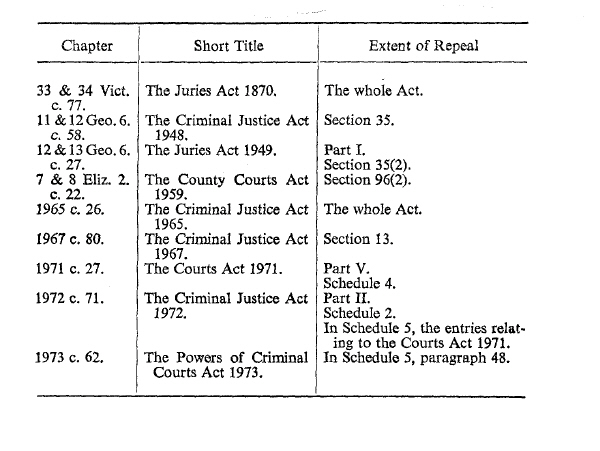
A1Nothing in section 20A, 20B , 20C or 20I affects what constitutes contempt of court at common law.X11The Coroners Act 1887M12 shall have effect subject to the amendments set out in Schedule 2 to this Act (being amendments consequential on certain of the repeals made by this Act).2Any enactment, instrument or document referring to any enactment repealed by this Act shall, so far as may be necessary for preserving its effect, be construed as referring, or as including a reference, to the corresponding provision of this Act.3Any instrument or document made, served or given and any other things done under any enactment repealed by this Act shall have effect as if made, served, given or done under the corresponding provision of this Act.X14The enactments mentioned in Schedule 3 to this Act are hereby repealed to the extent specified in the third column of that Schedule.5Nothing in subsections (2) and (3) above shall be construed as affecting the operation of sections 16(1) and 17(2)(a) of the Interpretation Act M131978.
23 Short title, interpretation, commencement and extent.
1This Act may be cited as the Juries Act 1974.2In this Act—
“court”, except where the context otherwise requires, means the Crown Court, the High Court, or the county court;
“the appropriate officer” means such officer as may be designated for the purpose in question in accordance with arrangements made by the Lord Chancellor.
“regular forces” has the same meaning as in the Armed Forces Act 2006 (see section 374 of that Act).
3This Act shall come into force at the expiration of the period of one month beginning with the date on which it is passed.4This Act extends to England and Wales only.
Part 1Persons subject to Mental Health Act 1983 or Mental Capacity Act 2005
1A person for the time being liable to be detained under the Mental Health Act 1983.1AA person for the time being resident in a hospital on account of mental disorder as defined by the Mental Health Act 1983.2A person for the time being under guardianship under section 7 of the Mental Health Act 1983 or subject to a community treatment order under section 17A of that Act.3A person who lacks capacity, within the meaning of the Mental Capacity Act 2005, to serve as a juror.41F44. . . . . . . . . . . . . . . . . . . . . . . . . . . . . . . .2F45. . . . . . . . . . . . . . . . . . . . . . . . . . . . . . . .
Part 2Other Persons Disqualified for Jury Service
5A person who is on bail in criminal proceedings (within the meaning of the Bail Act 1976).6A person who has at any time been sentenced in the United Kingdom, the Channel Islands or the Isle of Man—ato imprisonment for life, detention for life or custody for life,bto detention during her Majesty’s pleasure or during the pleasure of the Secretary of State,cto imprisonment for public protection or detention for public protection,dto an extended sentence under section 226A, 226B, 227 or 228 of the Criminal Justice Act 2003 or section 254, 266 or 279 of the Sentencing Code(including such a sentence imposed as a result of section 219A, 220, 221A or 222 of the Armed Forces Act 2006) or section 210A of the Criminal Procedure (Scotland) Act 1995, oreto a term of imprisonment of five years or more or a term of detention of five years or more.6AA person who at any time in the last ten years has been convicted of—aan offence under section 20A, 20B, 20C or 20D of this Act,ban offence under paragraph 5A, 5B, 5C or 5D of Schedule 6 to the Coroners and Justice Act 2009 (equivalent offences relating to jurors at inquests), orcan offence under paragraph 2, 3, 4 or 5 of Schedule 2A to the Armed Forces Act 2006 (equivalent offences relating to members of the Court Martial).7A person who at any time in the last ten years has—ain the United Kingdom, the Channel Islands or the Isle of Man—iserved any part of a sentence of imprisonment or a sentence of detention, oriihad passed on him a suspended sentence of imprisonment or had made in respect of him a suspended order for detention,bin England and Wales, had made in respect of him a community order under section 177 of the Criminal Justice Act 2003 or Chapter 2 of Part 9 of the Sentencing Code, a community rehabilitation order, a community punishment order, a community punishment and rehabilitation order, a drug treatment and testing order or a drug abstinence order, orchad made in respect of him any corresponding order under the law of Scotland, Northern Ireland, the Isle of Man or any of the Channel Islands or a service community order or overseas community order under the Armed Forces Act 2006.8For the purposes of this Part of this Schedule—C8aa sentence passed (anywhere) in respect of a service offence within the meaning of the Armed Forces Act 2006 is to be treated as having been passed in the United Kingdom, andba person is sentenced to a term of detention if, but only if—ia court passes on him, or makes in respect of him on conviction, any sentence or order which requires him to be detained in custody for any period, andiithe sentence or order is available only in respect of offenders below a certain age,and any reference to serving a sentence of detention is to be construed accordingly.
By Criminal Justice Act 1991 (c. 53, SIF 39:1), s. 101(1), Sch. 12 para. 23; S.I. 1991/2208, art. 2(1), Sch.1 it is provided (14.10.1991) that in relation to any time before the commencement of s.70 of that 1991 Act (which came into force on 1.10.1992 by S.I. 1992/333, art. 2(2), Sch. 2) references in any enactment amended by that 1991 Act, to youth courts shall be construed as references to juvenile courts.
S. 2: reference to the register of parliamentary and local government electors to be construed as mentioned in Representation of the People Act 1983 (c. 2, SIF 42), ss. 205, 206, Sch. 7 para. 10
C4
S. 2 modified (31.8.1999) by S.I. 1999/2128, art. 3(2).
F2
Words substituted by virtue of Interpretation Act 1978 (c. 30), s. 17(2)
M1
1978 c. 30.
F3
Word in s. 2(5)(a) repealed (5.4.2004) by Criminal Justice Act 2003 (c. 44), ss. 332, 336, Sch. 37 Pt. 10; S.I. 2004/829, art. 2(1)(2)(l)(iv)
F4
Words substituted by Administration of Justice Act 1982 (c. 53, SIF 37), s. 61(a)
F5
Words inserted by Administration of Justice Act 1982 (c. 53, SIF 37), s. 61(b)
C5
S. 3(1): references to the register of parliamentary and local government electors in each place where occurring to be construed as mentioned in Representation of the People Act 1983 (c. 2, SIF 42), ss 205, 206, Sch. 7 para. 10
F6
Words substituted by Representation of the People Act 1983 (c. 2, SIF 42), s. 206, Sch. 8 para. 17
S. 3(2): reference to the register of parliamentary and local government electors to be construed as mentioned in Representation of the People Act 1983 (c. 2, SIF 42), ss. 205, 206, Sch. 7 para. 10
M2
1957 c. x.
F8
S. 3(3) repealed by Representation of the People Act 1983 (c. 2, SIF 42), s. 206, Sch. 9 Pt. II
Word in s. 11(6) repealed (31.3.2005) by Domestic Violence, Crime and Victims Act 2004 (c. 28), ss. 58(1)(2), 60, Sch. 10 para. 8(3), Sch. 11 (with Sch. 12 para. 8); S.I. 2005/579, art. 3(i)(iv)
F30
Words repealed by Criminal Justice Act 1988 (c. 33, SIF 39:1), ss. 123(6), 170(2), Sch. 8 para. 16, Sch. 16
M4
1825 c. 50.
M5
1971 c. 23.
M6
1972 c. 71.
M7
1971 c. 23.
F31
Words in s. 14 substituted (1.9.2004) by Courts Act 2003 (c. 39), ss. 109(1), 110, Sch. 8 para. 173; S.I. 2004/2066, art. 2(c)(viii) (with art. 3)
C7
S. 19(1): certain functions of the Minister for the Civil Service are transferred to the Treasury and references to that Minister are to be construed as mentioned in S.I. 1981/1670, arts. 2(2), 3(5)
F32
Words substituted by Administration of Justice Act 1977 (c. 38), Sch. 2 Pt. I para. 7
F33
Words repealed by Social Security (Consequential Provisions) Act 1975 (c. 18), Sch. 1 Pt. I
S. 19(7) repealed by Social Security (Consequential Provisions) Act 1975 (c. 18, SIF 113:1), s. 1(2), Sch. 1 Pt. I and also expressed to be repealed by Administration of Justice Act 1977 (c. 38, SIF 37), s. 32(4), Sch. 5 Pt. II
Words substituted by Criminal Justice Act 1982 (c. 48, SIF 39:1), ss. 37, 38, 46 (with s. 47)
M9
1971 c. 23.
M10
1972 c. 71.
M11
1971 c. 23.
X1
The text of s. 22(1)(4) and Sch. 3 is in the form in which it was originally enacted: it was not reproduced in Statutes in Force and does not reflect any amendments or repeals which may have been made prior to 1.2.1991
M12
1887 c. 71.
F39
Words substituted by virtue of Interpretation Act 1978 (c. 30), s. 25(2)
The text of s. 22(1)(4) and Sch. 3 is in the form in which it was originally enacted: it was not reproduced in Statutes in Force and does not reflect any amendments or repeals which may have been made prior to 1.2.1991.
Words in Sch. 1 para. 6(d) inserted (3.12.2012) by Legal Aid, Sentencing and Punishment of Offenders Act 2012 (c. 10), s. 151(1), Sch. 21 para. 1; S.I. 2012/2906, art. 2(s)
F51
Words in Sch. 1 para. 6(d) inserted (3.12.2012) by Legal Aid, Sentencing and Punishment of Offenders Act 2012 (c. 10), s. 151(1), Sch. 22 para. 11; S.I. 2012/2906, art. 2(t)
F52
Sch. 1 Pt. 1 title substituted (15.7.2013) by Mental Health (Discrimination) Act 2013 (c. 8), ss. 2(2), 4(2); S.I. 2013/1694, art. 2
F53
Sch. 1 Pt. 2 title substituted (15.7.2013) by Mental Health (Discrimination) Act 2013 (c. 8), ss. 2(2), 4(2); S.I. 2013/1694, art. 2
F54
Sch. 1 title substituted (15.7.2013) by Mental Health (Discrimination) Act 2013 (c. 8), ss. 2(2), 4(2); S.I. 2013/1694, art. 2
F55
Sch. 1 paras. 1, 1A substituted for Sch. 1 para. 1 (15.7.2013) by Mental Health (Discrimination) Act 2013 (c. 8), ss. 2(2), 4(2); S.I. 2013/1694, art. 2
F56
Words in s. 1(1)(c) omitted (15.7.2013) by virtue of Mental Health (Discrimination) Act 2013 (c. 8), ss. 2(1)(a), 4(2); S.I. 2013/1694, art. 2
F57
S. 1(2) omitted (15.7.2013) by virtue of Mental Health (Discrimination) Act 2013 (c. 8), ss. 2(1)(b), 4(2); S.I. 2013/1694, art. 2
F58
Words in s. 1(3) substituted (15.7.2013) by Mental Health (Discrimination) Act 2013 (c. 8), ss. 2(1)(c), 4(2); S.I. 2013/1694, art. 2
F59
Words in s. 19(2) substituted (25.7.2013) by Coroners and Justice Act 2009 (c. 25), s. 182(4)(e), Sch. 21 para. 24 (with s. 180); S.I. 2013/1869, art. 2(o)(xi)
F60
Words in s. 19(5) substituted (25.7.2013) by Coroners and Justice Act 2009 (c. 25), s. 182(4)(e), Sch. 21 para. 24 (with s. 180); S.I. 2013/1869, art. 2(o)(xi)
F61
Words in s. 1(1) substituted (22.4.2014) by Crime and Courts Act 2013 (c. 22), s. 61(3), Sch. 9 para. 96(a); S.I. 2014/954, art. 2(c) (with art. 3) (with transitional provisions and savings in S.I. 2014/956, arts. 3-11)
F62
Words in s. 12(6) substituted (22.4.2014) by Crime and Courts Act 2013 (c. 22), s. 61(3), Sch. 9 para. 96(a); S.I. 2014/954, art. 2(c) (with art. 3) (with transitional provisions and savings in S.I. 2014/956, arts. 3-11)
F63
Words in s. 2(1) substituted (22.4.2014) by Crime and Courts Act 2013 (c. 22), s. 61(3), Sch. 9 para. 96(a); S.I. 2014/954, art. 2(c) (with art. 3) (with transitional provisions and savings in S.I. 2014/956, arts. 3-11)
F64
Words in s. 17(2) substituted (22.4.2014) by Crime and Courts Act 2013 (c. 22), s. 61(3), Sch. 9 para. 96(b); S.I. 2014/954, art. 2(c) (with art. 3) (with transitional provisions and savings in S.I. 2014/956, arts. 3-11)
F65
Words in s. 7 substituted (22.4.2014) by Crime and Courts Act 2013 (c. 22), s. 61(3), Sch. 9 para. 96(b); S.I. 2014/954, art. 2(c) (with art. 3) (with transitional provisions and savings in S.I. 2014/956, arts. 3-11)
F66
Words in s. 23(2) substituted (22.4.2014) by Crime and Courts Act 2013 (c. 22), s. 61(3), Sch. 9 para. 96(b); S.I. 2014/954, art. 2(c) (with art. 3) (with transitional provisions and savings in S.I. 2014/956, arts. 3-11)
S. 20 heading substituted (13.4.2015) by Criminal Justice and Courts Act 2015 (c. 2), ss. 71(2), 95(1); S.I. 2015/778, art. 3, Sch. 1 para. 56 (with Sch. 2 para. 3(a))
F74
S. 22(A1) inserted (13.4.2015) by Criminal Justice and Courts Act 2015 (c. 2), ss. 77(2), 95(1); S.I. 2015/778, art. 3, Sch. 1 para. 62
F75
Words in s. 3(1) substituted (9.9.2016) by Criminal Justice and Courts Act 2015 (c. 2), ss. 68(3), 95(1); S.I. 2016/896, art. 2(b)
F76
Words in s. 1(1)(a) substituted (1.12.2016) by Criminal Justice and Courts Act 2015 (c. 2), ss. 68(2), 95(1); S.I. 2016/896, art. 3(b)
F77
Words in s. 23(2) inserted (30.6.2018) by Armed Forces (Flexible Working) Act 2018 (c. 2), ss. 2(4), 3(3); S.I. 2018/799, reg. 2
F78
Words in s. 9(2A) substituted (30.6.2018) by Armed Forces (Flexible Working) Act 2018 (c. 2), ss. 2(2), 3(3); S.I. 2018/799, reg. 2
F79
Words in s. 9(2B) substituted (30.6.2018) by Armed Forces (Flexible Working) Act 2018 (c. 2), ss. 2(2), 3(3); S.I. 2018/799, reg. 2
F80
Words in s. 9A(1A) substituted (30.6.2018) by Armed Forces (Flexible Working) Act 2018 (c. 2), ss. 2(3), 3(3); S.I. 2018/799, reg. 2
F81
Words in s. 9A(1C) substituted (30.6.2018) by Armed Forces (Flexible Working) Act 2018 (c. 2), ss. 2(3), 3(3); S.I. 2018/799, reg. 2
F82
Words in s. 9A(2B)(a) substituted (30.6.2018) by Armed Forces (Flexible Working) Act 2018 (c. 2), ss. 2(3), 3(3); S.I. 2018/799, reg. 2
F83
Words in Sch. 1 para. 6(d) inserted (1.12.2020) by Sentencing Act 2020 (c. 17), s. 416(1), Sch. 24 para. 28(2) (with Sch. 27); S.I. 2020/1236, reg. 2
F84
Words in Sch. 1 para. 7(b) inserted (1.12.2020) by Sentencing Act 2020 (c. 17), s. 416(1), Sch. 24 para. 28(3) (with Sch. 27); S.I. 2020/1236, reg. 2
F85
S. 9B(4) inserted (temp. until the amendment by 2003 c. 39, Sch. 4 para. 3 comes into force) (2.4.2012) by Armed Forces Act 2011 (c. 18), s. 32(3), Sch. 2 para. 10(1)(2)(4); S.I. 2012/669, art. 4(c)
F86
S. 9B(3)(b) and word inserted (temp. until the amendment by 2003 c. 39, Sch. 4 para. 3 comes into force) (2.4.2012) by Armed Forces Act 2011 (c. 18), s. 32(3), Sch. 2 para. 10(1)(2)(4); S.I. 2012/669, art. 4(c)
F87
Words in s. 9B(3) renumbered as s. 9B(3)(a) (temp. until the amendment by 2003 c. 39, Sch. 4 para. 3 comes into force) (2.4.2012) by Armed Forces Act 2011 (c. 18), s. 32(3), Sch. 2 para. 10(1)-(3); S.I. 2012/669, art. 4(c)
F88
S. 9C inserted (28.6.2022) by Police, Crime, Sentencing and Courts Act 2022 (c. 32), ss. 196(2), 208(5)(x)
F89
Ss. 20H, 20I inserted (28.6.2022) by Police, Crime, Sentencing and Courts Act 2022 (c. 32), ss. 196(3), 208(5)(x)
F90
S. 16(2) omitted (28.6.2022) by virtue of Police, Crime, Sentencing and Courts Act 2022 (c. 32), ss. 197(b), 208(5)(x)
F91
Words in s. 16(1) substituted (28.6.2022) by Police, Crime, Sentencing and Courts Act 2022 (c. 32), ss. 197(a), 208(5)(x)
F92
Words in s. 22(A1) substituted (28.6.2022) by Police, Crime, Sentencing and Courts Act 2022 (c. 32), ss. 196(4), 208(5)(x)
F93
S. 20(5)(e) and word inserted (3.2.1995) by 1994 c. 33, s. 168(2), Sch 10 para. 28; S.I. 1995/127, art. 2(1), Sch. 1, Appendix B
F94
Words substituted by Criminal Justice Act 1982 (c. 48, SIF 39:1), ss. 37, 38, 46 (with s. 47)